Up or Down: Definition, Difference, and Examples
“Up or down” is a simple English expression, but its meaning changes depending on the situation. It can describe physical direction, position, movement, or a change in numbers and trends. For example, you might ask whether a switch should be up or down, whether prices are rising or falling, or whether a brisket should be placed fat side up or down. The expression is not difficult grammatically; the important point is understanding what up and down mean in the particular context.
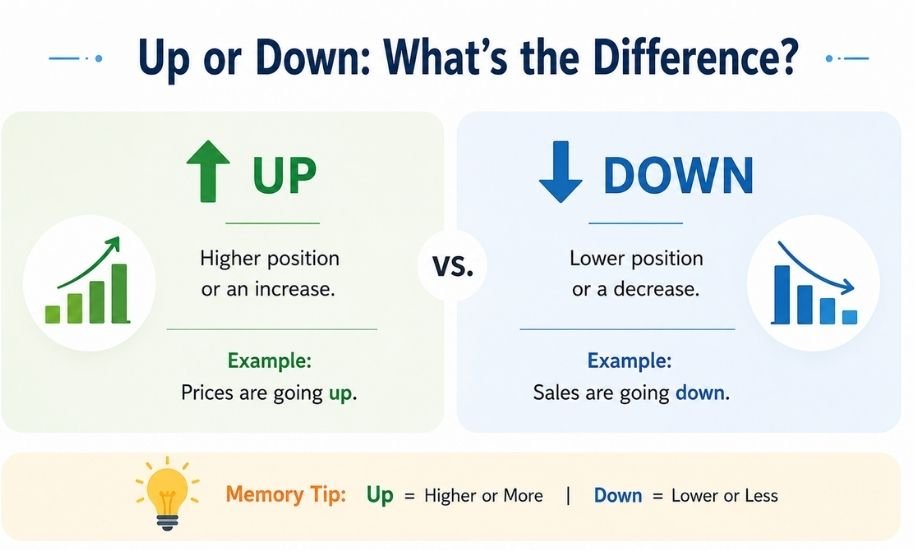
“Up or down” is a correct English expression used to describe two possible directions, positions, or trends. “Up” generally refers to a higher position or an increase, while “down” generally refers to a lower position or a decrease. The exact meaning depends on the context.
What Does “Up or Down” Mean?
The expression presents two alternatives: up or down.
In a physical sense, it usually refers to direction or position:
- Look up or down the street.
- Should this side face up or down?
- Move the lever up or down.
It can also describe change or movement in an abstract sense:
- Are prices going up or down?
- Is the temperature going up or down?
- Did the company’s revenue go up or down?
In these examples, up generally means an increase or movement toward a higher level, while down means a decrease or movement toward a lower level.
The expression therefore has a very broad range of uses without changing its basic grammatical structure.
Up or Down vs. Up and Down
One useful distinction is the difference between up or down and up and down.
Up or down presents a choice between two possibilities:
Should the button be up or down?
Up and down indicates movement or position involving both directions:
The elevator traveled up and down all afternoon.
Compare these:
- Is the price going up or down? — asks about the direction of a change.
- The price has moved up and down all week. — says it has changed in both directions.
The word or is important because it connects alternatives. The word and connects two things or directions occurring together.
When “Up” Means an Increase
“Up” is frequently used to describe an increase.
For example:
- Grocery prices are up this month.
- Sales went up after the promotion.
- The temperature is going up.
- Her test score is up from last semester.
- Interest rates could move up.
This usage is common in everyday conversation and is perfectly natural in English.
In more formal writing, you can sometimes replace up with words such as increased, rose, or higher, depending on the sentence.
For example:
Sales went up by 8%.
can become:
Sales increased by 8%.
Both are grammatically correct, but the second version can sound more formal.
When “Down” Means a Decrease
The opposite pattern applies to down.
Examples include:
- The temperature is down five degrees.
- Sales went down last quarter.
- The price has come down recently.
- The number of visitors is down compared with last year.
- Interest rates may move down.
Again, more formal alternatives are available. Depending on the context, decreased, fell, declined, or lower may work better.
For instance:
Profits went down last year.
could be written as:
Profits declined last year.
The choice depends on the tone and context rather than grammar alone.
Examples of “Up or Down” in Everyday English
The phrase appears naturally in questions and instructions.
Physical direction
Should I move the handle up or down?
The arrow tells you whether to go up or down.
Position
I can’t tell whether this picture is supposed to hang up or down.
Put the box down and check which side should face up.
Trends
Are housing prices going up or down?
We need to know whether demand is moving up or down.
Numbers
Is your score up or down from last week?
The number of applications is up, but completed enrollments are down.
Instructions
Scroll up or down to see the rest of the page.
These examples show why the expression cannot be assigned just one definition. Its meaning comes from the words around it.
Brisket Fat Side Up or Down?
One practical example of the expression is the cooking question “brisket fat side up or down?”
Here, up and down refer to the physical orientation of the brisket while it cooks.
There is no universal rule that applies identically to every smoker. The heat source and cooker design matter. In many smokers where the main heat comes from underneath, cooks commonly place the brisket fat side down so the fat cap can help shield the meat from direct heat and the meat side remains exposed for bark development.
Other cooking setups can produce different recommendations. The important principle is to consider where the heat is coming from, rather than assuming that fat side up is always correct or fat side down is always correct.
So in this context:
- Fat side up = the fat cap faces toward the top of the cooker.
- Fat side down = the fat cap faces toward the cooking grate or lower heat source.
This is a good example of how “up or down” describes physical orientation, rather than an increase or decrease.
Are CD Rates Going Up or Down?
The expression takes on a different meaning when discussing finance.
When someone asks, “Are CD rates going up or down?”, they are asking about the direction of interest rates over time.
Here, going up means rates are increasing, while going down means rates are decreasing.
For example:
CD rates are going up, so newly issued certificates may offer higher yields.
or:
CD rates are going down, so locking in a competitive rate may become more attractive.
However, financial rates do not necessarily move in one direction across every bank and every term. A 3-month CD, 12-month CD, and 5-year CD can have different yields, and individual financial institutions may change their rates at different times.
That means a question about whether CD rates are “up or down” often needs more information: which term, which institution, and compared with what date?
The same principle applies to many financial questions:
- Are mortgage rates going up or down?
- Is the stock market up or down today?
- Are savings account rates moving up or down?
- Are bond yields up or down?
In each case, the words describe a trend, not a physical direction.
How to Choose Between “Up” and “Down”
When deciding which word to use, first determine what kind of relationship you are describing.
| Context | “Up” usually means | “Down” usually means |
|---|---|---|
| Physical position | Higher | Lower |
| Direction | Toward a higher position | Toward a lower position |
| Price | More expensive | Less expensive |
| Temperature | Warmer/higher | Cooler/lower |
| Sales | Increased | Decreased |
| Interest rates | Increased | Decreased |
| Quantity | More | Less |
| Score | Higher | Lower |
There are exceptions, of course. For example, “turn the volume up” means increase the volume, while “turn the volume down” means decrease it. The basic idea remains the same: up is associated with a higher level and down with a lower level.
Common Mistakes With “Up or Down”
1. Confusing “or” with “and”
If you are asking someone to choose between two alternatives, use or:
Should the switch be up or down?
If you mean that something moves in both directions, use and:
The elevator moves up and down.
2. Assuming “up” always means physically higher
“Up” can describe an increase rather than a location.
Prices are up this year.
This does not mean that prices are physically located higher. It means they have increased.
3. Assuming “down” always means physically lower
The same applies to down:
Sales are down this quarter.
The sales figures have decreased; they have not physically moved downward.
4. Treating “up or down” as a fixed answer
The correct choice depends on what you are describing.
For example, the appropriate orientation for a brisket depends partly on the smoker’s heat source. Similarly, whether CD rates are “up” or “down” depends on the comparison period and the particular CD term.
5. Using “up or down” when a more precise word is better
The expression is natural in conversation, but formal writing sometimes benefits from more specific vocabulary.
Instead of:
The company’s revenue went down.
you might write:
The company’s revenue declined.
Instead of:
The temperature went up.
you might write:
The temperature increased.
Neither version is inherently more correct. The best choice depends on the tone and level of precision you need.
An Easy Way to Remember the Difference
A simple rule is:
Up = higher or more.
Down = lower or less.
Then ask yourself what is being compared.
- Higher position → up
- Lower position → down
- Greater amount → up
- Smaller amount → down
- Increasing trend → up
- Decreasing trend → down
If the question asks you to choose between those two possibilities, or connects them:
Is it up or down?
If something experiences both directions, and is normally appropriate:
It moved up and down.
Frequently Asked Questions
Is “up or down” grammatically correct?
Yes. “Up or down” is a standard English expression. It combines the adverbs or directional words up and down with the conjunction or to present two alternatives. The phrase can refer to physical direction, position, movement, or an increase versus a decrease.
What is another way to say “up or down”?
The best alternative depends on the context. For trends, you could say higher or lower, increasing or decreasing, or rising or falling. For physical direction, higher or lower or which direction may work. In casual English, “up or down” is often the most natural choice.
What is the difference between “up or down” and “up and down”?
“Up or down” presents alternatives, while “up and down” describes both directions. For example, “Should the lever go up or down?” asks you to choose one direction. “The lever moves up and down” indicates movement in both directions.
Does “up” always mean an increase?
No. “Up” can describe physical position, direction, movement, or an increase. In “Look up,” it indicates direction. In “Prices are up,” it indicates an increase. The surrounding context determines which meaning applies.
Does “down” always mean a decrease?
No. “Down” can indicate a lower physical position or downward direction, as in “The book fell down.” It can also indicate a decrease, as in “Sales are down.” It may have other meanings in particular expressions as well.
Which is correct: brisket fat side up or down?
Both expressions are grammatically correct because they describe two possible orientations. As a cooking question, the better position depends on the smoker and the location of the primary heat source. In many smokers with heat coming from below, fat side down is commonly preferred, but the cooker design should guide the decision.
The Bottom Line
“Up or down” is correct when you need to describe two possible directions, positions, or trends. The words can refer literally to location or figuratively to increases and decreases. “Up or down” asks you to choose between alternatives, while “up and down” describes both directions.
Whether you’re asking about a switch, a brisket, prices, or CD rates, the key is to identify what up and down represent in that particular situation. For more straightforward explanations of confusing English choices, Grammarifyr helps you know the difference and use the right words.
You may also Read : Weiner or Wiener: Meaning, Spelling and Usage