Couch or Coach: Difference, Meaning, and Examples
“Couch” and “coach” are easy to mix up because they look and sound remarkably similar. However, they refer to very different things. A couch is usually a piece of furniture, while a coach can be a person who trains or guides others, or a type of transportation. The words also have different verb forms: couching means expressing something in a particular way, while coaching means training or instructing someone. Understanding the context makes it much easier to choose the right word.
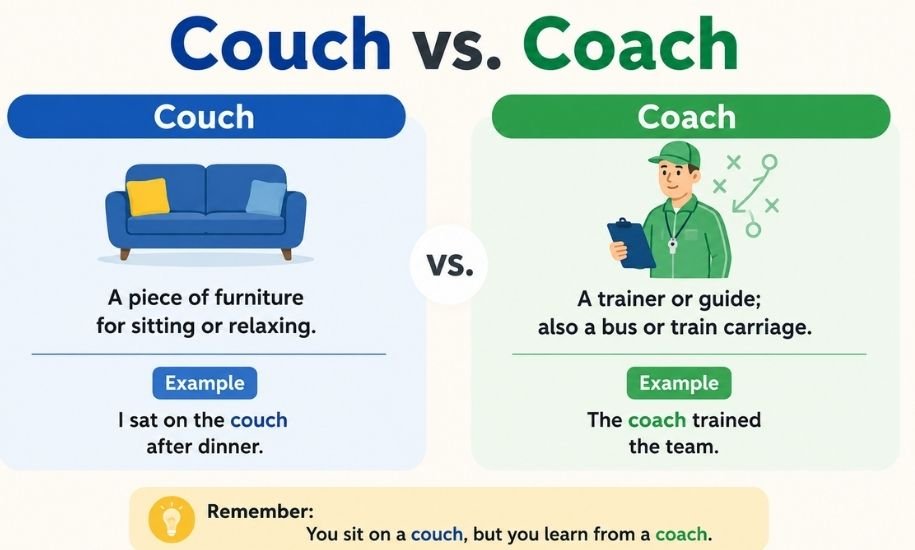
Both couch and coach are correct English words, but they have different meanings. A couch is furniture for sitting or reclining, while a coach is commonly a trainer, instructor, or guide. Coach can also refer to a bus, train carriage, or a class of travel.
Couch vs. Coach: A Quick Comparison
| Feature | Couch | Coach |
|---|---|---|
| Main meaning | A sofa or similar furniture | A person who trains or guides |
| Other meanings | To phrase or express something | A bus, train carriage, or travel class |
| Common verb | Couch | Coach |
| Related -ing form | Couching | Coaching |
| Example | “I sat on the couch.” | “The coach trained the team.” |
What Does “Couch” Mean?
Couch is primarily a noun meaning a piece of furniture designed for sitting or reclining. In everyday English, it is commonly used interchangeably with sofa.
For example:
- We bought a comfortable couch for the living room.
- I left my book on the couch.
- They sat on the couch and watched a movie.
- The cat has claimed the entire couch.
The word can describe furniture in homes, offices, waiting rooms, and other places where people sit or relax.
Couch as a verb
Couch can also function as a verb. In this use, it means to express or phrase something in a particular way.
For example:
- She couched her criticism in polite language.
- The proposal was couched in cautious terms.
- He couched his disagreement as a suggestion rather than a complaint.
This meaning is less familiar than the furniture-related sense, but it is completely standard English.
What Does “Coach” Mean?
Coach has several common meanings, but one of the most familiar is a person who trains, teaches, or guides someone.
A coach might work with athletes, students, performers, employees, or people pursuing personal or professional goals.
Examples:
- The basketball coach planned a new strategy.
- Her tennis coach helped improve her serve.
- He works as a career coach.
- The acting coach prepared the performers for the audition.
As a verb, coach means to train, instruct, or guide someone.
- She coaches the school volleyball team.
- He is coaching new employees.
- The consultant coached her through the interview process.
Coach Can Also Mean Transportation
One reason the word coach can be confusing is that it has meanings unrelated to teaching or sports.
In British English, a coach can mean a large bus used for longer-distance travel. The word can also refer to a passenger carriage on a train.
For example:
- We traveled by coach from London to Manchester.
- The passengers boarded the coach at the station.
- Our seats were in the first coach of the train.
In American English, coach can also describe a less expensive class of air or train travel.
For example:
- We decided to fly coach to save money.
- She usually travels coach rather than first class.
So if someone says, “I traveled by coach,” the context may be about transportation rather than sports or training.
The Key Difference Between the Two Words
The simplest way to understand the coach or couch difference is to consider what the word refers to.
Use couch when you mean:
- a sofa
- furniture for sitting
- a place to relax or recline
- expressing something in a particular way
Use coach when you mean:
- a sports trainer
- an instructor or mentor
- someone who provides professional guidance
- a bus
- a train carriage
- a class of travel
Compare these sentences:
I relaxed on the couch after dinner.
The football coach organized practice.
The first sentence is about furniture. The second is about a person who trains athletes.
Couching or Coaching?
Couching and coaching are both legitimate words, but they come from different verbs and have different meanings.
Coaching
Coaching is the present participle or gerund of coach. It means training, teaching, or guiding someone.
Examples:
- She is coaching the junior team.
- He specializes in coaching business leaders.
- The teacher spent the afternoon coaching students for the competition.
If you mean helping someone develop a skill or improve performance, coaching is the correct form.
Couching
Couching comes from couch. When used as a verb, it generally means expressing or presenting something in a particular way.
Examples:
- He was couching his criticism in diplomatic language.
- The author couched the argument in simple terms.
- Her disagreement was couched as a question.
Therefore:
Correct: The manager is coaching the new employee.
Incorrect for this meaning: The manager is couching the new employee.
But couching is correct when the meaning is “phrasing” or “expressing.”
Why Are “Couch” and “Coach” Confused?
The confusion is mainly caused by their similar spelling and pronunciation. Both begin with cou-/coa- and end with -ch, and their spoken forms are close.
The vowel sounds are different, though:
- couch is pronounced approximately like “kowch”
- coach is pronounced approximately like “kohch”
The distinction becomes easier with practice because the words belong to very different meaning groups.
A useful association is:
Couch → comfort and sitting
Coach → training and teaching
Common Mistakes to Avoid
1. Calling a sports trainer a “couch”
Incorrect:
The football couch spoke to the players.
Correct:
The football coach spoke to the players.
A person who trains a sports team is a coach.
2. Saying you sat on a “coach”
Incorrect when referring to furniture:
We sat on the coach and watched television.
Correct:
We sat on the couch and watched television.
The furniture is a couch.
3. Using “couch” for a professional trainer
Incorrect:
She hired a life couch.
Correct:
She hired a life coach.
Someone who provides training or guidance is a coach.
4. Confusing “coaching” with “couching”
Incorrect:
He is couching me for my job interview.
Correct:
He is coaching me for my job interview.
However, this is correct:
She was couching her criticism in careful language.
The intended meaning determines which word is appropriate.
How to Remember the Difference
A simple memory trick is:
You sit on a couch, but you learn from a coach.
Think of couch as belonging to the living room and coach as belonging to the training room, sports field, or classroom.
You can also remember the related forms:
- Couch → couching = expressing or phrasing
- Coach → coaching = training or instructing
This distinction works in most everyday situations.
Examples: Which Word Fits?
Here are a few examples that show how context determines the correct choice:
Furniture
The new couch is much more comfortable than the old one.
Sports
The basketball coach changed the lineup.
Professional development
She hired an executive coach to help with leadership skills.
Transportation
We traveled by coach instead of flying.
Expressing an idea
The statement was couched in diplomatic language.
Training
The consultant is coaching the team on communication skills.
Notice that replacing one word with the other changes the meaning entirely.
Frequently Asked Questions
Is it coach or couch?
Both spellings are correct, but they mean different things. Couch usually means a sofa or another piece of furniture for sitting or reclining. Coach commonly means someone who trains or guides others, but it can also refer to transportation or a class of travel.
What is the difference between coach and couch?
A couch is primarily furniture, while a coach is commonly a trainer, instructor, or mentor. Coach also has transportation-related meanings. As verbs, couch means to phrase something in a particular way, whereas coach means to train or instruct.
Is it “couching” or “coaching”?
Use coaching when you mean training, teaching, or guiding someone. Use couching when you mean expressing or phrasing something in a particular way, as in “couching criticism in polite language.”
Do you sit on a couch or a coach?
You normally sit on a couch when referring to household furniture. A coach can also be something you sit in when traveling, such as a coach bus or train carriage, so the context matters.
Is “couch” a verb?
Yes. Couch can be used as a verb meaning to phrase or express something in a particular manner. For example, “He couched his response in diplomatic language.” This is different from coach, which can mean to train or instruct.
Can “coach” be a verb?
Yes. Coach can be a verb meaning to train, teach, guide, or prepare someone. For example, “She coaches young athletes” means that she trains them.
The Bottom Line
When deciding between these two words, focus on the meaning rather than the spelling. Couch is primarily a piece of furniture, while coach is usually a trainer or instructor and can also describe certain forms of transportation. Likewise, coaching means training or guiding, while couching commonly means phrasing or expressing something in a particular way. For more clear explanations of easily confused English words, Grammarify helps you know the difference and use the right words.
You may also Read : Rhythm or Rythm: Meaning, Spelling and Examples