Learnt or Learned: British vs American English
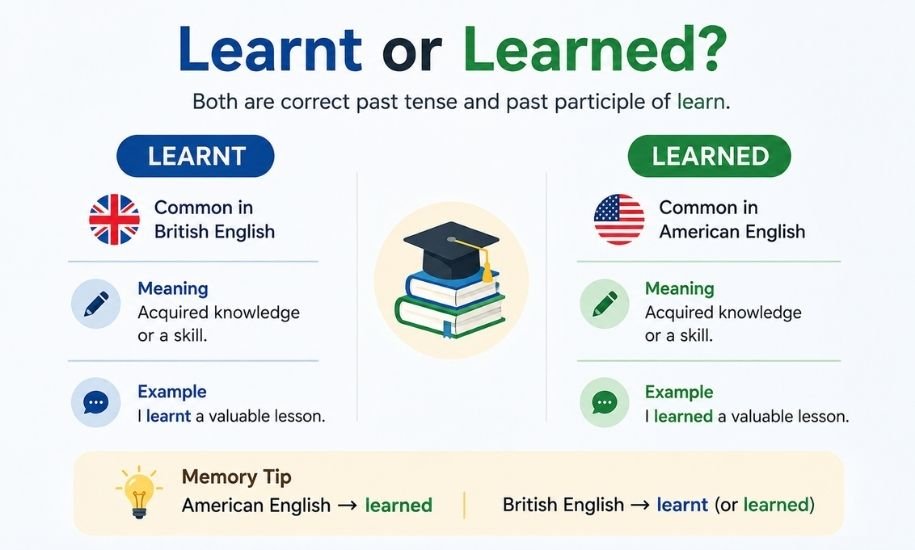
If you are unsure whether to write learnt or learned, you are not dealing with a simple spelling mistake. Both forms are correct past-tense and past-participle forms of the verb learn. The main difference is regional: learned is the usual form in American English, while learnt is particularly common in British English. British English accepts learned as well, so neither form is universally wrong. The best choice depends on the variety of English you are writing and the audience you want to reach.
Learned and learnt are both correct forms of learn. “Learned” is standard and especially common in American English, while “learnt” is particularly common in British English. In British English, “learned” is also perfectly acceptable.
Learnt or Learned: What’s the Difference?
The difference is mainly regional preference, not meaning.
| Feature | Learned | Learnt |
|---|---|---|
| Correct? | Yes | Yes |
| Verb | Learn | Learn |
| Past tense | Learned | Learnt |
| Past participle | Learned | Learnt |
| Common in American English | Yes | Less common |
| Common in British English | Yes | Yes, especially common |
| Meaning | Acquired knowledge or a skill | Acquired knowledge or a skill |
For example:
- American English: I learned something valuable from the experience.
- British English: I learnt something valuable from the experience.
The meaning is exactly the same.
What Does “Learned” Mean?
Learned is the past tense and past participle of learn. It means that someone acquired knowledge, information, a skill, or an understanding.
Examples:
- She learned Spanish at school.
- I learned how to repair the bicycle.
- We learned an important lesson from the mistake.
- He has learned to be more patient.
In American English, learned is overwhelmingly the natural choice in ordinary writing.
It is also used in British English, so choosing this form is not limited to American readers.
Learned in Different Verb Forms
The verb can appear in several forms:
- Present: learn
- Third-person singular: learns
- Past tense: learned / learnt
- Past participle: learned / learnt
- Present participle: learning
For example:
I learned a new technique yesterday.
She has learnt a great deal from her mentor.
Both sentences use a grammatically correct form.
What Does “Learnt” Mean?
Learnt is also a correct past-tense and past-participle form of learn. It is especially associated with British English and other varieties influenced by British usage.
Examples:
- I learnt to swim when I was seven.
- She learnt a valuable lesson.
- They learnt about the problem yesterday.
- He has learnt several useful skills.
There is no difference in meaning between learnt and learned when they function as forms of the verb learn.
The difference is primarily a matter of regional preference and style.
Is It Learned or Learnt in American English?
For American English, learned is generally the best choice.
For example:
I learned how to use the software.
The students learned several new concepts.
We learned from our mistakes.
Although learnt is understandable to American readers and is not inherently meaningless, it can sound distinctly British or less typical in American writing.
If you are writing an American English article, essay, report, or professional document, learned is usually the safer choice.
What About British English?
British English is a little more flexible.
Both forms are accepted:
I learnt something new today.
I learned something new today.
Learnt is a traditional and widely used British form, while learned is also established and completely grammatical.
This is important because it would be inaccurate to say that learned is American and learnt is British, full stop. The distinction is more nuanced: learned is used in both varieties, whereas learnt is particularly characteristic of British usage.
Lessons Learned or Learnt?
One of the most common questions concerns the phrase “lessons learned or learnt.”
Again, both are correct, depending on the variety of English.
American English
The team documented the lessons learned from the project.
British English
The team documented the lessons learnt from the project.
The expression refers to useful knowledge or insights gained from an experience, particularly something that can help with future situations.
If you are writing for an American audience, use lessons learned. If you are following British English conventions, lessons learnt is a natural choice.
The most important thing is consistency. If the rest of your document follows British English conventions, switching randomly between learnt and learned may make the writing look inconsistent.
Can It Be “Learned” or “Learnt” After “Can Be”?
Both forms work after can be.
For example:
This skill can be learned with practice.
This skill can be learnt with practice.
Here, the words are past participles used in a passive construction.
The choice follows the same regional pattern. Can be learned is the more natural American form, while can be learnt is particularly common in British English.
Other examples include:
- Patience can be learned over time.
- These techniques can be learnt through practice.
- A new language can be learned at any age.
- The rules can be learnt quite quickly.
None of these constructions is grammatically wrong simply because it uses one form rather than the other.
Why Are These Two Forms Confused?
The confusion comes from the fact that learn has two established forms for its past tense and past participle.
Many English verbs have more than one accepted form or follow regional patterns. For learn, both learned and learnt developed as legitimate forms.
The difference becomes particularly noticeable when American and British English are compared. American English tends to favor the regular-looking -ed form, while British English makes greater use of learnt in many contexts.
This does not mean that speakers must follow an absolute rule. British writers can use learned, and American readers can understand learnt.
Correct Usage Examples
Here are some examples showing how either form can work.
Using “Learned”
- Maya learned to play the piano.
- I learned an important lesson yesterday.
- The children learned about the water cycle.
- He has learned from his previous mistakes.
Using “Learnt”
- Maya learnt to play the piano.
- I learnt an important lesson yesterday.
- The children learnt about the water cycle.
- He has learnt from his previous mistakes.
The sentences have the same basic meaning. The difference is the preferred form in the variety of English being used.
Correct vs. Incorrect
Because both forms are accepted, it is misleading to label one as universally correct and the other as universally incorrect.
Correct: I learned a lot from the course.
Correct: I learnt a lot from the course.
The first is especially natural in American English; the second is especially natural in British English.
One Special Meaning of “Learned”
There is one additional point worth knowing: learned can also be an adjective meaning highly educated or scholarly.
For example:
She is a learned professor.
The book contains an essay by a learned historian.
In this use, learned is not simply the past tense of learn. It describes someone or something associated with extensive knowledge or scholarship.
This adjective also has a different pronunciation from the ordinary past-tense form in many varieties of English.
That distinction is separate from the learned vs. learnt choice discussed throughout this article.
How to Choose the Right Form
A simple rule works for most situations:
Writing in American English? Choose “learned.”
Writing in British English? “Learnt” and “learned” are both acceptable.
If you are writing for an international audience and do not have a specific regional style guide, learned is often the easiest default because it is widely recognized and standard.
Most importantly, choose one style and use it consistently within the same piece of writing.
For example, if your document consistently uses American forms such as color, center, and traveled, learned fits naturally with that style. If it follows British conventions such as colour, centre, and travelled, learnt may fit better.
Common Mistakes to Avoid
1. Calling “Learnt” a misspelling
Learnt is not a misspelling. It is a legitimate form of learn, particularly common in British English.
2. Assuming “Learned” is only American
It is not. British English also uses learned.
3. Mixing regional styles without a reason
Using learnt in one paragraph and learned in another is not automatically grammatically wrong, but unnecessary switching can make your regional style inconsistent.
4. Changing the meaning
When learned and learnt are used as forms of the verb learn, they do not have different meanings. The distinction is mainly regional.
5. Treating “lessons learnt” as incorrect
Lessons learnt is a valid British English expression. Lessons learned is the usual American version.
Easy Way to Remember the Difference
Think of the ending:
American English → learned
British English → learnt or learned
A useful practical rule is to associate learnt with other British-style forms ending in -t, such as spelt, dreamt, and burnt, although these verbs have their own usage patterns.
The safest approach is not to memorize learnt as “the British spelling” and learned as “the American spelling.” Instead, remember that both belong to standard English, with different regional preferences.
Frequently Asked Questions
Which is correct, learned or learnt?
Both are correct. Learned is the usual form in American English and is also used in British English. Learnt is particularly common in British English. The two forms have the same meaning when used as the past tense or past participle of learn.
Is it learnt or learned in British English?
British English accepts both learnt and learned. Learnt is particularly common, but learned is not an error. Your choice can depend on personal preference, context, and the style you are following.
Is “learned” correct in American English?
Yes. Learned is the standard choice in American English for the past tense and past participle of learn. For example: “I learned something new yesterday.”
Is “learnt” a real word?
Yes. Learnt is a genuine English word and a past-tense and past-participle form of learn. It is particularly associated with British English and is not simply an informal spelling mistake.
Should I write “lessons learned” or “lessons learnt”?
Use lessons learned for American English. In British English, lessons learnt is also natural and widely accepted. Both phrases describe knowledge or insights gained from previous experiences.
Can both forms be used in formal writing?
Yes. Both learned and learnt can appear in formal writing. The important consideration is regional consistency. Follow the English variety required by your audience, institution, publisher, or style guide.
Final Verdict: Learnt or Learned?
Learned and learnt are both correct. The key difference is regional preference: learned is the standard choice in American English, while learnt is especially common in British English, where learned is also accepted. When in doubt, match the form to your audience and keep your regional English consistent. For more clear explanations of easily confused English forms, Grammarify helps you know the difference and use the right words.
You may also Read : Allie or Ally: Meaning and Correct Usage