Compliment or Complement? Easy Difference Explained
If you are unsure whether to write compliment or complement, you are dealing with two real English words—not a correct spelling and a misspelling. The confusion comes from their very similar spelling, pronunciation, and related historical origins. Their meanings, however, are different. Compliment is connected with praise or admiration, while complement refers to something that completes, improves, or works well with something else.
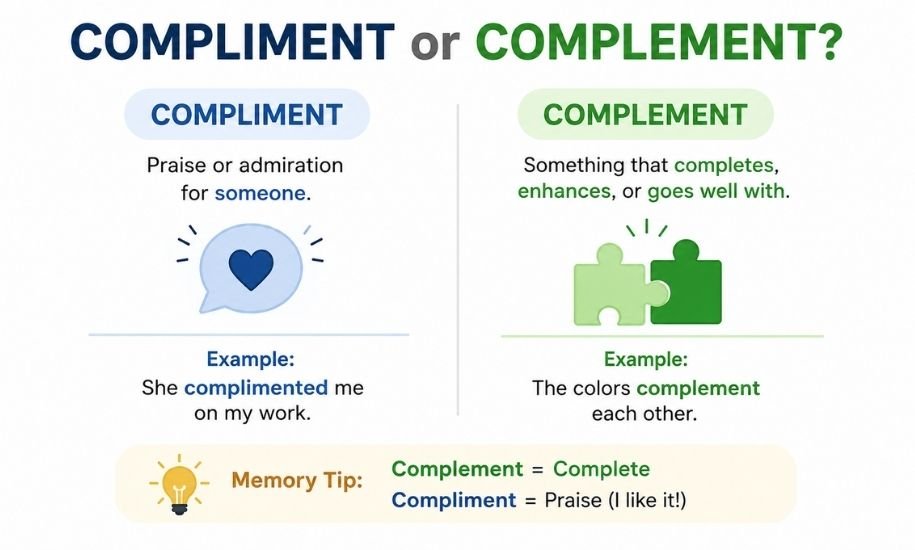
Compliment means praise or an expression of admiration: “She complimented my presentation.” Complement means something that completes, enhances, or goes well with something else: “The colors complement each other.” A simple memory trick is complement = complete.
Compliment vs. Complement at a Glance
| Feature | Compliment | Complement |
|---|---|---|
| Basic meaning | Praise or admiration | Something that completes or enhances |
| Common use | A person praises someone | Two things work well together |
| Part of speech | Noun and verb | Noun and verb |
| Example | “He complimented her dress.” | “The shoes complement her dress.” |
| Memory clue | I = “I like it” | E = “complete” |
Both spellings are correct. The choice depends on what you mean. Merriam-Webster distinguishes compliment as relating to admiration and complement as relating to completion or enhancement.
What Does “Compliment” Mean?
A compliment is a remark, statement, or action that expresses approval, admiration, or respect. As a verb, to compliment someone means to praise them.
As a noun
- She gave me a lovely compliment about my writing.
- He received several compliments on his presentation.
- “You have a great sense of humor” is a compliment.
As a verb
The usual construction is compliment someone on something.
- I complimented Maya on her excellent speech.
- The manager complimented the team on its hard work.
- She complimented him on his cooking.
Oxford specifically lists compliment somebody on something as a standard usage.
So if someone is saying something nice about a person, performance, appearance, skill, or achievement, use compliment.
What Does “Complement” Mean?
A complement is something that completes, enhances, or improves another thing. As a verb, to complement means to combine with something in a way that makes it better, more attractive, or more complete.
As a noun
- The sauce was the perfect complement to the fish.
- The scarf is a beautiful complement to her outfit.
- The two musicians are a natural complement to each other.
As a verb
- The blue curtains complement the gray walls.
- Her voice complements the piano beautifully.
- The fresh herbs complement the dish.
The key idea is combination or enhancement, rather than praise. Oxford describes complement as adding to something in a way that improves it or makes it more attractive.
The Easiest Way to Choose the Right Word
Ask yourself one question:
Am I talking about praise, or about things working well together?
If it is praise → compliment
The teacher complimented Jake on his essay.
The teacher praised Jake.
If it is enhancement → complement
The examples complement the explanation.
The examples make the explanation more complete or effective.
This distinction also works with nouns:
She gave me a compliment.
The examples are a useful complement to the explanation.
Compliments or Complements?
The plural forms follow the same rule.
Compliments = words of praise
- She received many compliments on her new haircut.
- The chef appreciated the diners’ compliments.
- He was surprised by all the compliments.
The expression “compliments to the chef” also uses the spelling with i because it refers to praise.
Complements = things that complete or enhance
- The curtains are complements to the room’s design.
- The two ingredients make excellent complements to one another.
However, in everyday writing, complement is often more natural as a verb or in the singular phrase a complement to. The plural noun is perfectly valid when you genuinely mean multiple things that complete or enhance something.
Complimenting or Complementing?
The same difference appears in the -ing forms.
Complimenting means praising:
She was complimenting him on his excellent work.
Complementing means enhancing or working well with:
The warm colors are complementing the room’s natural light.
Oxford lists complimenting as the -ing form of compliment and complementing as the -ing form of complement.
A useful comparison is:
The designer was complimenting the artist while explaining how the new colors were complementing the original artwork.
The first word describes praise; the second describes how two elements work together.
Common Examples: Correct or Incorrect?
Here are some situations where the difference becomes especially clear.
Talking about someone’s appearance
Correct:
She complimented me on my new jacket.
The person is praising you.
Correct:
The jacket complements my shoes.
The jacket and shoes look good together.
Talking about food
Correct:
The guests complimented the chef.
They praised the chef.
Correct:
The lemon sauce complements the fish.
The sauce enhances the fish.
Talking about colors
Correct:
He complimented her on her choice of colors.
He praised her choice.
Correct:
The two colors complement each other.
The colors work well together.
Talking about writing
Correct:
The editor complimented the author on the clarity of the article.
Correct:
The illustrations complement the article.
The first sentence involves praise; the second describes something that adds value to the article.
Why Are These Words So Easy to Confuse?
The words are unusually confusing because they look and sound almost alike. They also have related historical roots. Both ultimately connect to the Latin complēre, associated with completing or fulfilling something, although the words developed different meanings in English.
That history explains why the spelling feels so similar, but it does not change the modern distinction:
- compliment → praise
- complement → complete or enhance
Dictionary.com and Merriam-Webster both emphasize the similarity in spelling and pronunciation as a major source of the confusion.
Complementary vs. Complimentary
The confusion does not stop with the two base words. Their adjective forms are also easy to mix up.
Complimentary
Complimentary can mean expressing praise:
She made several complimentary remarks about his work.
It can also mean provided free of charge:
Guests received complimentary breakfast.
Dictionary.com and Oxford both recognize these meanings.
Complementary
Complementary means that things combine well, complete one another, or provide different but useful qualities.
The designers chose complementary colors.
The two employees have complementary skills.
So:
- complimentary → praising or free
- complementary → completing, matching, or working well together
A Simple Memory Trick
The easiest trick is:
Complement = Complete
Notice that complement contains the beginning of complete:
complement → complete
If something complements something else, it helps complete or improve it.
For compliment, think:
I = admiration
If you are saying, “I like that!” or expressing praise, you need compliment.
For example:
I complimented her on her artwork.
But:
The frame complements the artwork.
This distinction is also recommended by Merriam-Webster and Dictionary.com as a practical way to remember the difference.
Common Mistakes to Avoid
1. Using “compliment” for things that match
Incorrect:
The blue curtains compliment the gray walls.
Correct:
The blue curtains complement the gray walls.
The curtains enhance the walls visually.
2. Using “complement” when someone gives praise
Incorrect:
She complemented me on my presentation.
Correct:
She complimented me on my presentation.
She praised the presentation.
3. Confusing “complimentary” and “complementary”
Complimentary:
The hotel offers complimentary coffee.
Complementary:
The colors are complementary.
The first means free; the second means combining well.
4. Assuming one spelling is a mistake
Neither compliment nor complement is a misspelling. They are both established English words with different meanings.
Frequently Asked Questions
Is it compliment or complement?
Both are correct words. Use compliment when you mean praise or admiration. Use complement when you mean something that completes, enhances, or works well with something else.
Can I say “the colors compliment each other”?
In standard modern English, use complement in this meaning: “The colors complement each other.” You are describing how the colors work well together, not praising them.
Is “complimenting” or “complementing” correct?
Both are correct, but they have different meanings. Complimenting means praising someone or something. Complementing means enhancing or combining well with something else.
What is the difference between compliments and complements?
Compliments are expressions of praise. Complements are things that complete or enhance something else. For example, “She received compliments” means she received praise, while “The colors are complements” refers to elements that work together.
Does “complimentary” mean free?
Yes, complimentary can mean provided free of charge, as in “complimentary breakfast.” It can also mean expressing praise, as in “complimentary comments.” Complementary, with an e, has the sense of completing or working well together.
How can I remember the difference?
Think complement = complete. If one thing completes or enhances another, choose complement. If someone gives praise, choose compliment.
The Bottom Line
The difference is simple once you connect each word with its meaning: compliment is about praise, while complement is about completion or enhancement. You compliment someone on their skills, but a good design can complement the skills or qualities of its individual parts. When in doubt, remember complement = complete. For more clear explanations of easily confused English words, Grammarify helps you know the difference and use the right words.
You may also Read : Therefor or Therefore: Meaning and Usage Explained
One Comment