Auntie or Aunty: Meaning and Correct Usage
If you have ever wondered whether auntie or aunty is the correct spelling, the good news is that you do not have to choose between a correct and an incorrect word. Both “auntie” and “aunty” are accepted English forms used as informal or affectionate versions of aunt. The difference is mainly a matter of spelling preference, regional usage, family tradition, and context. For formal writing, however, the neutral word aunt is usually the safest choice.
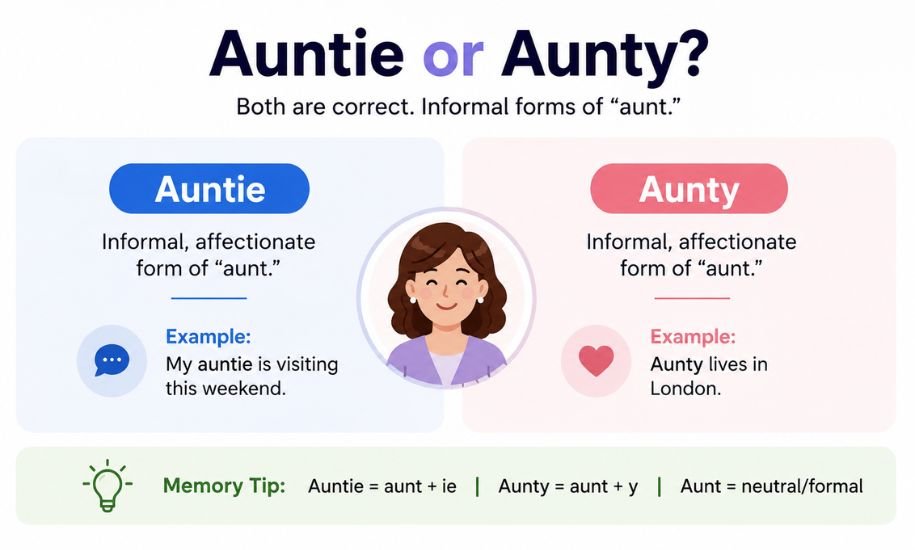
Both “auntie” and “aunty” are correct. They are informal forms of “aunt” and generally have the same meaning. “Auntie” is a widely recognized spelling, while “aunty” is an established alternative, often preferred in particular regions, communities, or families.
Auntie or Aunty: What’s the Difference?
There is no major difference in meaning between auntie and aunty. Both can refer to a person’s aunt and can also be used as a warm or familiar form of address.
The standard word is aunt, while the two alternatives add an informal or affectionate tone.
| Feature | Auntie | Aunty |
|---|---|---|
| Correct spelling? | Yes | Yes |
| Meaning | Informal form of “aunt” | Informal form of “aunt” |
| Word type | Noun | Noun |
| Tone | Familiar/affectionate | Familiar/affectionate |
| Usage | Widely used | Established alternative |
| Formal writing | Usually use “aunt” | Usually use “aunt” |
So, if someone writes, “My auntie is visiting,” and another person writes, “My aunty is visiting,” both sentences can be grammatically correct.
What Does “Auntie” Mean?
Auntie is an informal noun meaning aunt. It can describe the sister of your mother or father, your uncle’s wife, or sometimes another woman who has an aunt-like relationship with you.
It can also be used directly when addressing someone.
Examples:
- “My auntie lives in Manchester.”
- “Auntie Sarah brought us some gifts.”
- “I stayed with my auntie during the holidays.”
- “Thank you, Auntie, for helping me.”
The word often sounds warmer and more personal than simply saying aunt.
For example:
“My aunt is coming for dinner.”
is neutral, while:
“My auntie is coming for dinner.”
sounds more informal and affectionate.
What Does “Aunty” Mean?
Aunty is another accepted informal form of aunt. Its meaning is essentially the same as auntie.
Examples include:
- “My aunty lives next door.”
- “I called my aunty after work.”
- “Aunty Maria made a delicious cake.”
- “The children were excited to see their aunty.”
The spelling with -y is not simply a spelling mistake. It is a recognized variant found in English dictionaries and used in different English-speaking communities.
This is why it would be inaccurate to say that aunty is always wrong and auntie is always right.
Why Are Both Spellings Used?
The difference comes largely from spelling convention and personal preference.
English has many words that have more than one accepted spelling. In the case of auntie and aunty, speakers may learn one form from their family, community, school, or region and naturally continue using it.
For example, one family might commonly say:
“Ask Auntie to come inside.”
Another might use:
“Ask Aunty to come inside.”
The meaning remains the same.
In some varieties of English, particularly South Asian English, aunty or auntie can also be used as a respectful or familiar term for an older woman who is not literally a person’s aunt. The exact social meaning depends on the community and situation.
Is “Auntie” More Correct Than “Aunty”?
No. Neither spelling is universally more correct.
Auntie is a well-established form and is especially familiar to many English speakers. Aunty is also a legitimate variant.
The best choice is therefore usually based on audience and consistency.
If your family normally uses aunty, there is no grammatical reason to change it to auntie. Likewise, if you naturally use auntie, you do not need to replace it with aunty.
When writing for a general audience, auntie may be the more immediately familiar choice, but that does not make aunty incorrect.
When Should You Use “Aunt” Instead?
Although auntie and aunty are correct, aunt is generally better when you want a neutral or formal tone.
Compare these examples:
Informal:
“My auntie is staying with us this week.”
Neutral:
“My aunt is staying with us this week.”
Formal context:
“I contacted my aunt regarding the family arrangements.”
In a formal letter, academic assignment, report, or professional document, there is usually no need for the affectionate -ie or -y ending.
That does not make the informal versions grammatically incorrect. It simply makes aunt a better stylistic choice for formal situations.
Examples of Correct Usage
Here are some natural examples showing how both forms work.
Using “Auntie”
- “My auntie gave me this book.”
- “Auntie Linda is coming to dinner tonight.”
- “I used to visit my auntie every summer.”
- “Can you ask Auntie if she needs anything?”
Using “Aunty”
- “My aunty sent me a birthday card.”
- “Aunty Rose lives in Australia.”
- “We had lunch with our aunty on Sunday.”
- “I asked my aunty for some advice.”
Using “Aunt”
- “My aunt lives in Canada.”
- “I visited my aunt last weekend.”
- “Her aunt works as a teacher.”
All three forms can be correct. The choice depends largely on the desired tone and the spelling convention being followed.
Auntie vs. Aunty in Different Contexts
The most useful rule is to think about relationship and tone, rather than trying to find a strict grammatical distinction.
Family conversations
Either auntie or aunty can work naturally.
“Auntie is making dinner.”
or
“Aunty is making dinner.”
Direct address
Both can be used as names or forms of address.
“Auntie, can I help you?”
“Aunty, can I help you?”
Capitalization depends on how the word is being used. When it functions like a name directly before or instead of a person’s name, capitalization is often appropriate:
“Thank you, Auntie.”
When it is being used as an ordinary noun, lowercase is generally appropriate:
“My auntie lives nearby.”
Formal writing
Use aunt when a neutral tone is preferable:
“My aunt attended the meeting.”
This avoids unnecessary informality.
Common Mistakes to Avoid
1. Calling “aunty” a misspelling
This is the biggest mistake in this comparison. Aunty is an accepted variant, so it should not automatically be corrected to auntie.
2. Assuming “auntie” and “aunty” have different meanings
In ordinary usage, they mean essentially the same thing. The spelling does not normally indicate a different family relationship.
3. Using an informal form in a formal document
Although both forms are correct, auntie and aunty can sound more personal. In formal writing, aunt is usually the better option.
4. Mixing spelling conventions unnecessarily
If you are writing a personal story and choose aunty, there is generally no reason to switch randomly to auntie. Consistency makes writing cleaner.
5. Assuming one spelling works for every community
English usage varies across regions and cultures. A spelling that feels natural to one speaker may be less familiar to another.
An Easy Way to Remember the Difference
There is no complicated grammar rule to memorize because both forms are correct.
A simple way to remember them is:
- Auntie = aunt + ie
- Aunty = aunt + y
- Aunt = neutral/formal form
If you are writing informally, choose the spelling that matches your usual English or your audience. If you are writing formally and do not need an affectionate tone, simply use aunt.
Frequently Asked Questions
Is “auntie” or “aunty” correct?
Both are correct. They are informal forms of aunt and normally have the same meaning. The choice depends on regional, cultural, family, or personal preference.
Is “aunty” a real English word?
Yes. Aunty is an established English word and a recognized variant of auntie. It should not be treated as a simple spelling error.
Is “auntie” British or American English?
Auntie is used in both British and American English, as well as other varieties. Aunty is also used in several English-speaking communities. Neither spelling belongs exclusively to one country.
Which is better for formal writing: auntie, aunty, or aunt?
Aunt is usually the best choice for formal or neutral writing. Auntie and aunty have a more informal or affectionate character.
Can “auntie” refer to someone who is not my actual aunt?
Yes. In some English-speaking cultures and communities, auntie or aunty can be used for an older woman or a close family friend, even when there is no biological relationship.
Final Verdict: Auntie or Aunty?
Auntie and aunty are both correct spellings. They are informal, affectionate forms of aunt, and neither should automatically be considered a misspelling. Choose the version that fits your regional or family convention, and use aunt when a more neutral or formal expression is appropriate. For clear explanations of tricky English choices like this one, Grammarifyr follows a simple principle: Know the Difference. Use the Right Words.
You may also Read : Girly or Girlie: Meaning and Usage Explained