Girly or Girlie: Meaning and Usage Explained
It is easy to hesitate over girly or girlie, especially because both spellings appear in English writing. The good news is that neither form is simply a spelling mistake. Girly is the more straightforward and generally preferred adjective for describing something associated with girls or traditionally feminine qualities, while girlie is a recognized variant that can sound more playful, informal, or context-specific. The two forms overlap in meaning, but they are not always interchangeable in every situation.
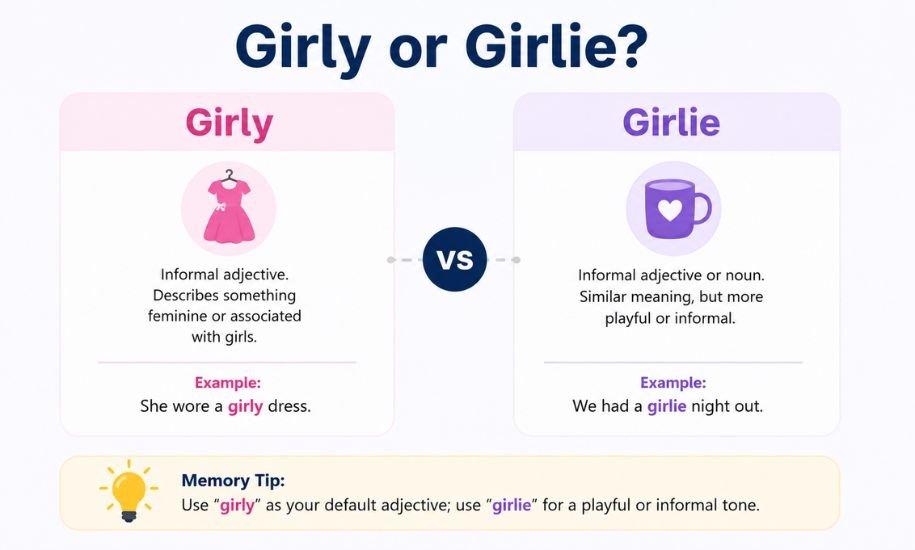
Both “girly” and “girlie” are correct English words. “Girly” is usually the better choice when you need an informal adjective meaning feminine or associated with girls. “Girlie” is a recognized alternative and can also have additional informal or specialized uses.
Girly or Girlie: What’s the Difference?
The simplest distinction is one of standard everyday usage and tone.
Girly is primarily an adjective. It describes something considered traditionally feminine, associated with girls, or characteristic of girls.
- She chose a girly pink dress.
- The bedroom has a very girly design.
- She prefers a less girly style.
Girlie can also be an adjective with much the same basic meaning:
- They planned a girlie weekend together.
- She bought a cute, girlie outfit.
However, girlie can feel more playful or deliberately informal. It can also function as a noun in some contexts, particularly when addressing someone informally.
So, if you simply need an adjective in ordinary writing, girly is usually the safest choice.
Quick Comparison
| Feature | Girly | Girlie |
|---|---|---|
| Is it correct? | Yes | Yes |
| Main grammatical role | Adjective | Adjective; sometimes noun |
| Basic meaning | Feminine or associated with girls | Feminine or associated with girls |
| Everyday adjective | Very common | Less neutral; more informal |
| Tone | Informal, ordinary | Informal, playful, or context-specific |
| Formal writing | Usually preferable | Less commonly preferred |
| Can have additional meanings? | Limited | Yes, depending on context |
The important point is that girlie is not merely a misspelling of girly. It is an established form in English.
What Does “Girly” Mean?
Girly is an informal adjective used for something considered typical of girls or traditionally feminine.
It can describe clothing, colors, decorations, interests, behavior, styles, or other characteristics.
For example:
- She bought a girly dress for the party.
- The shop sells girly accessories and stationery.
- Her room has a bright and girly appearance.
- I prefer simple clothes rather than anything too girly.
The word can be neutral, positive, humorous, or mildly negative depending on context and the speaker’s attitude. For example, saying that a design is “girly” may simply describe its style, but describing a person’s behavior that way can sometimes sound stereotypical or dismissive.
“Girly” as an Adjective
The most important grammatical fact is that girly is primarily an adjective.
It modifies a noun:
a girly outfit
a girly bedroom
a girly style
It can also appear after linking verbs:
The decoration looks girly.
Her style is quite girly.
What Does “Girlie” Mean?
Girlie is a legitimate English word that overlaps substantially with girly. As an adjective, it can describe something associated with girls or traditionally feminine qualities.
Examples include:
- She chose a girlie dress for the celebration.
- They enjoyed a girlie afternoon together.
- The decorations were colorful and girlie.
- She wanted something cute but not too girlie.
The main difference is often tone rather than basic meaning. Girlie can sound more playful, affectionate, deliberately informal, or stylistically marked than girly.
“Girlie” Can Also Be a Noun
Unlike girly, girlie can be used as a noun in certain informal contexts.
For example:
Come on, girlie, we’re going to be late.
Here, girlie is being used as an informal form of address rather than as an adjective.
This usage needs some care because addressing an adult woman as “girlie” can sound patronizing or disrespectful depending on the relationship and situation.
The word also occurs in some established expressions with meanings that go beyond simply “feminine.” Therefore, context matters when interpreting girlie.
Why Are These Two Spellings Confused?
The confusion is understandable because the words have:
- almost identical pronunciation in many varieties of English,
- nearly identical spelling,
- overlapping meanings,
- the same basic adjective function.
The spelling difference comes down to the ending: -y versus -ie.
English has many words where alternative endings create different forms or related words, so writers may wonder whether one version is a mistake. In this case, however, dictionaries recognize both forms.
The important thing is not to assume that every word ending in -ie is an incorrect version of a word ending in -y. Girlie has its own established usage.
When Should You Use “Girly”?
Use girly when you want the ordinary adjective meaning “associated with girls” or “traditionally feminine.”
It is particularly natural in phrases such as:
- girly clothes
- girly fashion
- girly colors
- girly accessories
- girly room
- girly style
- girly hairstyle
- girly design
For example:
The store has a large selection of girly accessories.
She wanted a girly bedroom with pastel decorations.
Her outfit is feminine without being overly girly.
If you are unsure which form to choose as an adjective, girly is generally the better default.
When Is “Girlie” Appropriate?
Choose girlie when the more playful or informal quality of the word fits the context.
For example:
We’re having a girlie night out this Friday.
She picked a cute and girlie dress.
It can also appear in informal forms of address:
Thanks, girlie!
That does not mean girlie should always replace girly. In many ordinary descriptive sentences, girly sounds more neutral and natural.
There are also established expressions in which girlie has a more specific meaning. Consequently, readers should consider the complete phrase rather than assuming that the two spellings are interchangeable everywhere.
Girly vs. Girlie in American and British English
It would be misleading to say that girly is American English while girlie is British English, or vice versa.
Both forms are recognized in major English dictionaries, and the distinction is not a simple US-versus-UK spelling rule.
Instead, the choice often depends on:
- context,
- tone,
- personal style,
- the particular expression,
- and whether the word is being used as an adjective or noun.
For ordinary descriptive writing, girly is generally the more straightforward option regardless of whether your audience uses American or British English.
Examples: Correct Usage in Sentences
Here are some natural examples showing how the two forms work.
Using “girly”
Correct: She decorated the room in a very girly style.
Correct: I don’t usually wear girly clothes.
Correct: The store specializes in girly accessories.
Using “girlie”
Correct: They planned a girlie weekend at the spa.
Correct: She bought a cute, girlie dress.
Correct: “Don’t worry, girlie,” she said jokingly.
Notice that the first two examples use girlie as an adjective, while the last uses it as an informal noun or form of address.
Is “Girlie” a Misspelling of “Girly”?
No.
This is one of the most important points to remember. Although girly is usually the preferred everyday adjective, girlie is a legitimate English form.
Calling girlie an outright spelling error would therefore be inaccurate.
Instead, think of the relationship this way:
Girly = the usual everyday adjective
Girlie = a recognized alternative with a more informal or context-dependent character
There are situations where replacing one with the other may make the sentence sound less natural, even though both are valid words.
Common Mistakes to Avoid
1. Calling “girlie” incorrect
The spelling girlie is not automatically wrong. It has dictionary-recognized uses.
2. Assuming the two words are always interchangeable
Their meanings overlap, but girlie has additional uses and can have a different tone.
3. Treating the difference as purely American vs. British
There is no simple rule that assigns one spelling exclusively to American English and the other exclusively to British English.
4. Using “girlie” in formal contexts without considering tone
Because girlie is strongly informal in many uses, girly may be the more natural choice when you need a straightforward adjective.
5. Using “girlie” as a form of address carelessly
Calling an adult woman “girlie” can be friendly in one situation but patronizing in another. The relationship and context matter.
An Easy Way to Remember the Difference
A practical rule is:
Use “girly” as your default adjective. Think of “girlie” as the alternative form that may add an informal, playful, or context-specific tone.
For example:
- girly dress → ordinary description
- girlie weekend → playful/informal expression
- girlie! → informal way of addressing someone
You do not need to memorize a complicated grammar rule. When you are simply describing something as feminine or associated with girls, girly will usually be the safest choice.
Frequently Asked Questions
Is “girly” the correct spelling?
Yes. Girly is a correct English word and is generally the more straightforward choice when used as an informal adjective meaning feminine or associated with girls.
Is “girlie” also correct?
Yes. Girlie is a recognized English word. It overlaps with girly as an adjective but can also have additional informal or specialized uses.
Is “girlie” British and “girly” American?
No. That is an oversimplification. Both forms are used in English, and the difference is better explained by context, tone, and usage rather than a strict British-American spelling distinction.
Which is better: “girly dress” or “girlie dress”?
Girly dress is generally the more straightforward choice. Girlie dress is also possible, particularly when the writer wants a more playful or informal tone.
Can “girlie” be used as a noun?
Yes. In informal contexts, girlie can be used as a form of address or as a noun. However, addressing an adult woman this way can sometimes sound patronizing, so context is important.
Is “girly” formal English?
Girly is a standard English word, but it is informal in register. It is perfectly normal in casual and general writing, but a more precise or neutral expression may be preferable in formal contexts depending on what you mean.
Final Verdict: Girly or Girlie?
Both “girly” and “girlie” are correct, but “girly” is usually the better default adjective. Use it when describing something as feminine or traditionally associated with girls. Choose girlie when its playful, informal, affectionate, or context-specific tone fits the sentence. For more straightforward explanations of confusing English words, Grammarifyr follows the simple principle: Know the Difference. Use the Right Words.
You may also Read : Catalog or Catalogue: US vs UK English Explained

One Comment