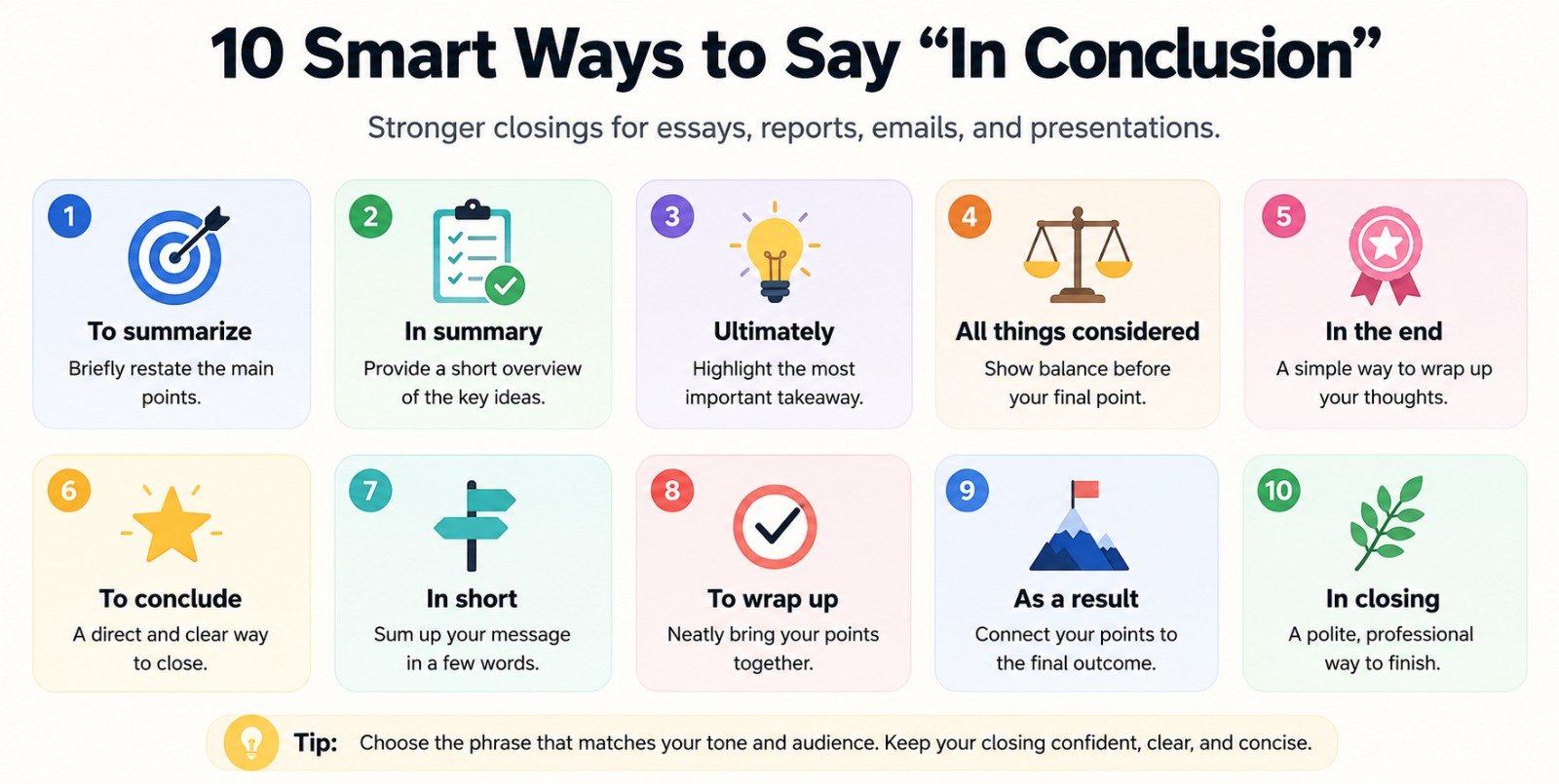
What to Say Instead of “In Conclusion”: 25 Better Ways to End Your Writing
“In conclusion” is perfectly correct, but using it every time you finish an essay, report, presentation, or article can make your writing feel predictable. Fortunately, there are plenty of better ways to say “in conclusion”, depending on your purpose, audience, and tone.
You might want to summarize your main points, emphasize a final judgment, connect evidence, recommend an action, or simply bring your writing to a natural close. The best alternative isn’t always a direct synonym, so choosing the right expression matters.
Quick Comparison: Alternatives to “In Conclusion”
| Alternative | Tone | Best Used For |
|---|---|---|
| In summary | Formal, neutral | Essays, reports, academic writing |
| To summarize | Formal | Research and explanatory writing |
| To sum up | Neutral | Essays, presentations, general writing |
| Overall | Neutral | Opinions, analysis, reports |
| Ultimately | Formal, thoughtful | Final judgments and outcomes |
| In closing | Formal | Speeches, letters, presentations |
| All things considered | Reflective | Weighing different factors |
| Taken together | Academic | Combining evidence or findings |
| In short | Concise | Brief summaries |
| In brief | Formal, concise | Reports and explanations |
| On the whole | Neutral | Overall assessments |
| The key takeaway is | Professional | Reports, presentations, business writing |
| The main point is | Direct | Explanations and informal writing |
| Finally | Neutral | Introducing a final point |
| To wrap up | Casual | Conversations and presentations |
Better Ways to Say “In Conclusion”
Not every alternative has exactly the same meaning as “in conclusion.” Some introduce a summary, while others express a final judgment or result. Here are the most useful choices and how to use them naturally.
1. In Summary
“In summary” is one of the closest alternatives to “in conclusion.” It signals that you’re bringing the major ideas together without sounding overly repetitive.
Example:
“In summary, the research suggests that regular exercise can improve both physical and mental well-being.”
Best for: Academic writing, reports, essays, and professional documents.
2. To Summarize
“To summarize” works well when the purpose of your final paragraph is specifically to review the key information.
Example:
“To summarize, the project succeeded because the team established clear goals from the beginning.”
It is particularly useful when your conclusion genuinely summarizes earlier information.
3. To Sum Up
“To sum up” is natural and widely understood. It is slightly less formal than “in summary,” making it suitable for presentations, articles, and general writing.
Example:
“To sum up, preparation, consistency, and patience are the three main factors behind the result.”
4. Overall
“Overall” is a simple and versatile option. It doesn’t explicitly announce a conclusion; instead, it presents an overall assessment.
Example:
“Overall, the new policy has produced positive results.”
This is often more natural than “in conclusion” when you’re giving a final evaluation.
5. Ultimately
“Ultimately” is useful when you’re expressing the final result, judgment, or most important consideration.
Example:
“Ultimately, the success of the program depends on how consistently it is implemented.”
It isn’t always interchangeable with “in conclusion.” Use it when you want to emphasize the final determining factor or outcome.
6. In Closing
“In closing” is a polished way to signal that you’re bringing a speech, letter, presentation, or formal piece of writing to an end.
Example:
“In closing, I would like to thank everyone who contributed to the project.”
It sounds especially natural when addressing an audience directly.
7. All Things Considered
“All things considered” works when you’ve discussed several advantages, disadvantages, facts, or competing viewpoints and are now giving your final assessment.
Example:
“All things considered, investing in the new equipment appears to be the most practical option.”
This phrase is more than a simple conclusion marker because it suggests that multiple factors have been weighed.
8. Taken Together
“Taken together” is particularly effective in academic and research writing. It shows that several pieces of evidence collectively lead to a conclusion.
Example:
“Taken together, these findings indicate that early intervention can significantly improve outcomes.”
This is a stronger choice than “in conclusion” when you’re interpreting evidence.
9. In Short
“In short” is ideal when you want to reduce a longer explanation to its essential message.
Example:
“In short, the proposal is affordable, practical, and easy to implement.”
It is concise and works in both professional and general writing.
10. In Brief
“In brief” has a similar function to “in short,” but it can sound slightly more formal.
Example:
“In brief, the report identifies three major causes of the decline.”
It works particularly well in reports and explanatory documents.
11. On the Whole
“On the whole” is useful when making an overall judgment after discussing individual details.
Example:
“On the whole, the changes have had a positive effect on employee productivity.”
It is particularly appropriate when your conclusion balances both positive and negative points.
12. The Key Takeaway Is
For business writing, presentations, and reports, “the key takeaway is” can be more useful than a traditional conclusion phrase.
Example:
“The key takeaway is that customers value convenience more than additional features.”
Rather than merely announcing the end, it tells readers exactly what they should remember.
13. The Main Point Is
“The main point is” is direct and conversational. It works especially well when you’ve explained several details and want to identify the central idea.
Example:
“The main point is that better planning would have prevented most of these problems.”
It is less formal than “in conclusion,” so it may not be the best choice for a highly academic paper.
14. In Essence
“In essence” means that you’re reducing a complicated discussion to its fundamental idea.
Example:
“In essence, the proposal asks the company to invest now to reduce costs later.”
Use it when you want to emphasize the core meaning, not simply repeat every point.
15. At Its Core
“At its core” provides a more conversational and analytical ending.
Example:
“At its core, the debate is about how much responsibility individuals should have for protecting the environment.”
This works particularly well in essays, opinion pieces, and explanatory articles.
16. Considering All the Evidence
This phrase is useful when your conclusion is based on research, facts, or multiple sources of evidence.
Example:
“Considering all the evidence, the most reasonable explanation is that the decline resulted from several factors.”
It makes the connection between the evidence and your conclusion explicit.
17. Based on These Findings
“Based on these findings” is an excellent choice for research papers, studies, reports, and analytical writing.
Example:
“Based on these findings, schools should consider introducing additional reading support.”
Unlike “in conclusion,” this phrase tells readers why the conclusion follows.
18. For These Reasons
Use “for these reasons” when the preceding discussion has established several arguments supporting your final position.
Example:
“For these reasons, expanding the program would be a worthwhile investment.”
It naturally connects the conclusion to the arguments you’ve already presented.
19. Therefore
“Therefore” is useful when you’re stating a logical result or consequence.
Example:
“The current system is inefficient and expensive. Therefore, replacing it would be a sensible decision.”
However, “therefore” is not simply a synonym for “in conclusion.” It expresses a logical relationship between ideas, so use it when the meaning calls for a result.
20. Consequently
“Consequently” also expresses a result or consequence.
Example:
“The company failed to adapt to changing customer expectations. Consequently, its market share declined.”
It is more formal than many everyday alternatives and is especially suitable for analytical writing.
21. Finally
“Finally” can introduce your last point, but it does not necessarily mean that you’re summarizing the entire piece.
Example:
“Finally, the study highlights the importance of continued monitoring.”
Use it when you’re introducing the last item in a sequence, rather than automatically replacing “in conclusion.”
22. As a Final Point
“As a final point” is useful when you have one last idea to present before finishing.
Example:
“As a final point, employers should remember that flexibility can improve employee satisfaction.”
It works particularly well in presentations and structured arguments.
23. To Bring It All Together
This expression has a warmer, more conversational tone.
Example:
“To bring it all together, the results show that small changes can produce significant improvements over time.”
It works well in presentations, articles, workshops, and educational content.
24. When All Is Said and Done
“When all is said and done” is an idiomatic, conversational alternative. It suggests a final perspective after everything has been considered.
Example:
“When all is said and done, the decision comes down to what provides the best long-term value.”
Avoid it in very formal academic writing because it is more conversational.
25. To Wrap Up
“To wrap up” is one of the most casual ways to signal the end.
Example:
“To wrap up, remember to check your sources before submitting the assignment.”
It’s especially natural in presentations, meetings, lessons, videos, and informal articles.
Other Ways to Say “In Conclusion” in an Essay
Essays usually benefit from language that sounds clear and deliberate rather than formulaic. The strongest choices include:
In Summary
Use this when your conclusion reviews the main argument.
“In summary, the evidence supports the argument that public transportation should receive greater investment.”
Ultimately
Choose this when you’re making a final judgment.
“Ultimately, individual choices can influence environmental outcomes, but broader policy changes are also necessary.”
Taken Together
This is particularly useful when your essay discusses multiple pieces of evidence.
“Taken together, these examples demonstrate the lasting impact of social media on public communication.”
Overall
Use this for a straightforward final assessment.
“Overall, the advantages of the proposal outweigh its potential disadvantages.”
In Essence
This works when you want to reduce a complex argument to its central idea.
“In essence, the debate concerns how society should balance individual freedom with collective responsibility.”
Tip: You don’t have to begin every essay conclusion with a transition phrase. Sometimes the strongest ending simply states the final insight directly.
“The evidence ultimately demonstrates that meaningful change requires both individual effort and institutional support.”
That can sound more confident than announcing, “In conclusion…”
Other Ways to Say “In Conclusion” in Academic Writing
Academic writing generally favors precise and restrained language. Consider these options:
- In summary
- To summarize
- Taken together
- Overall
- Ultimately
- Considering the evidence
- Based on these findings
- The evidence suggests that
- These findings indicate that
- On balance
The Evidence Suggests That
This is particularly useful when your conclusion is based on research rather than absolute proof.
Example:
“The evidence suggests that early education plays a significant role in long-term academic development.”
These Findings Indicate That
This works well in research papers and analytical reports.
Example:
“These findings indicate that the revised approach is more effective than the previous method.”
These expressions are often stronger academically because they tell the reader what the evidence supports, rather than simply announcing that the paper is ending.
Other Ways to Say “In Conclusion” Professionally
Professional writing usually benefits from concise, direct language.
Overall
“Overall, the proposed changes should improve efficiency without significantly increasing costs.”
The Key Takeaway Is
“The key takeaway is that consistent communication remains essential to the project’s success.”
Based on These Findings
“Based on these findings, the company should prioritize customer retention over short-term acquisition.”
For These Reasons
“For these reasons, extending the deadline would provide the team with sufficient time to complete the work properly.”
In Closing
“In closing, thank you for your time and consideration.”
For emails, reports, and workplace communication, a direct final statement can often sound better than a formal conclusion marker.
Instead of:
“In conclusion, I believe this proposal is worth considering.”
Try:
“For these reasons, I believe this proposal is worth considering.”
Other Ways to Say “In Conclusion” in a Presentation
Spoken English gives you more flexibility than academic writing.
To Wrap Up
“To wrap up, there are three things we need to remember.”
To Sum Up
“To sum up, the project met its goals and stayed within budget.”
Before We Finish
“Before we finish, let’s review the three main recommendations.”
In Closing
“In closing, I’d like to thank everyone for their contribution.”
The Key Takeaway Is
“The key takeaway is simple: preparation makes the entire process easier.”
These expressions sound natural because they acknowledge that the speaker is moving toward the end without sounding overly formal.
Other Ways to Say “In Conclusion” in a Casual Conversation
You don’t normally need formal conclusion language in everyday conversation. More natural options include:
So, Basically
“So, basically, we just need to give the project a little more time.”
The Main Point Is
“The main point is that we need a better plan before we start.”
All in All
“All in all, it was a pretty good experience.”
In a Nutshell
“In a nutshell, the new system is faster and easier to use.”
When All Is Said and Done
“When all is said and done, we just want everyone to be happy with the decision.”
These are appropriate for conversations, informal presentations, blogs, and friendly communication, but some may sound too casual for academic papers.
What Is the Best Alternative to “In Conclusion”?
There isn’t one universal replacement. The best choice depends on what you want the final paragraph to accomplish.
| If you want to… | Best choice |
|---|---|
| Summarize the main ideas | In summary |
| Give a concise summary | In short |
| Make a final judgment | Ultimately |
| Give an overall assessment | Overall |
| Combine research findings | Taken together |
| Refer directly to evidence | Based on these findings |
| Highlight one lesson | The key takeaway is |
| Weigh different factors | All things considered |
| End a speech | In closing |
| Introduce the final point | Finally |
| Sound conversational | To wrap up |
| Explain the core idea | In essence |
“Ultimately” vs. “In Conclusion”: Are They the Same?
No. Although they can sometimes appear in similar positions, they perform different jobs.
“In conclusion” tells the reader that you’re moving into your concluding remarks.
“Ultimately” emphasizes the final result, judgment, or determining factor.
Compare:
“In conclusion, the proposal has several advantages.”
with:
“Ultimately, the proposal offers the most practical solution.”
The first signals a conclusion. The second makes a final judgment.
“Finally” vs. “In Conclusion”: What’s the Difference?
“Finally” usually introduces the last point in a sequence.
“Finally, the researchers examined the long-term effects.”
“In conclusion” signals that the writer is summarizing or closing the overall argument.
So, replacing “in conclusion” with “finally” can change the meaning. If you’re presenting your last argument rather than summarizing the whole discussion, “finally” may be the better choice.
Do You Have to Say “In Conclusion” in an Essay?
No. There is no requirement to use the exact phrase “in conclusion.”
A conclusion can begin naturally with your final argument:
“The evidence ultimately shows that access to education remains one of the strongest factors influencing social mobility.”
This approach can make academic writing feel less repetitive. The important thing is that the reader can recognize the shift from analysis to your final interpretation.
How to End an Essay Without Saying “In Conclusion”
Instead of using a standard transition, focus on the final insight.
For example:
Less engaging:
“In conclusion, social media has both positive and negative effects.”
More direct:
“Social media can strengthen human connection, but its benefits depend largely on how responsibly it is used.”
The second version doesn’t announce that the essay is ending. It simply delivers the conclusion.
Common Mistakes When Replacing “In Conclusion”
Using “Finally” as a direct synonym
“Finally” normally introduces the last item or argument, so it isn’t always appropriate for a summary.
Using “Therefore” without a cause-and-effect relationship
“Therefore” should connect an earlier fact or argument to a logical result.
Using casual expressions in formal academic writing
Phrases such as “to wrap up” and “in a nutshell” may sound too informal for a research paper.
Using “ultimately” when you only want to summarize
“Ultimately” usually adds the idea of a final judgment or outcome. If you simply want to review the main points, “in summary” is clearer.
Forcing a transition into every conclusion
Sometimes no introductory phrase is needed. A strong final paragraph can move directly to the central takeaway.
How to Choose the Right Alternative
Think about three things before selecting your phrase:
1. What are you doing?
Are you summarizing, judging, explaining a result, or introducing one last point?
2. Who are you writing for?
An academic paper requires different language from a presentation or text message.
3. How formal should you sound?
“In summary” is formal and neutral, while “to wrap up” is conversational.
The goal isn’t to avoid “in conclusion” at all costs. The goal is to choose wording that accurately reflects the function of your final paragraph.
Frequently Asked Questions
What is another way to say “in conclusion”?
Common alternatives include in summary, to sum up, overall, ultimately, in closing, in short, taken together, and all things considered. The best option depends on the context.
What is a better way to say “in conclusion” in an essay?
For most essays, “in summary,” “overall,” “ultimately,” or “taken together” can work well. You can also skip the transition and begin with your final insight.
What are some formal ways to say “in conclusion”?
Formal options include in summary, to summarize, in closing, taken together, ultimately, on balance, and considering all the evidence.
What can I say instead of “in conclusion” in academic writing?
Try “in summary,” “taken together,” “overall,” “based on these findings,” or “the evidence suggests that.” Choose according to whether you’re summarizing information or interpreting evidence.
Can I use “ultimately” instead of “in conclusion”?
Sometimes. “Ultimately” is best when you are presenting a final judgment, result, or determining factor. It isn’t an exact replacement when you simply want to summarize your preceding points.
Is “to sum up” formal or informal?
“To sum up” is neutral and can work in essays, presentations, articles, and general communication. For highly formal academic writing, “in summary” or “to summarize” may sound more appropriate.
Is it okay to use “in conclusion” in an essay?
Yes. “In conclusion” is grammatically correct and acceptable in essays. The issue is usually repetition, not correctness. If you use it frequently, varying your transitions or writing a direct final statement can make your work more natural.
How do I end a conclusion without saying “in conclusion”?
State your final judgment, implication, recommendation, or takeaway directly. For example: “The evidence therefore supports a balanced approach that combines individual responsibility with institutional action.”
What is the most natural alternative to “in conclusion”?
For a straightforward summary, “in summary” is probably the closest natural alternative. For a final judgment, “ultimately” or “overall” may be better.
Final Thoughts
The best alternative to “in conclusion” isn’t necessarily the phrase that sounds most different. It is the one that accurately communicates what you’re doing at the end of your writing. Use “in summary” when summarizing, “ultimately” for a final judgment, “taken together” for combined evidence, and “in closing” when formally ending a speech or message. And when your final paragraph is already clear, you may not need a transition at all.
Choosing the right concluding expression is one of those small language decisions that can make writing sound more natural and precise. That’s exactly the kind of distinction Grammarifyr is designed to make easier: knowing not just what words mean, but when each one fits best.
You may also Read : Ways to Say Good Morning: 50+ Cute, Funny, Fun & Friendly Greetings


One Comment