Other Ways to Say “For Example”: 30+ Useful Alternatives
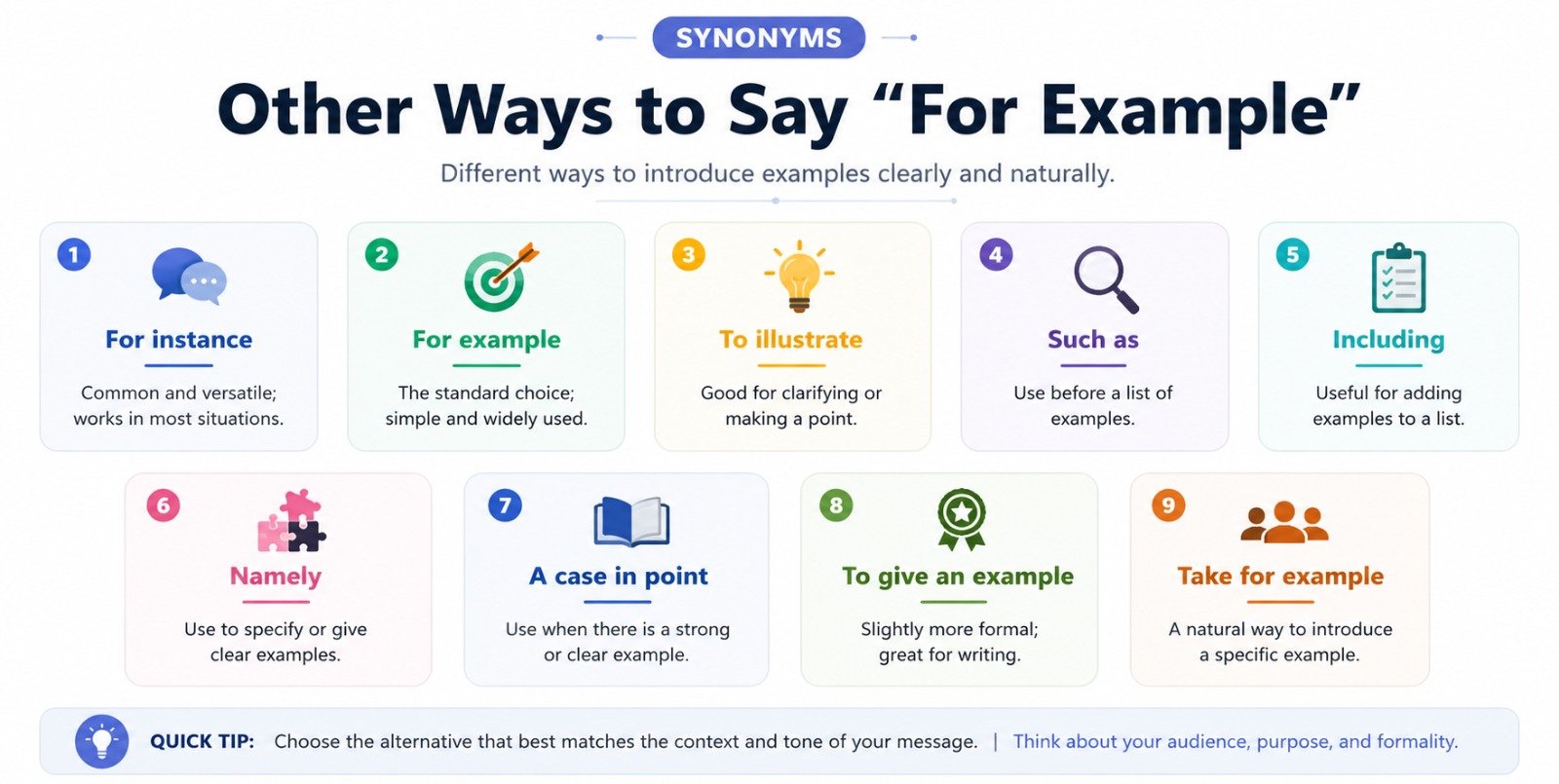
When you use “for example” repeatedly, your writing can start to feel predictable. Fortunately, English offers several natural alternatives, but they are not all interchangeable. “For instance” works much like “for example,” while phrases such as “such as,” “namely,” and “to illustrate” serve slightly different purposes.
Below are useful other ways to say “for example”, organized by context so you can choose an expression that actually fits your sentence.
Quick Answer
The closest alternatives to “for example” are for instance, such as, as an example, to illustrate, one example is, and take, for example. The best choice depends on whether you are writing formally, academically, professionally, or casually.
Quick Comparison: Alternatives to “For Example”
| Alternative | Tone | Best Used For | Example |
|---|---|---|---|
| For instance | Neutral/Formal | General and academic writing | For instance, regular exercise can improve sleep. |
| Such as | Neutral | Lists and categories | Eat foods such as apples and oranges. |
| To illustrate | Formal | Essays and explanations | To illustrate, consider the following case. |
| As an example | Neutral | General writing | As an example, consider a small business. |
| Specifically | Formal | Precise details | Specifically, we need two more volunteers. |
| Namely | Formal | Naming exact items | Two options remain, namely, A and B. |
| In particular | Neutral/Formal | Highlighting one item | I enjoy outdoor sports, in particular hiking. |
| Like | Casual | Conversation | Try activities like swimming or cycling. |
| Including | Neutral | Lists | Several cities, including London, joined the program. |
| A case in point is | Formal | Strong supporting example | A case in point is the company’s recent expansion. |
Other Ways to Say “For Example”
1. For Instance
“For instance” is the closest everyday and formal alternative to “for example.” In many sentences, you can substitute one for the other without changing the basic meaning.
Example:
“Some people prefer working early. For instance, my manager starts at 7 a.m.”
It works particularly well in essays, reports, presentations, and conversations.
2. Such As
Use “such as” when you want to introduce one or more members of a broader group.
Example:
“Many fruits, such as apples and bananas, are easy to add to breakfast.”
Unlike “for example,” “such as” usually fits directly into the sentence rather than introducing a separate thought.
3. To Illustrate
“To illustrate” sounds more formal and is useful when an example helps explain an idea.
Example:
“To illustrate, imagine a company that suddenly loses its largest customer.”
It is a strong option for academic, professional, and explanatory writing.
4. As an Example
“As an example” is straightforward and natural. It can introduce a specific case without sounding overly formal.
Example:
“As an example, consider a student preparing for an important exam.”
5. As an Illustration
This is a more formal variation that works well when discussing an idea, principle, or concept.
Example:
“As an illustration, the following case demonstrates how the system works.”
It is less common in casual conversation.
6. Specifically
“Specifically” can sometimes replace “for example,” but the two do not mean exactly the same thing.
“Specifically” usually narrows a general statement to a particular detail.
Example:
“The project needs additional resources, specifically more staff and equipment.”
Use it when precision is more important than simply giving an example.
7. Namely
“Namely” is useful when you are identifying the exact people, things, or details you have in mind.
Example:
“The company has two major priorities, namely customer retention and product quality.”
It is more formal than “for example,” and it should not be used when you merely want to mention one possible example.
8. In Particular
“In particular” highlights one specific person, thing, or example from a broader group.
Example:
“She enjoys several creative hobbies, in particular painting.”
This expression is especially useful when you want to emphasize one item.
9. Including
“Including” is useful for introducing examples within a list.
Example:
“The course covers several skills, including writing, editing, and research.”
It is natural in both professional and everyday writing.
10. Like
“Like” is a simple, conversational alternative when giving examples.
Example:
“You can use free tools like Google Docs and Canva.”
It sounds natural in conversation and informal writing but may be less appropriate in highly formal academic prose.
11. Take, for Example
“Take, for example” draws attention to a particular case.
Example:
“Take, for example, a business that relies entirely on one supplier.”
It is especially effective when you want the reader to consider a specific situation.
12. One Example Is
This is one of the clearest ways to introduce an example.
Example:
“One example is the growing popularity of remote work.”
It works well when clarity matters more than stylistic variety.
13. A Good Example Is
Use “a good example is” when the example strongly demonstrates the point you have just made.
Example:
“A good example is the way small businesses use social media to reach customers.”
It sounds natural and accessible.
14. To Give an Example
“To give an example” directly tells the reader that you are about to provide supporting evidence or an illustration.
Example:
“To give an example, imagine trying to learn a language without ever practicing it.”
This works in both speech and writing.
15. A Case in Point Is
“A case in point is” is more formal and emphasizes an example that strongly supports your argument.
Example:
“Many companies have benefited from flexible working arrangements. A case in point is the firm’s recent productivity increase.”
It is better suited to formal writing than casual conversation.
16. By Way of Example
This is a formal expression meaning that something is being presented as an example.
Example:
“By way of example, consider the following scenario.”
You are most likely to see it in formal, academic, legal, or professional writing.
17. To Demonstrate
“To demonstrate” introduces an example that shows how something works or proves a point.
Example:
“To demonstrate this principle, consider what happens when demand suddenly increases.”
It is particularly useful when the example has an explanatory purpose.
18. To Exemplify
“To exemplify” means to serve as or provide an example of something.
Example:
“This case helps to exemplify the importance of careful planning.”
It is formal and more common in academic or professional writing than everyday conversation.
19. As Shown By
Use “as shown by” when an example provides evidence for a statement.
Example:
“The strategy has produced positive results, as shown by the increase in customer retention.”
This phrase emphasizes evidence rather than simply presenting an example.
20. As Demonstrated By
“As demonstrated by” is another formal option when a particular case provides evidence.
Example:
“The approach can improve efficiency, as demonstrated by the company’s latest results.”
It works particularly well in reports, research writing, and professional documents.
21. As Evidenced By
“As evidenced by” focuses strongly on evidence supporting a claim.
Example:
“The campaign was successful, as evidenced by the significant increase in website traffic.”
It is more formal than ordinary “for example” wording.
22. Examples Include
“Examples include” is concise and useful when you are about to provide several examples.
Example:
“Popular forms of exercise include walking, cycling, and swimming.”
This construction is especially useful for lists.
23. One Instance Is
“One instance is” can introduce a particular occurrence or case.
Example:
“One instance is the company’s response to the unexpected supply shortage.”
It is more formal and less conversational than “one example is.”
24. Consider
Sometimes you don’t need an introductory phrase at all. “Consider” can naturally direct the reader toward an example or hypothetical situation.
Example:
“Consider a student who studies for only ten minutes each day.”
This is particularly effective in explanatory and academic writing.
25. Let’s Say
“Let’s say” is informal and conversational. It is commonly used when introducing a hypothetical example.
Example:
“Let’s say you have $500 to spend on a new laptop.”
It sounds natural in conversation but is generally too casual for formal academic writing.
26. Say
In informal speech, “say” can introduce a hypothetical example.
Example:
“Say you wanted to start your own business. Where would you begin?”
This is conversational rather than formal.
27. For One Thing
“For one thing” can introduce a supporting point, but it is not a direct synonym for “for example.”
Example:
“I don’t think we should cancel the project. For one thing, we’ve already invested months of work.”
Here, the phrase introduces one reason rather than an example.
28. In This Case
“In this case” refers to a particular situation that has already been introduced.
Example:
“Several solutions are available. In this case, a simpler approach may be more practical.”
It should not be treated as a universal replacement for “for example.”
29. By Way of Illustration
This formal phrase introduces something intended to make an idea easier to understand.
Example:
“By way of illustration, consider how the same rule applies to a small business.”
It works especially well in formal explanatory writing.
30. For Illustrative Purposes
“For illustrative purposes” signals that the following information is being used to explain an idea rather than necessarily describing a real situation.
Example:
“For illustrative purposes, assume that the company receives 1,000 orders per day.”
This is particularly useful in technical, academic, business, and instructional contexts.
Formal Ways to Say “For Example”
When writing an essay, report, research paper, business document, or formal email, some alternatives fit better than others.
For Instance
This is usually the safest direct replacement.
Example:
“Several factors influence employee satisfaction. For instance, flexible working hours can improve morale.”
To Illustrate
Use this when the example helps explain an argument or concept.
Example:
“To illustrate this point, consider the effects of poor communication within a team.”
Namely
Choose “namely” when you are specifying exactly what you mean.
Example:
“The study identified two major concerns, namely cost and accessibility.”
Specifically
Use “specifically” to narrow a broad statement.
Example:
“The policy affects several employees, specifically those working in the finance department.”
A Case in Point Is
This works when the example is especially relevant or convincing.
Example:
“Technology has changed workplace communication. A case in point is the widespread use of video conferencing.”
By Way of Example
This is distinctly formal and can work in academic or professional prose.
Example:
“By way of example, consider a company operating in a highly competitive market.”
Other Ways to Say “For Example” in an Essay
Academic writing benefits from precise transitions, but you don’t need to replace every occurrence of “for example.” The original phrase is perfectly acceptable.
Still, these alternatives can add variety:
For Instance
“Several factors affect academic performance. For instance, students who manage their time effectively may find it easier to meet deadlines.”
To Illustrate
“To illustrate, a student with a structured study schedule may complete assignments more consistently.”
Specifically
“Several study habits can improve performance, specifically regular revision and effective time management.”
In Particular
“Some learning strategies are especially useful, in particular active recall and practice testing.”
One Example Is
“One example is the use of practice questions to identify areas that need further study.”
To Demonstrate
“To demonstrate the value of preparation, consider a student who begins reviewing material several weeks before an examination.”
The key is to choose a phrase that matches the grammatical role and meaning you need.
Different Ways to Say “For Example” in Professional Writing
Professional communication often benefits from concise, neutral language.
In Emails
Instead of:
“For example, we could schedule the meeting on Tuesday.”
You could write:
“For instance, we could schedule the meeting on Tuesday.”
Or:
“One option would be to schedule the meeting on Tuesday.”
In Reports
Instead of:
“For example, customer complaints increased in March.”
You could write:
“For instance, customer complaints increased in March.”
Or:
“This is illustrated by the increase in customer complaints in March.”
In Presentations
You might say:
“Take, for example, our latest marketing campaign.”
This sounds natural when speaking to an audience.
Casual Ways to Say “For Example”
Everyday conversations don’t require formal alternatives. These expressions often sound more natural:
Like
“You could try something relaxing, like reading or walking.”
Let’s Say
“Let’s say you have an extra hour this evening. What would you do with it?”
Say
“Say you wanted to change careers. What would your first step be?”
Take…
“Take my brother, for example. He never drinks coffee.”
Such As
“I enjoy outdoor activities such as hiking and cycling.”
For casual communication, simple language is often better than unnecessarily formal wording.
“For Example” vs. “For Instance”
These two expressions are extremely close in meaning.
For example:
“Some vegetables contain high levels of nutrients. For example, spinach contains several important vitamins.”
For instance:
“Some vegetables contain high levels of nutrients. For instance, spinach contains several important vitamins.”
In most ordinary contexts, either works. “For instance” can sometimes feel slightly more polished, but there is no need to replace “for example” merely for the sake of sounding sophisticated.
“For Example” vs. “Such As”
These expressions have different grammatical patterns.
For example can introduce a separate sentence:
“Some pets require a lot of attention. For example, dogs need regular exercise.”
Such as generally appears within a sentence:
“Some pets, such as dogs, need regular exercise.”
So while both introduce examples, they should not automatically be substituted for each other.
“For Example” vs. “Namely”
The difference is even clearer with “namely.”
“For example” suggests that what follows is an example of a broader idea.
“Several cities have introduced the program. For example, Boston has expanded it.”
“Namely” identifies specific items:
“Two cities were selected, namely Boston and Chicago.”
Using “namely” where you mean “for example” can therefore change the meaning of your sentence.
Which Alternative Should You Choose?
The best expression depends on what you are trying to accomplish.
- Need the closest replacement? Use for instance.
- Introducing items in a list? Use such as or including.
- Explaining an idea? Use to illustrate.
- Naming exact details? Use namely.
- Narrowing a broad statement? Use specifically.
- Highlighting one item? Use in particular.
- Writing formally? Try to demonstrate, by way of example, or a case in point is.
- Writing casually? Use like, say, or let’s say.
- Presenting evidence? Consider as shown by or as evidenced by.
Common Mistakes When Replacing “For Example”
Using “Namely” for Any Example
Don’t use “namely” whenever you want to give an example. It generally introduces specific information rather than a merely possible example.
Using “Like” in Very Formal Writing
“Like” is perfectly natural in conversation, but “such as” may be more appropriate in formal academic prose.
Assuming Every Alternative Is Identical
Expressions such as “specifically,” “in particular,” and “namely” have their own functions. Replacing “for example” without checking the sentence can change the meaning.
Making Writing Too Formal
You don’t need to turn every “for example” into “by way of illustration.” Sometimes the simplest wording is the strongest.
Frequently Asked Questions
What is another way to say “for example”?
The closest alternatives are “for instance,” “as an example,” “to illustrate,” and “one example is.” Other options, such as “such as” and “including,” work in specific grammatical contexts.
What is the most formal way to say “for example”?
For formal writing, options include “to illustrate,” “by way of example,” “a case in point is,” “as demonstrated by,” and “as evidenced by.” The right choice depends on the sentence.
What can I say instead of “for example” in an essay?
You can use “for instance,” “to illustrate,” “specifically,” “in particular,” “one example is,” or “to demonstrate.” However, “for example” itself is completely acceptable in academic writing.
Is “for instance” better than “for example”?
Not necessarily. They are very similar and can often be used interchangeably. “For instance” may provide stylistic variety, but there is no general rule that makes it better.
Can I use “such as” instead of “for example”?
Sometimes. “Such as” normally introduces examples within a sentence, while “for example” can introduce a separate example or sentence.
Is “namely” the same as “for example”?
No. “Namely” is generally used to identify or specify exact items, while “for example” introduces an example that illustrates a broader point.
Is “e.g.” another way to say “for example”?
Yes. “e.g.” is the standard abbreviation for the Latin exempli gratia, meaning “for example.” It is mainly used in writing rather than ordinary conversation.
What is a casual way to say “for example”?
In informal conversation, “like,” “say,” “let’s say,” and “take…” can introduce examples naturally. Choose them according to the sentence rather than treating them as exact synonyms.
How can I avoid repeating “for example” in writing?
You can vary your wording with expressions such as “for instance,” “to illustrate,” “such as,” “including,” or “one example is.” More importantly, choose the expression according to whether you’re listing examples, highlighting evidence, or explaining a specific case.
Final Thoughts
There are plenty of ways to say “for example,” but the best alternative isn’t necessarily the most sophisticated one. “For instance” is usually the easiest direct substitute, while “such as,” “namely,” “specifically,” and “to illustrate” each serve different purposes. When you match the phrase to your sentence, your writing becomes clearer rather than simply more varied.
That attention to small differences is exactly what makes word choice effective. Grammarifyr helps you understand those distinctions so you can choose expressions that sound natural, precise, and appropriate for the situation.
You may also Read : What to Say Instead of “In Conclusion”: 25 Better Ways to End Your Writing

One Comment