That or Which: What’s the Difference and When Should You Use Each?
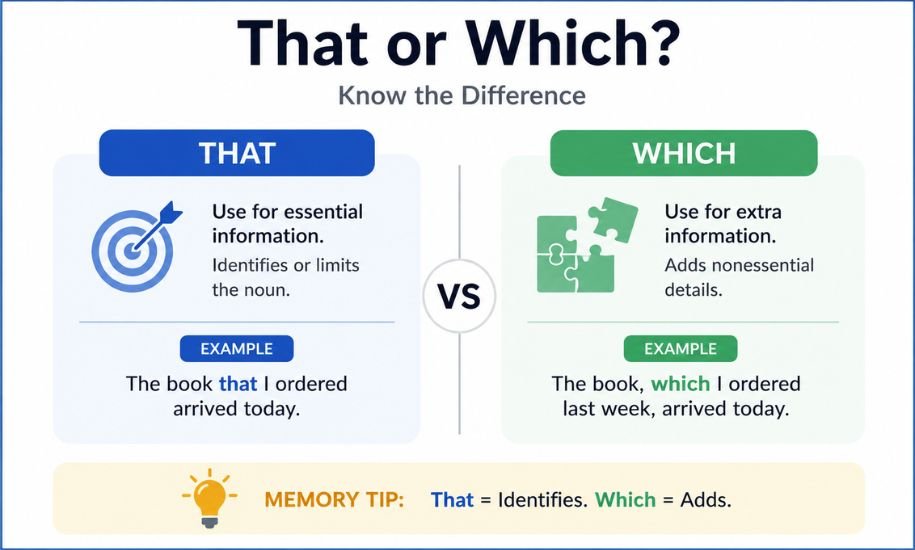
Choosing between that and which can be surprisingly tricky because both words can introduce relative clauses. The traditional rule says to use that for essential information and which for extra information, but modern English is a little more flexible. The key is understanding whether the clause is restrictive or nonrestrictive, and punctuation often helps show the difference. Once you understand that distinction, deciding when to use that or which becomes much easier.
Both that and which are correct relative pronouns. In traditional formal American English, that is generally preferred for restrictive clauses, while which is used for nonrestrictive clauses set off by commas. However, which can also introduce restrictive clauses, especially in British English.
That or Which: The Basic Difference
The most useful distinction is between restrictive and nonrestrictive relative clauses.
A restrictive clause provides information that identifies or limits the noun. Removing it can change the intended meaning.
The jacket that I bought yesterday is already torn.
The phrase “that I bought yesterday” tells us which jacket is being discussed.
A nonrestrictive clause adds extra information. The noun is already sufficiently identified, so the clause can be removed without changing the basic reference.
My jacket, which I bought yesterday, is already torn.
Here, “which I bought yesterday” simply adds information about an already identified jacket.
This leads to the traditional guideline:
- That → usually restrictive
- Which → usually nonrestrictive
- Which with commas → nonrestrictive
- Which without commas → possible in restrictive clauses, depending on style and variety of English
Quick Comparison
| Feature | That | Which |
|---|---|---|
| Restrictive clause | Yes, traditionally preferred | Yes, also possible |
| Nonrestrictive clause | Generally not used | Yes |
| Commas around clause | No | Usually yes for nonrestrictive use |
| Formal American style | Common for restrictive clauses | Common for nonrestrictive clauses |
| British English | Common | Common in both restrictive and nonrestrictive clauses |
| Example | The phone that I bought works. | The phone, which I bought yesterday, works. |
The important point is that the choice is not simply about whether the noun is a person or a thing. The function of the relative clause matters most.
When to Use “That”
Use that when a relative clause is essential to identifying the noun, particularly in formal American English.
Consider:
The reports that contain errors need to be corrected.
The clause “that contain errors” identifies which reports need correction. Without it, we would have:
The reports need to be corrected.
That sentence has a different meaning because it could refer to all the reports.
Here are a few more examples:
I returned the shoes that were damaged.
She chose the restaurant that had the best reviews.
We need the files that were updated this morning.
In each case, the relative clause narrows down the noun.
“That” Can Refer to People Too
Although who is normally preferred for people, that can occur in some restrictive relative clauses:
She is the person that helped me.
However, this is generally more natural:
She is the person who helped me.
So the distinction between that and which should not be confused with the separate choice between who and that.
When to Use “Which”
Use which for a nonrestrictive relative clause when the information is additional rather than essential. The clause is normally separated from the rest of the sentence with commas.
My laptop, which is three years old, still works perfectly.
The listener already knows which laptop is being discussed. The information about its age is supplementary.
More examples:
The museum, which opened in 1925, attracts thousands of visitors each year.
Our old printer, which was becoming unreliable, has finally been replaced.
The apartment, which overlooks the park, costs more than we expected.
The commas matter because they signal that the clause is parenthetical or nonessential.
Can You Use “Which” Without a Comma?
Yes. This is where the traditional rule can become confusing.
You may encounter sentences such as:
The book which I ordered last week finally arrived.
This construction is grammatical. Which is introducing a restrictive clause, meaning the clause identifies the particular book.
In formal American writing, many style guides traditionally recommend:
The book that I ordered last week finally arrived.
But that does not mean the version with which is universally incorrect. Restrictive which is well established in British English and occurs in other varieties and styles as well.
Therefore, if you are writing for a broad audience, the safest practical rule is:
Use “that” for restrictive clauses when following traditional American formal style, but recognize that restrictive “which” is also grammatically accepted.
Why the Comma Can Change the Meaning
Punctuation is particularly important when deciding which relative pronoun to use.
Compare these two sentences:
The employees who work remotely receive a travel allowance.
This can mean that only the employees who work remotely receive the allowance.
Now compare:
The employees, who work remotely, receive a travel allowance.
The commas suggest that all the employees work remotely, and the clause simply adds information about them.
The difference is therefore not merely stylistic. A comma can change how the reader understands the scope of the information.
Another example:
Cars that use electric motors are becoming more common.
This refers specifically to cars using electric motors.
Electric cars, which use electric motors, are becoming more common.
Here, the clause provides additional information about electric cars.
Which Are or That Are: Which Is Correct?
Both which are and that are can be grammatical. The correct choice depends on the role of the clause.
Use that are when the information is restrictive:
The documents that are missing must be replaced.
The clause identifies which documents are being discussed.
Use which are when the clause is nonrestrictive:
The documents, which are stored securely, are available to authorized staff.
The documents are already identified, and the clause adds information about them.
You can also encounter restrictive which are:
The documents which are stored securely are available to authorized staff.
This is grammatical, although that are may be preferred in traditional American formal writing.
That or Which After a Preposition
There is another useful grammatical distinction: which can follow a preposition, while that generally cannot.
For example:
The company for which I work is expanding.
You would not normally write:
The company for that I work is expanding.
In everyday English, the sentence can often be rewritten more naturally:
The company that I work for is expanding.
So both constructions are possible, but they use different structures.
Other examples include:
The project on which we worked was successful.
The subject about which she was speaking was controversial.
These more formal constructions commonly use which.
Common Mistakes With That and Which
1. Using “that” after a comma
Incorrect in standard formal usage:
My car, that I bought last year, is blue.
Better:
My car, which I bought last year, is blue.
A nonrestrictive relative clause normally uses which, not that.
2. Assuming “which” is always wrong without commas
It is too absolute to say that which must always have commas.
The computer which I bought yesterday is already malfunctioning.
This can be grammatical, especially in British English. If following traditional American style, that would usually be preferred:
The computer that I bought yesterday is already malfunctioning.
3. Adding unnecessary commas
Incorrect:
The books, that are on the desk, belong to Sarah.
If the clause identifies which books are meant, the commas should be removed and that is the traditional choice:
The books that are on the desk belong to Sarah.
4. Using “which” for a person
Incorrect:
The woman which called earlier left a message.
Better:
The woman who called earlier left a message.
Who is normally used for people.
5. Ignoring the meaning created by punctuation
A writer may insert commas simply because a sentence feels long. That can unintentionally change a restrictive clause into a nonrestrictive one.
Before adding commas, ask whether the information is necessary to identify the noun.
An Easy Way to Choose
When you are unsure when to use which or that, ask one question:
Does the relative clause identify the noun, or does it merely add information?
If it identifies the noun, use that in traditional American formal writing:
The house that has a blue roof is for sale.
If it adds information about an already identified noun, use which with commas:
My house, which has a blue roof, is for sale.
A simple memory aid is:
That = identifies. Which = adds.
Remember, though, that this is a practical style rule rather than an absolute description of every form of English.
American and British English Usage
American and British English can differ in how strictly they follow the traditional distinction.
In formal American English, writers are often encouraged to use that for restrictive clauses and which for nonrestrictive clauses:
The phone that I ordered arrived today.
My phone, which I ordered last week, arrived today.
British English is generally more accepting of which in restrictive clauses:
The phone which I ordered arrived today.
This means you may see both forms in reputable English writing.
If you are writing for an American audience and want to follow a conventional formal style, choosing that for restrictive clauses is a reliable approach. If you are writing in British English, restrictive which is not automatically an error.
The most important thing is to maintain clarity and consistency.
Examples: Choosing the Right Form
Here are several examples showing the distinction in context.
Restrictive:
The recipe that uses fresh tomatoes tastes better.
The clause identifies the recipe.
Nonrestrictive:
This recipe, which uses fresh tomatoes, tastes better.
The recipe has already been identified.
Restrictive:
The students that completed the assignment received feedback.
The clause identifies which students received feedback.
Nonrestrictive:
The students, who completed the assignment, received feedback.
The commas suggest that all the students completed the assignment.
Restrictive with “which”:
The software which runs on older computers requires fewer resources.
This is grammatical, particularly in British English, though traditional American style would commonly use that.
Frequently Asked Questions
Is “that or which” grammatically correct?
Yes. Both that and which are standard English words that can function as relative pronouns. The choice depends largely on whether the relative clause is restrictive or nonrestrictive, as well as on regional and stylistic conventions.
When do you use which or that?
Use that for restrictive clauses when following traditional formal American usage. Use which for nonrestrictive clauses set off by commas. However, which can also introduce restrictive clauses, especially in British English.
Is “which” wrong without a comma?
No. A restrictive relative clause can use which without commas. For example, “The book which I ordered arrived today” is grammatical. In formal American style, “The book that I ordered arrived today” is often preferred.
Should I use “that” or “which” after a comma?
For a standard nonrestrictive relative clause, use which, not that.
The car, which is nearly new, runs well.
The commas show that the clause provides additional information.
Which are or that are: which should I choose?
Choose that are when the clause identifies a specific group: “The files that are damaged need replacing.” Choose which are when the clause adds information: “The files, which are stored online, are easy to access.” Restrictive which are is also possible in some styles.
Is “which” more formal than “that”?
Not necessarily. The two words perform different grammatical functions depending on context. Which is often associated with nonrestrictive clauses in formal writing, while that is commonly used for restrictive clauses. Neither is simply the universally “more formal” word.
The Bottom Line
The best way to decide between that and which is to focus on the relative clause, not just the noun before it. If the clause is essential for identifying what you mean, that is the traditional choice in formal American English. If the clause simply adds extra information, use which and set it off with commas. Since English usage varies, restrictive which is not automatically wrong.
For a clear, practical approach to confusing English choices, Grammarify follows the same principle: understand the difference, then use the form that best fits your sentence.
You may also Read : Utmost or Upmost: Which Is Correct? Meaning, Difference and Examples
Similar Posts
Compliment or Complement? Easy Difference Explained
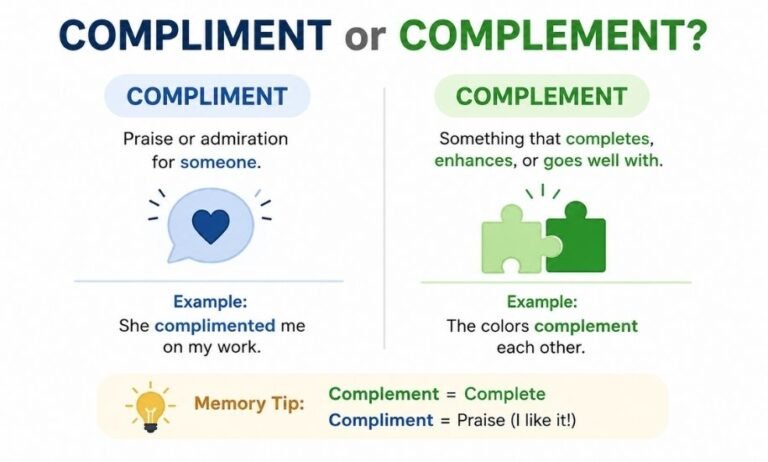
If you are unsure whether to write compliment or complement, you are dealing with two real English words—not a correct spelling and a misspelling. The confusion comes from their very similar spelling, pronunciation, and related historical origins. Their meanings, however, are different. Compliment is connected with praise or admiration, while complement refers to something that…
Connotation vs Denotation: Differences and Examples
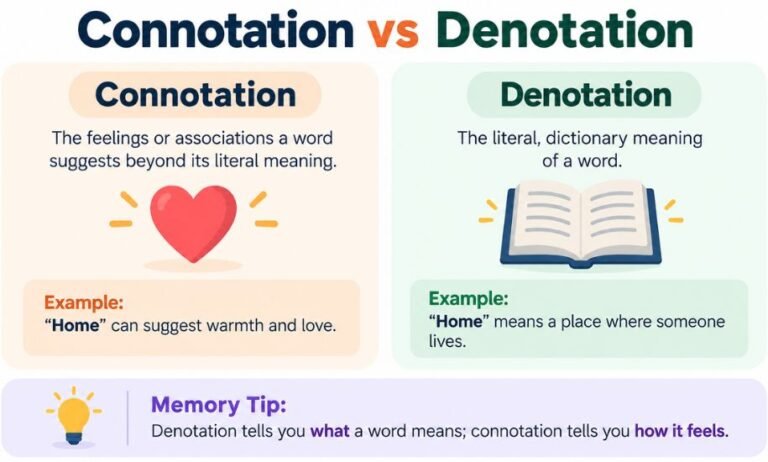
Words can have more than one layer of meaning. Some communicate a straightforward definition, while others also create feelings, impressions, or associations. This is where connotation and denotation come in. Although both terms describe aspects of a word’s meaning, they serve different purposes. Understanding the distinction can help you choose more appropriate words, interpret literature,…
Axe or Ax: American and British English Explained
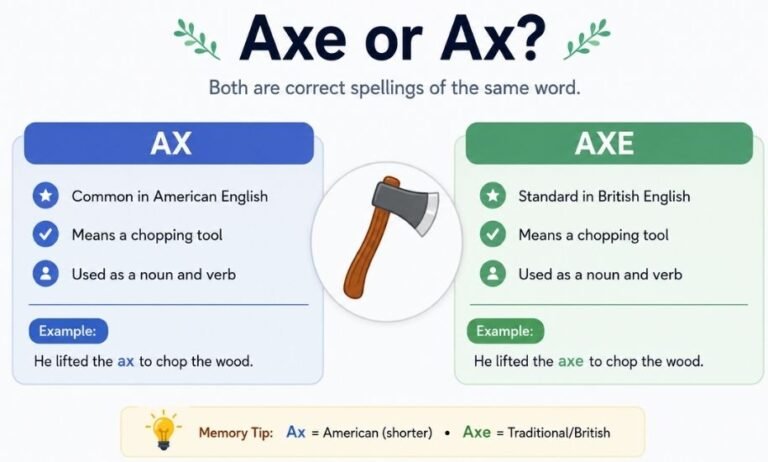
If you have ever wondered whether the cutting tool is spelled axe or ax, you are not alone. Both forms appear in dictionaries and in everyday English, but their usage varies somewhat by region and style. Axe is the traditional spelling and is especially common in British English, while ax is strongly established in American…
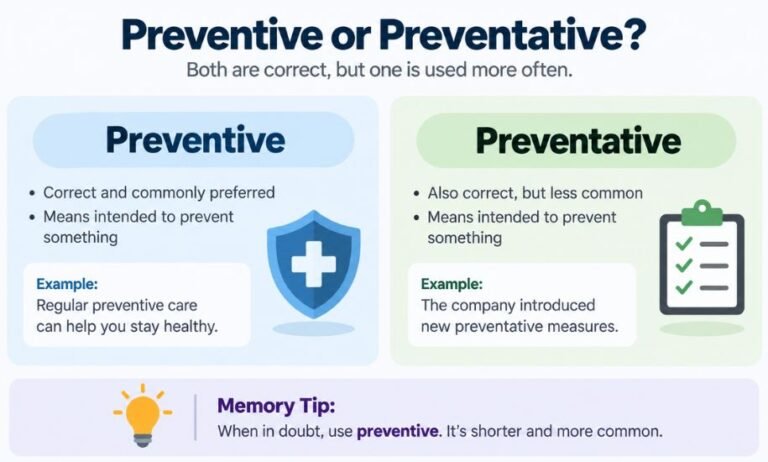
Preventive or Preventative Care and Maintenance
If you have ever hesitated between preventive and preventative, you are not alone. Both forms appear in dictionaries and are used in standard English, and both describe something intended to stop a problem before it happens. The difference is mainly one of preference and usage rather than meaning. In most modern professional and formal writing,…
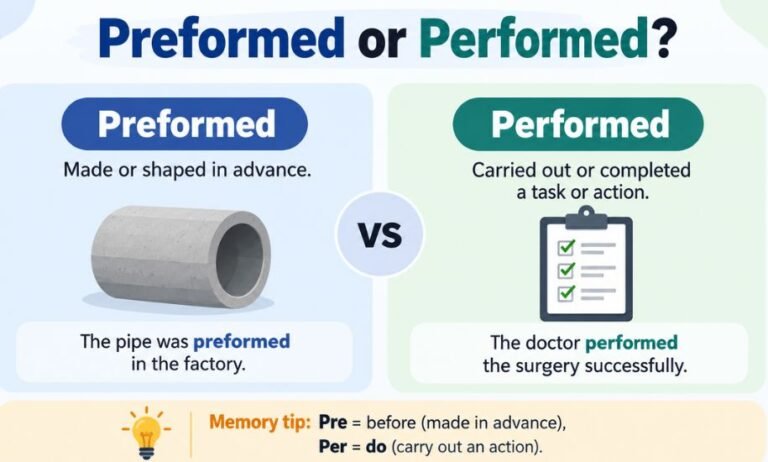
Preformed or Performed: Meaning and Examples
It is easy to confuse preformed and performed because they look almost identical and are built from the same base word, form. However, they have completely different meanings. Preformed means something was formed, shaped, or prepared in advance, while performed is the past tense and past participle of perform, meaning something was carried out, completed,…
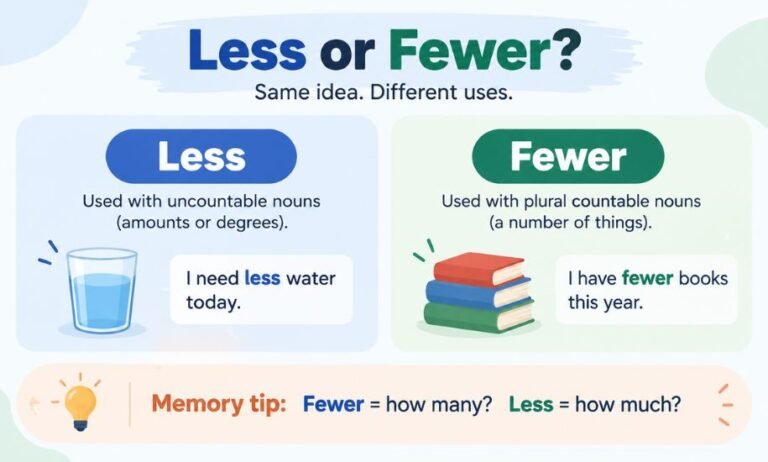
Less or Fewer? Meaning and Usage Explained
It is easy to hesitate between less and fewer, especially because both describe a smaller quantity. The key is what you are talking about: less generally refers to an amount, while fewer normally refers to a number of separate, countable things. Once you recognize whether a noun can be counted individually, the choice becomes much…
One Comment