Utmost or Upmost: Which Is Correct? Meaning, Difference and Examples
“Utmost” and “upmost” look and sound similar, so it is easy to confuse them. However, they do not normally serve the same purpose. Utmost is the standard word when you mean the greatest degree, amount, importance, effort, or respect. Upmost is a real but uncommon word referring to something at the highest physical or positional level. Knowing this small distinction can help you avoid phrases such as “upmost respect” and choose the wording that sounds natural and correct in standard English.
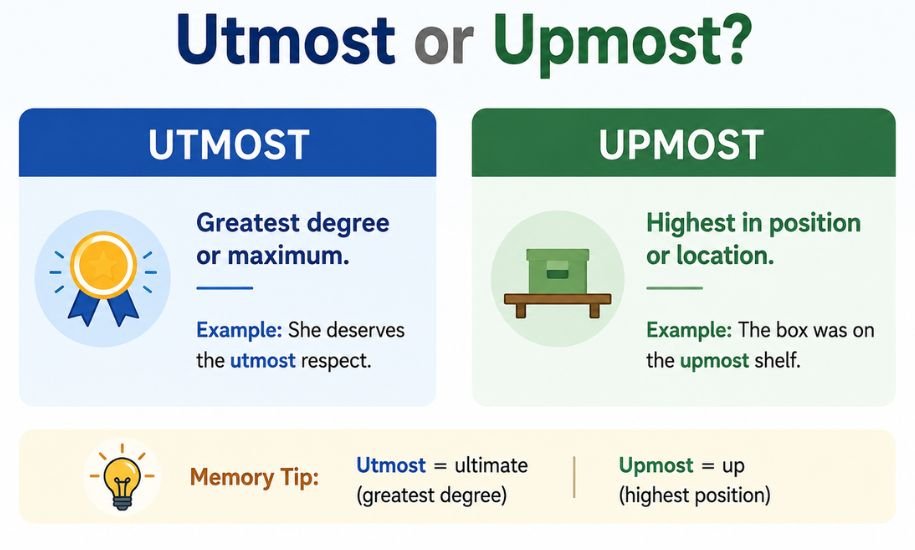
Utmost is correct when you mean “greatest,” “highest in degree,” or “maximum,” as in “utmost respect” and “utmost importance.” Upmost is also a real word, but it means “highest in position” and is uncommon in modern English. For physical position, “uppermost” or “topmost” is often more natural.
Utmost or Upmost: What’s the Difference?
The simplest distinction is degree versus position.
| Feature | Utmost | Upmost |
|---|---|---|
| Basic meaning | Greatest or highest degree | Highest physical position |
| Commonness | Common | Uncommon |
| Typical use | Respect, care, importance, effort | Physical or positional descriptions |
| Example | “She deserves the utmost respect.” | “The upmost shelf was difficult to reach.” |
| More natural alternative | — | “Uppermost” or “topmost” |
In everyday English, utmost is the word you will need in most expressions involving an abstract quality or degree.
For example:
- The safety of passengers is of the utmost importance.
- We treated the matter with the utmost care.
- I have the utmost respect for her decision.
- They made the utmost effort to solve the problem.
By contrast, upmost relates to being physically or positionally high:
- The object was placed on the upmost shelf.
- The birds were sitting on the upmost branches.
Even in these cases, uppermost is usually the more familiar modern choice.
What Does “Utmost” Mean?
Utmost means the greatest possible degree, amount, extent, or level of something. It can function as an adjective and, in established expressions, as a noun.
When used as an adjective, it commonly appears before abstract nouns:
- utmost importance
- utmost care
- utmost caution
- utmost confidence
- utmost respect
- utmost concern
For example:
Your privacy is of the utmost importance to us.
The researchers handled the samples with the utmost care.
He showed the utmost respect for his opponent.
It can also appear in the expression “do your utmost,” meaning to make your greatest possible effort.
We will do our utmost to complete the work on time.
Here, utmost refers to the maximum effort a person can make.
What Does “Upmost” Mean?
Upmost is a genuine English word, but it is much less common than utmost. It means highest in position and is closely related to uppermost.
For example:
The old box was stored on the upmost shelf.
A small flag was attached to the upmost part of the tower.
The important point is that upmost describes where something is located, rather than the greatest degree of an abstract quality.
In modern writing, however, many speakers would choose uppermost, topmost, or simply top instead:
The old box was stored on the top shelf.
The flag was attached to the uppermost part of the tower.
So, although upmost is not simply a misspelling, it is not the word you should normally use in phrases such as “upmost respect” or “upmost importance.”
Is It “Upmost or Utmost Respect”?
The standard expression is utmost respect.
Correct: I have the utmost respect for your work.
Incorrect in standard usage: I have the upmost respect for your work.
The reason is straightforward. Here, respect is not describing a physical location. The speaker means the greatest possible degree of respect. Therefore, utmost is appropriate.
The same principle applies to similar expressions:
- utmost respect
- utmost care
- utmost attention
- utmost consideration
- utmost concern
- utmost gratitude
If you are deciding between “upmost or utmost respect,” choose utmost respect.
Is It “Utmost or Upmost Importance”?
The correct phrase is utmost importance.
Correct: This information is of the utmost importance.
Incorrect in standard usage: This information is of the upmost importance.
Importance represents a degree of significance. Saying something has “utmost importance” means it has the greatest possible importance.
This pattern also works with many other abstract nouns:
The patient’s safety is of the utmost importance.
The team approached the situation with the utmost seriousness.
We must exercise the utmost caution.
She gave the project her utmost attention.
Whenever the intended meaning is “greatest possible,” utmost is generally the right choice.
Why Are These Words Confused?
The confusion is understandable because the words have similar spelling and pronunciation. Both contain -most, and upmost seems intuitively connected with the idea of something being “up” or “high.”
There is also a semantic overlap. Both words can be associated with something being at an extreme or highest level, but they approach that idea differently.
Compare:
The issue is of the utmost importance.
Here, “highest” means the greatest degree of importance.
Now compare:
The box is on the upmost shelf.
Here, “highest” refers to physical position.
That distinction—maximum degree versus highest position—is the most useful way to separate the two.
Common Expressions With “Utmost”
Because utmost is the standard choice for maximum degree, it appears in several established expressions.
Utmost respect
She has earned the utmost respect of her colleagues.
Utmost importance
Accuracy is of the utmost importance in this report.
Utmost care
The equipment must be handled with the utmost care.
Utmost effort
The volunteers made the utmost effort to help.
Do your utmost
We will do our utmost to find a solution.
These expressions all involve an abstract idea of maximum degree or effort, which is why utmost fits naturally.
When Can “Upmost” Be Used?
You can use upmost when describing something at the highest physical or positional level, although uppermost is often a better choice in contemporary English.
For example:
The statue was placed at the upmost point of the structure.
Snow covered the upmost branches of the tree.
The word can therefore be grammatically valid without being appropriate in every sentence containing the idea of “highest.”
If you are writing formal, general-purpose English, uppermost or topmost will often sound more natural:
The statue was placed at the uppermost point of the structure.
Snow covered the topmost branches of the tree.
This is an important distinction: upmost is a real word, but that does not make it interchangeable with utmost.
Correct and Incorrect Examples
Seeing the two words side by side makes the difference easier to remember.
Abstract meaning
Correct: We treated the complaint with the utmost seriousness.
Incorrect: We treated the complaint with the upmost seriousness.
Respect
Correct: He deserves the utmost respect.
Incorrect: He deserves the upmost respect.
Importance
Correct: Security is of the utmost importance.
Incorrect: Security is of the upmost importance.
Effort
Correct: She made her utmost effort to finish the assignment.
Incorrect: She made her upmost effort to finish the assignment.
Physical position
Possible: The painting hangs in the upmost section of the building.
More natural: The painting hangs in the uppermost section of the building.
The pattern is consistent: use utmost for the greatest degree and upmost for the highest position.
An Easy Way to Remember the Difference
Use this simple rule:
Utmost = ultimate or greatest.
Upmost = up or highest in position.
If you could replace the word with “greatest possible,” choose utmost.
greatest possible respect → utmost respect
greatest possible care → utmost care
greatest possible importance → utmost importance
If you are describing something physically located at the top, upmost may fit, although uppermost is often preferable.
highest shelf → uppermost shelf
highest branch → uppermost branch
A quick mental test is to ask: Am I talking about degree or location?
- Degree → utmost
- Location → upmost/uppermost
Common Mistakes to Avoid
1. Writing “upmost respect”
This is probably the most noticeable mistake.
Use utmost respect because the phrase means the greatest degree of respect.
2. Writing “upmost importance”
Use utmost importance because importance is being measured by degree, not physical height.
3. Assuming “upmost” is always wrong
It is not. Upmost is a legitimate word. It is simply uncommon and has a different meaning.
4. Assuming “utmost” means physically highest
It generally refers to the greatest degree or extent in modern everyday expressions. For physical position, uppermost or topmost is usually clearer.
5. Replacing “do your utmost” with “do your upmost”
The established expression is do your utmost, meaning to make your greatest effort.
Frequently Asked Questions
Is it upmost or utmost?
For most expressions involving the greatest degree, the correct choice is utmost. For example, say “utmost respect,” “utmost importance,” and “utmost care.” Upmost is a real but uncommon word referring to the highest position.
Is “upmost respect” correct?
No, utmost respect is the standard expression. It means the greatest possible degree of respect. Upmost relates to physical or positional height rather than an abstract degree of respect.
Is “upmost” a real word?
Yes. Upmost is a legitimate English word meaning highest in position. However, it is relatively uncommon, and uppermost or topmost will often sound more natural in modern English.
Is it utmost or upmost importance?
Use utmost importance. The phrase means the greatest possible importance, so it describes degree rather than physical position.
Is “do your utmost” correct?
Yes. Do your utmost is an established expression meaning to make your greatest possible effort or try your best.
How can I remember the difference?
Think utmost = ultimate/greatest and upmost = up/high. If the sentence is about the maximum degree of something, use utmost. If it concerns physical position, upmost may apply, although uppermost is often more natural.
The Bottom Line
Utmost is the word you want in expressions such as utmost respect, utmost importance, utmost care, and utmost effort because it describes the greatest possible degree. Upmost is a real but uncommon word for something situated at the highest position. When physical height is intended, uppermost is often the clearer choice. For more straightforward explanations of confusing English words, Grammarify follows a simple principle: Know the Difference. Use the Right Words.
You may also Read :Transferred or Transfered: Which Spelling Is Correct?