Transferred or Transfered: Which Spelling Is Correct?
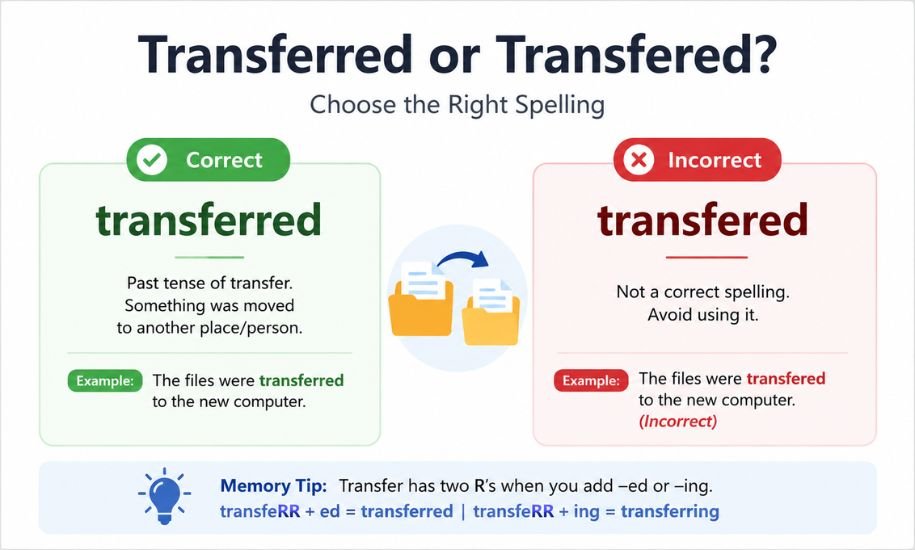
If you are unsure whether to write transferred or transfered, the answer is straightforward: transferred is the correct spelling in standard English. The word comes from the verb transfer, meaning to move someone or something from one place, person, position, or system to another. The extra r can be easy to overlook, especially because many English verbs simply take -ed. However, transfer doubles its final r before -ed and -ing, giving us transferred and transferring.
Transferred is the correct spelling. Transfered is a misspelling and should not be used in standard English. The same spelling pattern appears in transferring, not “transfering.”
Transferred or Transfered: Which One Is Correct?
The correct form is transferred, with two rs.
| Form | Correct? | Use |
|---|---|---|
| transferred | ✅ Yes | Past tense and past participle of transfer |
| transfered | ❌ No | Standard English misspelling |
| transferring | ✅ Yes | Present participle/gerund |
| transfering | ❌ No | Standard English misspelling |
| transferable | ✅ Yes | Adjective meaning capable of being transferred |
| transferrable | Less common | Recognized variant, but transferable is the usual form |
Cambridge Dictionary gives transferred as the relevant past form and shows the spelling of transfer with -rr-. It also lists transferable as the adjective.
So, if you are writing a formal email, essay, report, article, or business document, use transferred.
What Does “Transferred” Mean?
Transferred is the past tense and past participle of transfer, a verb.
To transfer something means to move it from one place, person, position, account, system, or situation to another. The word can describe physical movement, changes in employment or education, money transfers, data movement, ownership, telephone calls, and many other situations.
For example:
- The employee was transferred to another department.
- She transferred the money to her savings account.
- The files were transferred to a new computer.
- He transferred to another university.
- The call was transferred to the billing department.
The meaning changes slightly according to context, but the spelling stays the same.
Why Is There a Double “R” in “Transferred”?
The spelling becomes easier to remember when you look at the base verb:
transfer + ed → transferred
The final r is doubled before the ending:
transfer → transferred
The same pattern appears with -ing:
transfer + ing → transferring
This is why transfered and transfering are incorrect spellings in standard English.
It is easy to assume that the word should work like a verb such as answer:
answer → answered
But transfer follows a different spelling pattern, so you need to keep the double r in the derived forms.
A useful way to remember it is:
Transfer has two R’s when you add -ed or -ing.
That gives you:
- transfer → transferred
- transfer → transferring
Is “Transfered” a Real Word?
Transfered is not the standard spelling of the past tense or past participle of transfer.
It may appear in informal writing, typing, user-generated content, or documents containing spelling mistakes, but that does not make it the accepted standard form.
For careful writing, use:
Correct: The payment was transferred yesterday.
Incorrect: The payment was transfered yesterday.
The same rule applies whether you are talking about money, files, employees, students, property, calls, or information.
Transferred in Different Grammatical Forms
Understanding the verb forms can prevent spelling mistakes.
| Verb form | Example |
| Base form | We transfer the files. |
| Third-person singular | She transfers the files. |
| Past tense | She transferred the files. |
| Past participle | The files have been transferred. |
| Present participle | She is transferring the files. |
The past tense and past participle are both transferred.
For example:
I transferred the money yesterday.
I have transferred the money already.
The money was transferred to the correct account.
Cambridge’s dictionary examples likewise use transferred in constructions such as “has been transferred” and “transferred to” another institution or location.
Transferring or Transfering?
Another spelling question closely related to this one is transfering or transferring.
The correct spelling is:
transferring
Not:
transfering
The reason is the same: the final r is doubled before -ing.
Correct examples
- She is transferring the documents.
- They are transferring the patient to another facility.
- We are transferring the data to a secure server.
- He is transferring to a different department.
Incorrect examples
- ❌ She is transfering the documents.
- ❌ They are transfering the patient.
- ❌ We are transfering the data.
If you remember transferred, remembering transferring becomes much easier: both forms retain the double r.
Transferable or Transferrable?
The adjective transferable is another related form that sometimes causes uncertainty.
Transferable is the usual spelling.
It means that something can be moved, passed to someone else, legally assigned, or used in another situation. Cambridge gives examples involving transferable tickets, transferable skills, and things that can be moved from one situation to another.
For example:
- These tickets are transferable.
- She has highly transferable skills.
- The warranty is transferable to the new owner.
- The knowledge is transferable to other situations.
You may encounter transferrable, but it is much less common than transferable. Therefore, transferable is generally the best choice for standard contemporary writing.
This is an important distinction: transfered is not the standard past-tense spelling, while transferrable can be encountered as a variant of transferable.
Examples: Correct and Incorrect Usage
Seeing the difference in context makes the spelling easier to recognize.
Example 1: Money
Correct: The bank transferred the funds to her account.
Incorrect: The bank transfered the funds to her account.
Example 2: Employment
Correct: Marcus was transferred to the company’s London office.
Incorrect: Marcus was transfered to the company’s London office.
Example 3: Education
Correct: She transferred to another university after her first year.
Incorrect: She transfered to another university after her first year.
Example 4: Data
Correct: The information was transferred to the new database.
Incorrect: The information was transfered to the new database.
Example 5: Telephone calls
Correct: The receptionist transferred my call to the manager.
Incorrect: The receptionist transfered my call to the manager.
In every example, the correct form contains two r’s.
Why Do People Write “Transfered”?
The most likely reason is that writers apply a simple spelling pattern incorrectly.
Many verbs form their past tense by adding -ed:
- work → worked
- clean → cleaned
- open → opened
It is therefore tempting to treat transfer in the same way:
transfer + ed = transfered
But the established spelling is:
transfer + ed = transferred
The same issue occurs when adding -ing. Someone may write transfering because they do not notice that the r needs to be doubled.
The safest approach is to learn the small group of forms together rather than trying to construct them from memory each time:
transfer → transferred → transferring → transferable
Common Mistakes to Avoid
1. Writing “transfered”
❌ The documents were transfered.
✅ The documents were transferred.
2. Writing “transfering”
❌ She is transfering the money.
✅ She is transferring the money.
3. Assuming it is a US/UK spelling difference
Transferred is not a case where American English uses one spelling and British English uses another. The standard spelling is transferred in both varieties.
4. Confusing “transferred” with “transferable”
These words have different grammatical functions.
Transferred describes an action that has happened or is happening in a completed form:
The employee was transferred.
Transferable describes something that can be transferred:
The ticket is transferable.
5. Forgetting the double “r”
The easiest correction is simply to associate the two forms:
transferred — transferring
Both retain the double r.
What About “Transferred or Transferred”?
If you encounter the comparison transferred or transferred, there is no spelling distinction to resolve: the two forms are identical.
For example:
The money was transferred yesterday.
There is only one standard spelling of that word in the sentence. If the intended comparison is actually transferred or transfered, choose transferred.
Likewise, transfered or transferred has the same answer: transferred.
A Simple Way to Remember the Spelling
Use this three-step pattern:
1. Start with:
transfer
2. Add -ed:
transferred
3. Add -ing:
transferring
Think of the final r as staying doubled when these endings are added:
transfeRR + ed → transferred
transfeRR + ing → transferring
You do not need to memorize a complicated grammar rule. Just remember that transfer keeps two r’s in its -ed and -ing forms.
FAQs
Is “transfered” correct?
No. Transfered is not the standard spelling of the past tense or past participle of transfer. The correct spelling is transferred, with two rs.
What is the past tense of “transfer”?
The past tense is transferred.
For example:
She transferred to another department last month.
Is it “transferring” or “transfering”?
The correct form is transferring, with two rs. Transfering is a misspelling in standard English.
Is “transferrable” wrong?
Not necessarily. Transferable is the usual spelling, while transferrable is encountered as a less common variant. For most formal and general-purpose writing, transferable is the better choice.
Is “transferred” an American or British spelling?
Transferred is standard in both American and British English. It is not a US-versus-UK spelling difference.
How can I remember “transferred”?
Remember the pair transferred and transferring. Both keep the double r from the spelling pattern used when the endings -ed and -ing are added.
Final Verdict: Transferred or Transfered?
The correct spelling is transferred. If you are describing something that was moved, reassigned, sent to another location, or changed from one person or system to another, use transferred with two rs. The related form transferring also keeps the double r, while transferable is the standard adjective. For clear, polished writing, Grammarifyr follows the same practical principle behind its tagline, “Know the Difference. Use the Right Words.” And when you want a quick reference for word choices, Grammarifyr can help you compare confusing English forms with confidence.
Sources
The spelling and usage guidance above is supported by dictionary references from Cambridge Dictionary, including its entries for transfer and transferable. Cambridge identifies transfer as a verb meaning to move someone or something from one place, person, or position to another and uses transferred and transferring in its examples.
You may also Read : Smelled or Smelt: Which Is Correct?


One Comment