Different Ways to Say Bro: Cool, Funny & Casual Alternatives
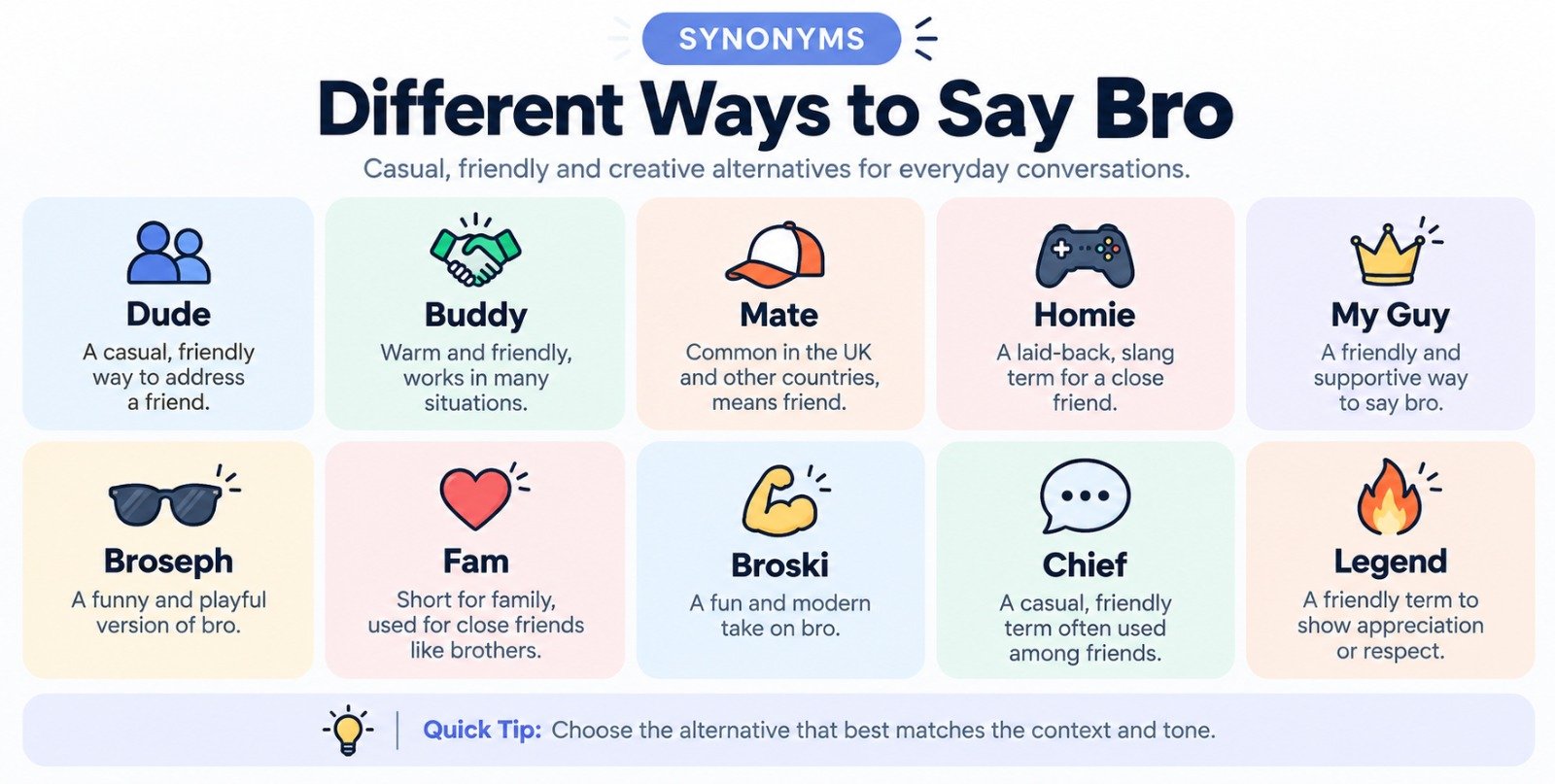
“Bro” is one of the most common casual ways to address a male friend, brother, or someone you feel close to. But using the same word all the time can get repetitive. Depending on your relationship and the mood of the conversation, you might prefer dude, buddy, mate, homie, my guy, bruh, broski, or something more playful.
This guide covers different ways to say bro, including natural alternatives, slang, texting expressions, and funny ways to say bro. The key is choosing a phrase that matches the relationship and situation rather than treating every alternative as an exact synonym.
What Does “Bro” Mean?
“Bro” is an informal shortening of brother. In everyday conversation, however, it does not necessarily refer to a biological sibling. People commonly use it for a close male friend or as a casual form of address.
For example:
“Bro, are you coming with us tonight?”
Here, “bro” simply signals familiarity and friendliness.
The word can also communicate different emotions depending on how it is said:
- Friendly: “Thanks, bro!”
- Excited: “Bro, you actually did it!”
- Surprised: “Bro, what just happened?”
- Annoyed: “Bro, seriously?”
- Supportive: “I’ve got you, bro.”
Because its meaning depends heavily on context, the best replacement also changes with the situation.
Different Ways to Say Bro
Here are some of the most useful alternatives and the situations where they sound natural.
Dude
Dude is one of the easiest replacements for “bro.” It is casual, familiar, and widely understood.
Example:
“Dude, that movie was incredible.”
It works particularly well between friends but is usually too informal for professional communication.
Buddy
Buddy sounds friendly and approachable. Unlike “bro,” it can be used for people you know casually as well as close friends.
Example:
“Hey buddy, how have you been?”
It can also sound slightly playful depending on the context.
Mate
Mate is especially common in British, Australian, and some other varieties of English. It means a friend or companion rather than specifically a brother.
Example:
“Thanks for helping me out, mate.”
It is a natural choice when you want a relaxed, friendly expression.
Man
Man can work almost exactly like “bro” in casual speech.
Example:
“Man, you have to see this!”
However, “man” can also be an expression of surprise or frustration rather than a name for a friend, so context matters.
Pal
Pal means friend or companion and has a friendly, casual feel.
Example:
“Good to see you, pal.”
It can sound warmer or more old-fashioned than “bro,” depending on the speaker.
Homie
Homie is informal slang for a close friend. It generally suggests familiarity and a strong friendship.
Example:
“What’s up, homie?”
Because it is slang, it is best suited to casual conversations, texts, and social settings.
My Guy
My guy is a relaxed and increasingly common way to address a friend.
Example:
“What’s going on, my guy?”
It can sound friendly, humorous, or supportive depending on the situation.
My Man
My man is another warm, informal expression for a male friend or acquaintance.
Example:
“Good looking out, my man.”
It is especially natural when thanking or congratulating someone.
Brother
If you want something warmer than “bro,” simply use brother.
Example:
“You can always count on me, brother.”
It can refer to a biological sibling or communicate a close friendship.
Fam
Fam is slang derived from “family.” It is often used for close friends who feel like family.
Example:
“What’s good, fam?”
Unlike “bro,” it isn’t specifically male, so it can work for a group or friends of different genders.
Bruh
Bruh is a highly informal variation of “bro.” It is especially common in online communication, memes, gaming, and texting.
Example:
“Bruh, you forgot your keys again?”
It often carries an emotional reaction such as disbelief, amusement, or mild frustration.
Bruv
Bruv is a British slang form associated with “brother.” It is strongly informal.
Example:
“You alright, bruv?”
It can give your message a distinctly British flavor.
Dawg
Dawg is slang for a close male friend.
Example:
“What’s up, dawg?”
It is very casual and should generally be reserved for informal conversations.
King
King is more of a complimentary nickname than a direct synonym for “bro.”
Example:
“You handled that perfectly, king.”
Use it when you want to encourage, praise, or hype up a friend.
Legend
Calling someone a legend is a way of praising them rather than simply replacing “bro.”
Example:
“Thanks for picking me up, legend!”
It works particularly well after someone does you a favor.
Quick Comparison: Which Alternative Fits Best?
| Alternative | Tone | Best Used For | Example |
|---|---|---|---|
| Dude | Casual | Friends and acquaintances | “Dude, check this out.” |
| Buddy | Friendly | Friends and casual acquaintances | “Hey buddy!” |
| Mate | Casual | Friends, especially British/Australian English | “Cheers, mate.” |
| Man | Relaxed | Everyday casual speech | “Man, that was close.” |
| Pal | Friendly | Casual conversations | “Nice one, pal.” |
| Homie | Slang | Close friends | “What’s up, homie?” |
| My guy | Casual | Friends and texting | “My guy, you nailed it.” |
| My man | Friendly | Friends and casual praise | “Thanks, my man.” |
| Brother | Warm | Close friends or siblings | “Thanks, brother.” |
| Fam | Slang | Close friends/groups | “What’s good, fam?” |
| Bruh | Slang | Texting, memes, reactions | “Bruh, seriously?” |
| Bruv | British slang | Informal British-style speech | “You good, bruv?” |
| King | Playful | Praise and encouragement | “You got this, king.” |
| Legend | Complimentary | Thanking or praising a friend | “You’re a legend!” |
Funny Ways to Say Bro
Sometimes you don’t want a normal synonym. You want something ridiculous enough to make your friend laugh. That’s where playful variations of “bro” come in.
Broski
Broski is a playful version of “bro.” It is casual and intentionally humorous.
Example:
“What’s the plan, broski?”
Broseph
Broseph humorously combines “bro” with the name “Joseph.”
Example:
“Listen up, Broseph. We need a better plan.”
Brochacho
Brochacho is a playful invention modeled after words such as “muchacho.”
Example:
“Good work, brochacho!”
Brotato
Brotato is a silly nickname built around “bro” and “potato.”
Example:
“What’s cooking, brotato?”
Brotato Chip
Taking “brotato” one step further, brotato chip is an intentionally goofy way to address a friend.
Example:
“Come on, brotato chip, we’re going to be late.”
Brofessor
Brofessor is perfect for jokingly treating your friend like an expert on everything.
Example:
“Alright, Brofessor, explain how this works.”
Broseidon
Broseidon is a humorous, grand-sounding nickname inspired by Poseidon.
Example:
“Make way for Broseidon!”
Brozilla
Brozilla turns your friend into a giant, chaotic version of “bro.”
Example:
“Brozilla has entered the group chat.”
Broham
Broham is another playful variation that works well among close friends.
Example:
“What’s happening, broham?”
The Brofather
The Brofather is a humorous choice for a friend who acts like the leader of the group.
Example:
“The Brofather has spoken.”
Cool Ways to Say Bro
If you’re looking for something that sounds natural without being overly silly, try:
- My guy
- My man
- Homie
- Fam
- Dawg
- King
- Chief
- Boss
- Ace
- Legend
- Mate
- Dude
- Brother
- Bruh
For example:
“What’s up, bro?”
could become:
“What’s up, my guy?”
or:
“What’s good, homie?”
The best choice depends on your normal speaking style. “King” and “legend,” for instance, sound more complimentary than “dude.”
Ways to Say Bro in a Text Message
Texting gives you more freedom to use slang and playful spellings. Some natural options include:
- Bro
- Bruh
- Broski
- Broseph
- My guy
- My man
- Homie
- Fam
- Bruv
- Dawg
- G
- King
- Chief
- Boss
Examples
Instead of:
“Hey bro, are you free tonight?”
Try:
“Yo, my guy, you free tonight?”
Instead of:
“Thanks, bro!”
Try:
“Appreciate you, my man!”
Instead of:
“Bro, what are you doing?”
Try:
“Bruh, what are you doing?”
Texting is one of the best places to use playful options such as “broski” or “broseph” because the informal setting makes them feel natural.
Different Ways to Say “Hey Bro”
Want to change up your usual greeting? Try one of these:
- Hey, dude!
- Yo, my guy!
- What’s up, homie?
- Hey, buddy!
- What’s good, fam?
- Yo, broski!
- What’s up, my man?
- Hey, legend!
- Yo, king!
- What’s happening, chief?
- How’s it going, mate?
- Yo, broseph!
The more playful versions are best saved for friends who already understand your sense of humor.
Ways to Say Bro to a Close Friend
When you’re talking to someone you’re genuinely close to, you can use warmer expressions:
My Brother
“My brother” emphasizes closeness and loyalty.
Example:
“Don’t worry, my brother. I’ve got your back.”
Homie
“Homie” suggests a close friendship and works especially well in relaxed conversations.
Example:
“That’s my homie right there.”
My Guy
“My guy” feels casual and modern without being as strongly slang-based as some alternatives.
Example:
“My guy came through when I needed him.”
My Man
“My man” works especially well when showing appreciation.
Example:
“Thanks for having my back, my man.”
Brother From Another Mother
This humorous expression describes a close friend who feels like a brother despite not being biologically related.
Example:
“He’s my brother from another mother.”
It is more of a playful description than a direct replacement for “bro.”
Ways to Say Bro When You Want to Be Funny
Not every funny nickname needs to contain “bro.” You can use a playful title based on your friend’s personality:
- Chief
- Boss
- Captain
- Legend
- Champ
- King
- Professor
- Big man
- The man
- Commander
- Your Majesty
- Mr. Reliable
- The GOAT
- Sir Bro
- Captain Chaos
For example:
“Morning, Captain Chaos. Ready to cause trouble?”
This approach can be funnier than simply replacing “bro” with another slang word.
Are All These Words Interchangeable With “Bro”?
No. This is an important distinction.
Brother can indicate a family relationship, while bro often refers to friendship. Mate is particularly associated with certain varieties of English. Homie implies a close friendship, whereas buddy can be used with someone you aren’t particularly close to.
Likewise, king, legend, and champ are usually complimentary nicknames rather than literal synonyms.
Consider the difference:
- “Thanks, bro.” → Friendly and casual.
- “Thanks, mate.” → Casual, with a British/Australian feel.
- “Thanks, homie.” → Strongly informal and familiar.
- “Thanks, legend.” → Praise is emphasized.
- “Thanks, brother.” → Warmer and more heartfelt.
- “Thanks, sir.” → More formal or intentionally playful.
Choosing the right word is therefore more about tone and relationship than finding a perfect dictionary synonym.
How to Choose the Best Alternative
Use the relationship and situation as your guide.
For a normal friend:
Choose dude, buddy, mate, my guy, or my man.
For a very close friend:
Try homie, brother, fam, or my brother.
For texting:
Bruh, broski, my guy, fam, and broseph work well.
For a joke:
Use brofessor, brotato, brochacho, Broseidon, or the Brofather.
For praise:
Try king, legend, champ, or boss.
For British-style casual speech:
Mate and bruv are natural choices.
The safest option is always to match the way your friends already speak. A phrase that sounds hilarious among close friends may sound strange or forced with someone you barely know.
Frequently Asked Questions
What is another word for “bro”?
Common alternatives include brother, dude, buddy, mate, man, pal, homie, my guy, my man, fam, and bruh. The best option depends on how close you are to the person and the tone you want.
What are some funny ways to say bro?
Funny options include broski, broseph, brochacho, brotato, brotato chip, brofessor, Broseidon, Brozilla, broham, and the Brofather.
What is a cool way to say bro?
For a cool and casual feel, try my guy, homie, my man, fam, dawg, king, mate, or bruh. “My guy” and “homie” are particularly natural in casual conversations.
Can I use “dude” instead of “bro”?
Yes. “Dude” is a common casual alternative, especially between friends. However, it doesn’t specifically communicate brotherhood or closeness in the same way that “bro” sometimes does.
Is “bruh” the same as “bro”?
Not exactly. “Bruh” is a slang variation of “bro,” but it is particularly common as a reaction to something surprising, funny, frustrating, or ridiculous. For example, “Bruh, seriously?” expresses a reaction as much as it addresses someone.
What is a British way to say bro?
Bruv is a British slang term related to “brother.” Mate is another very common British informal term for a friend, although it isn’t specifically a synonym for “bro.”
What can I say instead of “hey bro”?
You can say “Hey dude,” “Yo, my guy,” “What’s up, homie,” “Hey buddy,” “What’s good, fam,” “Yo, broski,” or “Hey, my man.” For a humorous greeting, try “Yo, Brofessor!”
Is “bro” appropriate in professional communication?
Usually not. “Bro” is strongly informal and is better suited to friends, family, casual conversations, and informal online communication. In a workplace setting, using the person’s name or a neutral greeting is generally more appropriate.
Conclusion
There are plenty of different ways to say bro, but the best choice depends on what you want your message to communicate. Dude, buddy, mate, my guy, and my man are easy everyday alternatives, while homie, fam, bruh, and bruv add more slang. When the goal is humor, expressions such as broski, broseph, brochacho, brotato, and brofessor can make an ordinary greeting much more playful.
The trick is not to choose the fanciest alternative but the one that fits your relationship, audience, and mood. For everyday language questions like these, Grammarifyr helps you understand those small differences so you can choose words that sound natural rather than forced.
You may also Read : Other Ways to Say Good Luck: 40+ Natural Phrases for Every Situation