Was or Were? Simple Rules, Examples and Common Mistakes
Choosing between was and were can seem simple until sentences such as “I wish I were there,” “If I was wrong,” or “Everyone was ready” appear. Both forms are correct English, but they do different grammatical jobs. The usual choice depends on the subject: was goes with I, he, she, and it, while were normally goes with you, we, and they. There is also an important exception: were is traditionally used in hypothetical, wished-for, or contrary-to-fact situations, even with I or he. Understanding that distinction makes these forms much easier to choose.
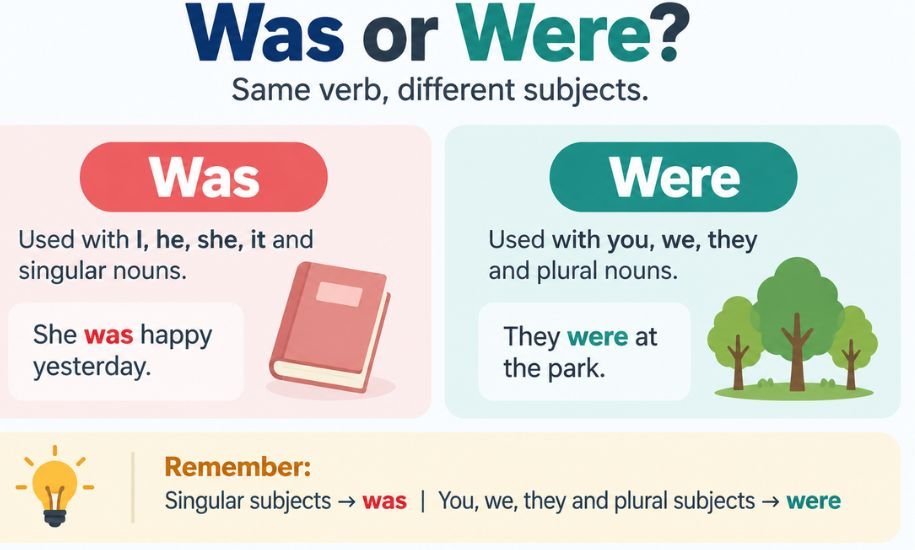
Was is normally used with I, he, she, and it, while were is normally used with you, we, and they. However, were is also traditionally used for hypothetical or unreal situations, as in “If I were you” and “I wish I were there.”
Was vs. Were: The Basic Difference
Both was and were are past-tense forms of the verb be. The main difference is grammatical agreement.
| Subject | Normal past form | Example |
|---|---|---|
| I | was | I was tired. |
| He | was | He was late. |
| She | was | She was happy. |
| It | was | It was cold. |
| You | were | You were right. |
| We | were | We were ready. |
| They | were | They were busy. |
So, in ordinary statements, the rule is easy:
Singular first- and third-person subjects → was
You and plural subjects → were
However, were has another important use. In the subjunctive mood, it can describe an imagined, unlikely, wished-for, or contrary-to-fact situation.
If I were taller, I would play basketball.
I wish she were here.
Here, were does not follow ordinary subject agreement. It signals that the situation is hypothetical or unreal.
When to Use Was
Use was for ordinary past situations with I, he, she, it, and singular nouns.
With “I”
I was at home last night.
I was nervous before the interview.
With “he” or “she”
She was busy yesterday.
He was the first person to arrive.
With “it”
It was a beautiful morning.
It was difficult to find the address.
With singular nouns
The restaurant was crowded.
My phone was on the table.
In each example, the sentence describes a past situation rather than an imagined one.
When to Use Were
Use were with you, we, they, and plural nouns in ordinary past-tense sentences.
You were very helpful.
We were ready to leave.
They were at school.
The children were asleep.
My friends were waiting outside.
There is one important additional use: were can appear with a singular subject when the sentence expresses a hypothetical or contrary-to-fact idea.
If I were you, I would wait.
I wish he were here.
She talks as if she were the owner.
This is why simply memorizing “I = was” is not enough. It works for ordinary past statements, but not for every grammatical construction.
Everyone Was or Were?
The correct standard form is:
Everyone was ready.
Not:
Everyone were ready.
The reason is that everyone is grammatically singular, even though it refers to every person in a group.
Compare:
Everyone was invited.
Everyone was excited.
Everyone was waiting for the announcement.
The same rule applies to someone, somebody, anyone, anybody, no one, and nobody.
Someone was knocking at the door.
Everybody was surprised.
Nobody was available.
The meaning may involve many people, but the indefinite pronoun takes a singular verb.
Everybody Was or Were?
Everybody was is the standard choice.
Everybody was happy with the result.
Everybody was talking at once.
Everybody was given a ticket.
A common mistake is to choose were because everybody means “all people.” Grammatically, however, everybody behaves as a singular pronoun.
A useful comparison is:
Everybody was ready.
but:
They were ready.
The first sentence uses the singular pronoun everybody; the second uses the plural pronoun they.
I Wish I Was or Were?
This is one of the trickiest cases because both forms can be heard in modern English.
For formal or traditional grammar, I wish I were is preferred when the wish describes a situation that is contrary to reality.
I wish I were taller.
I wish I were on vacation.
I wish I were more confident.
The same principle applies to I wish I were there.
I wish I were there with you.
The speaker is normally saying that they are not there and would like the situation to be different.
You will also encounter:
I wish I was there.
This form is common in informal conversation and modern usage. It is not useful to tell learners that every occurrence of I wish I was is meaningless or impossible. Instead, the practical distinction is:
- I wish I were there — traditional/formal choice for an unreal wish.
- I wish I was there — common informal usage.
For formal writing, were is the safer choice when expressing a contrary-to-fact wish.
Data Was or Were?
The choice between data was and data were depends partly on the style and context.
Traditionally, data is treated as a plural noun, so formal scientific or academic writing often uses were:
The data were collected over six months.
The data were analyzed by the research team.
However, modern English frequently treats data as a mass noun, particularly in general, business, and everyday contexts:
The data was stored securely.
The data was useful for making the decision.
Therefore, data were is a strong choice when following a traditional academic style, while data was can be acceptable when data is being treated as an uncountable mass noun.
The important point is consistency. If a particular publication, university, or style guide specifies how data should be treated, follow that standard throughout the document.
I Wish There Was or Were?
Both forms occur, but the traditional formal construction is:
I wish there were more opportunities.
The sentence describes a desired situation that does not currently exist.
More examples:
I wish there were more hours in the day.
I wish there were another way to solve this problem.
I wish there were fewer restrictions.
In everyday English, you will also hear:
I wish there was more time.
This is widespread, especially in conversation. For formal writing, were is generally the better choice when the construction clearly expresses an unreal or wished-for situation.
Notice that the choice is not simply determined by whether the noun after there is singular or plural. The wish construction creates the hypothetical meaning.
Weather Was or Were?
The correct standard form is:
The weather was beautiful.
Not:
The weather were beautiful.
Weather is normally an uncountable singular noun, so it takes was in the past tense.
Examples:
The weather was terrible yesterday.
The weather was warmer than expected.
The weather was perfect for a picnic.
Do not confuse weather with whether. Weather refers to atmospheric conditions, while whether introduces alternatives or uncertainty.
The weather was cold.
I don’t know whether he will come.
As If It Was or Were?
Both was and were can occur after as if, but the meaning matters.
Use were in a traditional formal construction when the situation is presented as hypothetical or contrary to fact:
He acts as if he were the manager.
She speaks as if she were an expert.
He looked at me as if I were a stranger.
Here, the speaker is presenting the comparison as unreal or contrary to the known situation.
Was can be appropriate when the sentence refers to a possible or apparently real past situation:
She looked as if she was going to cry.
In everyday English, as if … was is also very common. The important lesson is not to assume that as if automatically requires were in every sentence.
Real Past vs. Hypothetical: The Rule That Solves Most Problems
When you’re unsure, ask yourself whether you’re talking about something that actually happened or something imagined, wished for, or contrary to fact.
Real past situation
I was at the meeting yesterday.
The speaker really was at the meeting.
If I was rude yesterday, I apologize.
The speaker is considering the possibility that they were rude.
Hypothetical situation
If I were the manager, I would change the schedule.
The speaker is not the manager.
I wish I were more organized.
The speaker is not as organized as they would like to be.
This distinction explains why both of these can be correct:
If I was wrong, I’m sorry.
If I were wrong, I would admit it.
The first can refer to a real possibility concerning the past. The second presents a hypothetical condition.
There Was or There Were?
Another useful rule involves sentences beginning with there.
Use there was with a singular noun:
There was a problem with the computer.
There was an interesting article on the website.
Use there were with a plural noun:
There were several problems with the computer.
There were three people outside.
The verb agrees with the noun that follows the construction.
Singular:
There was a mistake.
Plural:
There were several mistakes.
This is separate from the special subjunctive use in sentences such as:
I wish there were more choices.
Common Mistakes to Avoid
1. Using “were” with everyone
Incorrect:
Everyone were excited.
Correct:
Everyone was excited.
2. Assuming “I” always takes “was”
For ordinary past statements:
I was tired.
But for an unreal or hypothetical situation:
If I were you, I would apologize.
3. Treating everybody as plural
Incorrect:
Everybody were ready.
Correct:
Everybody was ready.
4. Automatically using “were” after “as if”
Not every sentence with as if requires were.
She looked as if she was going to cry.
can be perfectly natural.
When the comparison is clearly hypothetical or contrary to fact, were is the traditional formal choice:
He behaves as if he were the owner.
5. Assuming “data” always requires one form
Traditional academic usage often treats data as plural:
The data were analyzed.
Modern usage may treat it as a mass noun:
The data was analyzed.
Follow the style required by your context.
An Easy Way to Remember Was and Were
For ordinary past tense, remember:
I / he / she / it → was
you / we / they → were
Then remember the special “imaginary were” rule:
If the situation is hypothetical, wished-for, or contrary to fact, were can be used even with I, he, she, or it.
For example:
I was there. → real past
I wish I were there. → unreal wish
She was the manager. → real past
If she were the manager, things would be different. → hypothetical
This two-step approach is more useful than trying to memorize dozens of individual expressions.
Examples at a Glance
| Sentence | Correct form | Reason |
|---|---|---|
| I ___ tired yesterday. | was | Ordinary past |
| They ___ late. | were | Plural subject |
| Everyone ___ ready. | was | Everyone is singular |
| Everybody ___ invited. | was | Everybody is singular |
| The weather ___ awful. | was | Weather is singular/uncountable |
| I wish I ___ there. | were | Formal unreal wish |
| If I ___ you, I’d wait. | were | Hypothetical |
| She ___ at home. | was | Ordinary past |
| We ___ exhausted. | were | Plural subject |
| The data ___ collected carefully. | were | Traditional plural treatment |
| I wish there ___ more time. | were | Formal hypothetical/wish |
| He acts as if he ___ the boss. | were | Unreal comparison |
Frequently Asked Questions
Is “was or were” determined by singular and plural subjects?
Usually, yes. Was is used with I, he, she, and it in ordinary past-tense statements, while were is used with you, we, and they and plural nouns. The subjunctive is the important exception, because were can accompany a singular subject in hypothetical situations.
Is “everyone was” or “everyone were” correct?
Everyone was is correct in standard English. Although everyone refers to all the people in a group, it is grammatically singular and therefore takes a singular verb.
Should I say “I wish I was” or “I wish I were”?
For formal or traditional English, I wish I were is preferred when the wish describes an unreal or contrary-to-fact situation. I wish I was is also common in informal modern English.
Is “I wish there was” or “I wish there were” correct?
Both forms are used, but I wish there were is the traditional formal choice for a wished-for or unreal situation. In everyday conversation, I wish there was is common and widely understood.
Is “data was” grammatically correct?
It can be, depending on the style and how data is being treated. Traditional academic usage often treats data as plural and uses data were. Modern English also commonly treats data as a mass noun and uses data was, particularly in less formal contexts.
Which is correct: “as if it was” or “as if it were”?
Both can be correct depending on meaning. Were is traditionally preferred when the situation is hypothetical or contrary to fact. Was is natural when referring to a possible or apparently real past situation and is also common in conversational English.
Final Verdict: Was or Were?
The simplest rule is was for I/he/she/it and singular nouns, and were for you/we/they and plural nouns in ordinary past-tense sentences. The major exception is the subjunctive: use were in formal hypothetical or contrary-to-fact expressions such as If I were you and I wish I were there. Once you distinguish real past events from imagined situations, choosing the right form becomes much easier. For more clear, practical explanations of confusing English forms, Grammarifyr follows the same goal: Know the Difference. Use the Right Words.
You may also Read : Eaten or Ate: Difference, Rules, and Examples
One Comment