Principle or Principal: Meaning and Correct Usage
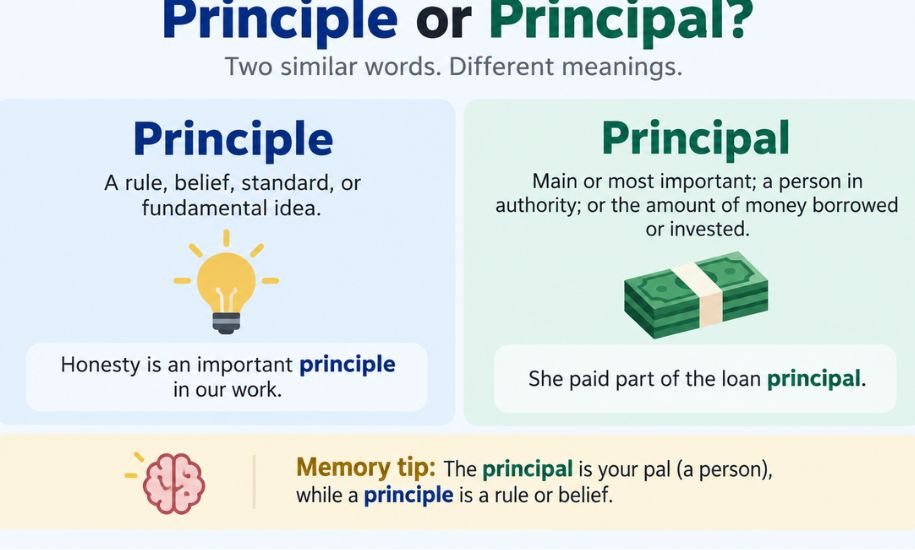
Principle and principal are easy to confuse because they sound alike, but they have different meanings. One usually refers to a rule, belief, or fundamental idea, while the other can mean something that is most important, a person in authority, or the amount of money involved in a loan or investment. Knowing the difference becomes especially useful in phrases such as agreement in principle, loan principal, and principal of a company. The good news is that a few simple rules can make the distinction much easier to remember.
Principle means a rule, belief, standard, or fundamental idea. Principal means the main or most important thing, a person in authority, or the original amount of money borrowed or invested. So you write loan principal, but agreement in principle.
Principle or Principal: Which One Should You Use?
Both principle and principal are legitimate English words. The correct choice depends entirely on what you mean.
| Word | Main meaning | Example |
|---|---|---|
| Principle | Rule, belief, standard, or fundamental idea | Honesty is an important principle. |
| Principal | Main or most important | The principal reason was cost. |
| Principal | Money borrowed or invested | She paid part of the loan principal. |
| Principal | Person in authority | The school principal welcomed the students. |
A quick way to think about them is:
Principle = a rule or belief
Principal = main, person, or money
What Does “Principle” Mean?
Principle is a noun. It generally refers to a fundamental rule, belief, standard, or idea that guides behavior or explains how something works.
For example:
- “Fairness is an important principle of the organization.”
- “The machine works according to a simple scientific principle.”
- “She refused to compromise her principles.”
- “The decision was based on the principle of equal treatment.”
The word can be used in moral, ethical, scientific, political, legal, and general contexts.
Principle in “in principle”
One particularly important expression is in principle.
It means agreeing with something generally or theoretically, even though practical details may still need to be resolved.
For example:
“The two sides agreed in principle to the proposed deal.”
This does not necessarily mean every detail has been finalized. It indicates agreement with the basic idea or proposal.
What Does “Principal” Mean?
Principal has several distinct meanings.
1. Main or most important
As an adjective, principal means the main, primary, or most important.
Examples:
- “The principal cause of the problem was poor planning.”
- “Her principal concern was safety.”
- “The company’s principal objective is to improve customer service.”
Here, replacing principal with main usually works.
2. A person in authority
As a noun, principal can refer to a person who holds an important position of authority.
The familiar example is a school principal:
“The principal announced the new school policy.”
In business and legal contexts, a principal can also refer to a person who owns, controls, or has authority within an organization, depending on the context.
3. Money borrowed or invested
In financial contexts, principal refers to the capital amount of a loan or investment, rather than the interest or other additional charges.
For example:
“The borrower made a large payment toward the principal.”
This is why loan principal is correct.
Loan Principle or Principal: Which Is Correct?
When you are talking about money borrowed from a lender, the correct word is principal.
Correct
- loan principal
- principal balance
- principal amount
- principal payment
- principal and interest
- outstanding principal
Incorrect in standard financial usage
- loan principle
- principle balance
- principle payment
For example:
“My monthly payment covers both interest and principal.”
Here, principal refers to the capital amount owed. Interest is the additional amount charged for borrowing the money.
So if you’re wondering, “Is it principle or principal on a loan?”, the answer is principal.
Agreement in Principle or Principal?
The correct expression is:
Agreement in principle
Not:
Agreement in principal
The word principle is correct because the expression refers to agreement with the basic idea or terms of something.
For example:
“The companies reached an agreement in principle.”
An agreement in principle generally means that the parties have accepted the general basis of a proposal, while some details may still need to be negotiated or formally documented.
The same distinction appears in mortgage terminology. A mortgage Agreement in Principle indicates that a lender may be prepared to lend a particular amount based on the information available at that stage. It is not necessarily the same as a final mortgage offer.
Agree in Principle and Agreed in Principle
Both of these expressions use principle, not principal.
Agree in principle
Use this when describing the act of generally accepting an idea or proposal.
“I agree in principle, but I want to discuss the conditions.”
Agreed in principle
Use this when saying that general agreement has already been reached.
“The parties have agreed in principle to the new terms.”
So the correct forms are:
- agree in principle
- agreed in principle
- agreement in principle
Not:
- agree in principal
- agreed in principal
- agreement in principal
The reason is that in principle is an established phrase meaning generally or theoretically.
Settlement in Principle or Principal?
When the intended meaning is a preliminary or general agreement about a settlement, settlement in principle is the appropriate spelling.
For example:
“The two parties reached a settlement in principle.”
The word principle is used because the phrase follows the same pattern as agreement in principle and agreed in principle.
However, the exact legal effect of a settlement described as “in principle” can depend on the circumstances and jurisdiction. A general understanding is not necessarily the same thing as a finalized and legally binding settlement.
Principle or Principal of a Company?
This phrase requires attention because both words can be correct, but they communicate completely different meanings.
Principal of a company
Use principal when referring to a person who has a significant position of authority or ownership.
“She is a principal of the company.”
In this context, principal is a noun referring to a person.
Principle of a company
Use principle when referring to a rule, value, or guiding belief.
“Transparency is a core principle of the company.”
The difference is therefore:
Principal of a company = an important person associated with or responsible for the company.
Principle of a company = a rule, value, or belief followed by the company.
This is a particularly useful distinction because changing one letter changes the meaning completely.
Money: Principle or Principal?
When referring to a sum of money, use principal.
For example:
“The investor wanted to protect the principal.”
“The borrower reduced the principal by making an extra payment.”
“Interest was calculated on the outstanding principal.”
Principle does not mean a sum of money.
So:
❌ “The loan principle is $10,000.”
✅ “The loan principal is $10,000.”
The same applies to investments. If you are talking about the original capital invested, principal is the appropriate term.
Why Are These Words So Often Confused?
The biggest reason is pronunciation: principle and principal are pronounced alike in standard English varieties where these words are homophones.
Their spellings are also very similar:
- principle
- principal
The difference is easy to overlook when writing quickly, particularly in financial phrases where principal has a specialized meaning.
There is also a useful grammatical clue. Principal can be an adjective meaning “main”:
“the principal issue”
Principle does not work this way.
You cannot say:
❌ “the principle issue” when you mean “the main issue.”
You should write:
✅ “the principal issue.”
Examples: Correct vs. Incorrect
Seeing the two words in context makes the distinction clearer.
Rules and beliefs
Correct: “Respect is one of our guiding principles.”
Incorrect: “Respect is one of our guiding principals.”
Main or primary
Correct: “The principal reason for the delay was bad weather.”
Incorrect: “The principle reason for the delay was bad weather.”
Loan money
Correct: “She made an extra payment toward the loan principal.”
Incorrect: “She made an extra payment toward the loan principle.”
General agreement
Correct: “The two sides agreed in principle.”
Incorrect: “The two sides agreed in principal.”
Company values
Correct: “Integrity is a fundamental principle of the company.”
Company leader
Correct: “One of the company’s principals attended the meeting.”
These examples show why context matters more than pronunciation.
An Easy Way to Remember the Difference
A popular memory trick is:
The principal is your pal.
A school principal is a person, so this association helps you remember the spelling with -pal.
You can then reserve principle for rules, beliefs, and ideas.
Another useful test is to ask what the word means:
- Can you replace it with rule, belief, or standard? → principle
- Can you replace it with main or primary? → principal
- Does it refer to borrowed or invested money? → principal
- Does it refer to a person in authority? → principal
For phrases containing in principle, simply remember that the established expression always uses principle.
Common Mistakes to Avoid
1. Writing “loan principle”
This is one of the most frequent errors in financial writing.
Use loan principal when referring to the capital owed.
2. Writing “in principal”
When you mean generally or theoretically, write in principle.
Correct:
“We agree in principle.”
3. Confusing “principal” with “principle” before a noun
When you mean “main,” use principal:
“The principal objective”
not:
“The principle objective”
4. Assuming “principal” always means a person
A principal can be a person, but it can also mean the main thing or the capital amount of a loan or investment.
5. Assuming “principle” is always related to morality
Principles can be moral or ethical, but they can also be scientific, mathematical, organizational, legal, or general rules.
Quick Guide to Choosing the Right Word
When you’re unsure, use this checklist:
Use principle when you mean:
- rule
- belief
- value
- standard
- fundamental idea
- basic truth
- general agreement in the phrase “in principle”
Use principal when you mean:
- main
- primary
- most important
- school leader
- person with authority
- loan capital
- investment capital
A few common expressions can therefore be memorized directly:
| Expression | Correct |
|---|---|
| loan ___ | principal |
| ___ balance | principal |
| ___ and interest | principal |
| agreement in ___ | principle |
| agree in ___ | principle |
| agreed in ___ | principle |
| settlement in ___ | principle |
| ___ reason | principal |
| school ___ | principal |
| guiding ___ | principle |
| core ___ of a company | principle |
| ___ of a company | principal when referring to a person |
FAQs
Is it principle or principal?
Both are correct words, but they have different meanings. Principle means a rule, belief, standard, or fundamental idea. Principal can mean main or most important, a person in authority, or the capital amount of a loan or investment.
Is it loan principle or loan principal?
The correct expression is loan principal. In finance, principal refers to the amount of money borrowed or the outstanding capital balance. Principle means a rule or belief and is not the appropriate word for the money involved in a loan.
Is it agreement in principle or agreement in principal?
The correct phrase is agreement in principle. It means that the parties generally agree with the basic proposal or terms, although some details may still need to be settled.
Is it agree in principle or agree in principal?
Use agree in principle. The expression means to accept or support an idea generally, without necessarily agreeing to every detail. “Agree in principal” is incorrect when this meaning is intended.
Is it principal or principle on a loan?
Use principal. The principal is the capital amount borrowed or still owed, while interest is the additional cost charged for borrowing the money.
Is it principal or principle of a company?
Either can be correct depending on the meaning. Principal of a company can refer to an important person or owner, while a principle of a company is a rule, value, or guiding belief.
Final Verdict: Principle or Principal?
Choose principle for a rule, belief, standard, or fundamental idea, and choose principal for something main or primary, a person in authority, or money borrowed or invested. Remember “in principle,” “loan principal,” and “principal reason” as especially useful examples. For more clear explanations of easily confused English words, Grammarifyr helps you know the difference and use the right words.
You may also Read : Preventive or Preventative Care and Maintenance


One Comment