Hunny or Honey: Meaning, Nickname and Usage
If you are writing a sweet message to your husband, wife, partner, or someone you love, you may wonder whether “hunny” or “honey” is the right spelling. The confusion is understandable because both forms appear in casual messages, nicknames, and affectionate conversations. The key difference is that honey is the standard English spelling, while hunny is an informal alternative spelling used mainly as a playful or affectionate form of address. Knowing when each form fits can help you choose the right word without overthinking your message.
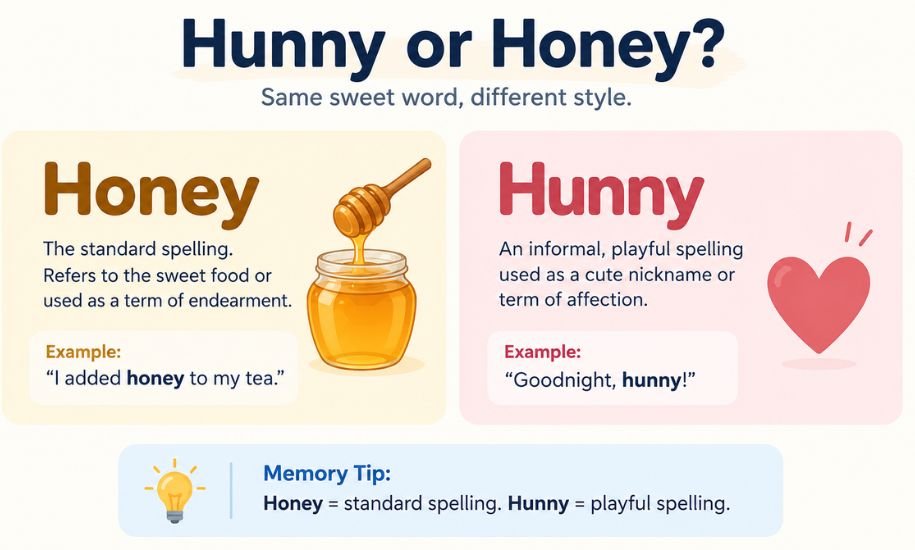
Honey is the standard spelling in English. Hunny is an informal, playful spelling that can be used as a term of endearment, especially in personal messages. For formal or standard writing, choose honey; for a deliberately cute or casual tone, hunny can be appropriate.
Hunny or Honey: What’s the Difference?
The simplest distinction is one of standard spelling versus informal usage.
| Feature | Honey | Hunny |
|---|---|---|
| Standard spelling | Yes | No, as the standard form |
| Informal affectionate use | Yes | Yes |
| Refers to bee-produced food | Yes | No |
| Can be a nickname | Yes | Yes |
| Suitable for formal writing | Generally, depending on context | Usually not |
| Typical tone | Standard, warm, affectionate | Casual, cute, playful |
Honey has a broader range of uses. It can refer to the sweet substance made by bees, or it can be used as an affectionate name for another person.
Hunny generally appears as an informal spelling of the affectionate use of honey. It does not replace the standard spelling when you are talking about the food.
For example:
- “I put honey in my tea.”
- “Thanks, honey.”
- “Goodnight, hunny.”
The first sentence requires the standard spelling. In the last sentence, hunny is a deliberately informal spelling.
What Does “Honey” Mean?
Honey is a noun with several established meanings.
Its most familiar literal meaning is the sweet substance produced by bees from flower nectar:
“The recipe calls for two tablespoons of honey.”
The word also functions as a term of endearment. Someone might call a romantic partner, family member, or another person they are close to honey.
Examples include:
- “Are you feeling better, honey?”
- “I saved you some dinner, honey.”
- “Thank you for helping me, honey.”
- “Good morning, honey.”
In these examples, honey is not referring to food. It expresses affection, familiarity, or warmth.
The standard spelling remains honey, regardless of whether you mean the food or the affectionate nickname.
Is “Hunny” a Real Word?
Hunny is an informal alternative spelling of honey when it is used as a term of endearment. It is therefore more accurate to describe it as a nonstandard or informal spelling rather than treating it as a completely unrelated English word.
You may encounter hunny in personal texts, social posts, messages, fictional dialogue, or playful nicknames.
For example:
- “I miss you, hunny.”
- “Sleep well, hunny.”
- “Call me when you get home, hunny.”
The spelling gives the message a more casual or cute feel.
However, if you are writing an article, essay, formal email, report, recipe, or other standard English text, honey is the better choice.
Hunny or Honey as a Nickname
Both spellings can function as affectionate nicknames, but they create slightly different impressions.
Honey is the conventional form:
“How was your day, honey?”
Hunny is more playful:
“How was your day, hunny?”
The meaning is essentially the same in these examples. The spelling changes the tone rather than creating a completely different definition.
Someone might deliberately choose hunny because it looks cute, informal, or personal. There is no grammatical requirement that an affectionate nickname must be spelled one way in private communication.
If you want the safest standard spelling, use honey. If you are intentionally adopting a playful texting style, hunny can work.
Hunny or Honey for Husband
If you are deciding how to address your husband, both forms can work in an informal, affectionate context.
For example:
- “Good morning, honey.”
- “I love you, honey.”
- “Can you pick up some milk, honey?”
- “Goodnight, hunny.”
- “Drive safely, hunny.”
- “Miss you, hunny.”
There is no special spelling reserved for husbands. Honey is the standard choice, while hunny gives the message a more playful appearance.
If you are writing something that will be seen in a formal setting, such as a card with a traditional tone or a piece of standard prose, honey is usually preferable.
For an ordinary text message between spouses, the choice is largely a matter of personal style.
Hunny or Honey for Wife
The same rule applies when addressing a wife.
You could write:
“Thank you, honey. I really appreciate it.”
Or, in a more playful message:
“Thank you, hunny. You’re the best.”
Both communicate affection. The difference lies mainly in the spelling and tone.
Honey sounds natural and conventional, while hunny can feel more deliberately cute or informal.
The word is not grammatically restricted by gender. A person can use honey or hunny for a wife, husband, boyfriend, girlfriend, or another loved one, depending on the relationship and context.
When Should You Use “Honey”?
Choose honey whenever you want the standard English spelling.
It is appropriate when:
- You mean the food produced by bees.
- You are writing formal or standard English.
- You are using the word as a conventional term of endearment.
- You want your spelling to be universally recognizable.
- You are writing for an audience that expects standard English.
Examples:
Correct: “Honey is often used as a natural sweetener.”
Correct: “Honey, could you help me with this?”
Correct: “I bought a jar of honey from the market.”
Notice that the word remains honey regardless of which meaning is intended.
When Can You Use “Hunny”?
Hunny is most suitable when you intentionally want an informal, affectionate, or playful tone.
For example:
“Goodnight, hunny ❤️”
“I’ll call you later, hunny.”
“Miss you so much, hunny.”
This spelling is particularly natural in casual personal communication. However, it should not normally be substituted for honey when discussing the food.
For example:
Standard: “Add one teaspoon of honey.”
Not standard: “Add one teaspoon of hunny.”
The second version may appear in playful writing, but it is not the normal spelling of the food.
Why Are Honey and Hunny Confused?
The confusion comes largely from their similar pronunciation and appearance.
When people hear honey, they may naturally spell the sound as hunny, particularly in informal communication. Once hunny is used intentionally as a cute nickname, the spelling can become part of a person’s personal texting style.
There is also a strong association between hunny and playful representations of honey, including the familiar spelling associated with Winnie-the-Pooh’s honey jars.
The important point is that seeing hunny does not necessarily mean the writer has made an accidental spelling mistake. Context matters. Someone writing hunny in a romantic text may be deliberately choosing an informal spelling.
Correct and Incorrect Examples
Here are some practical examples to make the distinction clearer.
When referring to the food
Correct: “Bees produce honey.”
Incorrect in standard English: “Bees produce hunny.”
When using a standard affectionate form
Correct: “Thanks for everything, honey.”
When deliberately using an informal spelling
Informal: “Thanks for everything, hunny.”
The second example is not the standard spelling, but it can be intentional and understandable in a personal message.
In formal writing
Better: “Honey is a common ingredient in this recipe.”
Avoid replacing honey with hunny simply to make standard writing sound casual.
An Easy Way to Remember the Difference
Use this simple rule:
Honey = the standard spelling.
Hunny = the playful spelling.
You can also remember it by thinking about the literal meaning. If you can eat it, spell it honey.
- honey in tea
- honey on toast
- a jar of honey
- honey in a recipe
When you are calling someone you love by a cute name, hunny may be used informally.
- “Good morning, honey.”
- “Good morning, hunny.”
When in doubt, choose honey. It is the standard form and works perfectly well as an affectionate nickname.
Common Mistakes to Avoid
1. Treating “hunny” as the standard spelling
The standard spelling is honey. Hunny is better understood as an informal alternative spelling used in affectionate contexts.
2. Using “hunny” for the food
When referring to the substance produced by bees, use honey.
“Honey tastes delicious in tea.”
3. Assuming “hunny” is always a spelling error
In a personal message, the writer may deliberately use hunny for a cute or playful effect. Context determines whether the spelling is intentional.
4. Thinking the nickname has to change for men or women
There is no separate spelling for a husband and wife. Honey and informal hunny can both be used for people of different genders.
5. Using the informal spelling in formal writing
In academic, professional, or other standard writing, stick with honey.
Frequently Asked Questions
Is “hunny” or “honey” correct?
Honey is the standard English spelling. Hunny is an informal alternative spelling used mainly when honey is a term of affection. Therefore, use honey in standard writing and hunny when you deliberately want a playful or casual style.
Is “hunny” acceptable as a nickname?
Yes. Hunny can be used informally as a nickname or term of endearment. It generally has the same affectionate sense as honey, but its unusual spelling gives it a more casual, cute, or playful tone.
Can I call my husband “honey”?
Absolutely. Honey is a common affectionate form of address and can be used for a husband, wife, partner, or another loved one. For example, “I’ll see you tonight, honey” is grammatically natural in an informal conversation.
Can I call my wife “hunny”?
Yes. Hunny can be used as a playful spelling of honey when addressing a wife. It is informal rather than the standard spelling, so it is best suited to personal communication rather than formal writing.
Does “hunny” have a different meaning from “honey”?
Usually, no, when both are being used as terms of endearment. The primary difference is spelling and tone. Honey also has the literal meaning of the sweet substance made by bees, whereas hunny is not the standard spelling for that meaning.
Should I use “honey” or “hunny” in formal writing?
Use honey. It is the standard English spelling. Hunny is informal and can be useful in a deliberately playful personal message, but it is not the appropriate choice for most formal or academic contexts.
Final Verdict: Hunny or Honey?
Honey is the correct standard spelling. It works both for the sweet substance produced by bees and as an affectionate term for someone you love. Hunny is an informal, playful spelling that can be perfectly understandable in personal messages and nicknames, but it should not replace honey in standard writing.
When you are unsure, remember: standard English uses “honey”; playful affection can use “hunny.” For more straightforward explanations of confusing English words and spelling choices, Grammarifyr helps you know the difference and use the right words.
You may also Read : Benefited or Benefitted: UK vs American English
One Comment