Eaten or Ate: Difference, Rules, and Examples
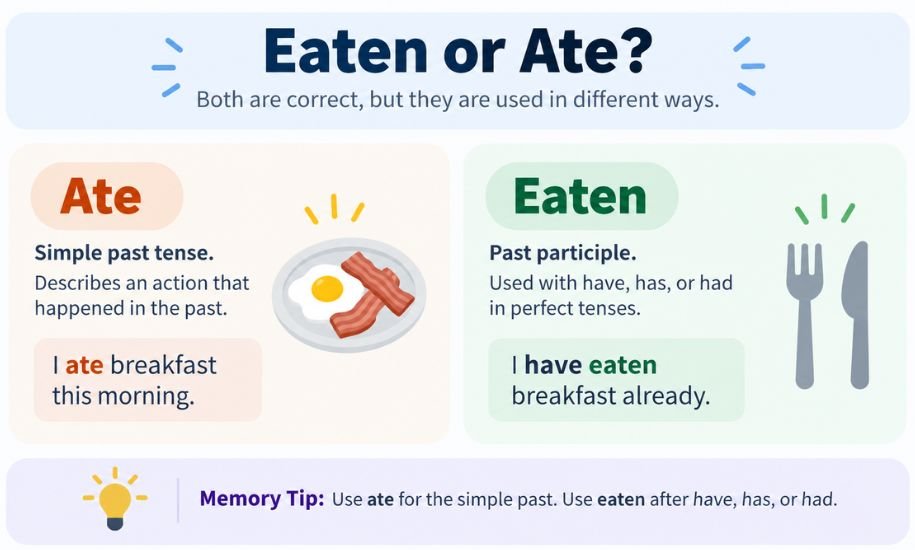
If you are unsure whether to say “I ate” or “I have eaten,” the answer depends on the grammatical structure and tense of the sentence. Both ate and eaten are correct forms of the irregular verb eat, but they cannot normally be used interchangeably. Ate is the simple past form, while eaten is the past participle. This small difference explains why we say “I ate breakfast” but “I have eaten breakfast.” Understanding which helping verbs go with eaten makes the choice much easier.
Ate is the simple past form of eat, while eaten is its past participle. Say “I ate lunch” for the simple past, but “I have eaten lunch” with have. Therefore, “Have you eaten?” and “I haven’t eaten” are correct, while “Have you ate?” and “I haven’t ate” are not standard English.
Ate vs. Eaten: The Key Difference
The easiest way to understand the difference is to look at the forms of eat:
| Form | Verb form | Example |
|---|---|---|
| eat | Base form | I eat breakfast at home. |
| ate | Simple past | I ate breakfast at 8 o’clock. |
| eaten | Past participle | I have eaten breakfast. |
The important point is that ate can stand as the main verb in a simple past sentence, whereas eaten generally needs an auxiliary or helping verb.
For example:
- I ate the sandwich. ✅
- I have eaten the sandwich. ✅
- She ate dinner early. ✅
- She has eaten dinner already. ✅
You would not normally say:
- I eaten the sandwich. ❌
The sentence needs a helping verb such as have, has, or had.
What Does “Ate” Mean?
Ate is the simple past tense of eat. It describes an eating action that happened in the past.
Examples:
- I ate breakfast before work.
- Daniel ate the last piece of cake.
- We ate at a small restaurant yesterday.
- She ate too quickly.
- They ate dinner at seven.
Because eat is irregular, its past tense is ate, not eated.
Ate with past-time expressions
Ate commonly appears with expressions that identify a completed past period:
- yesterday
- last night
- this morning, when the morning has finished
- two hours ago
- last weekend
- at 6 p.m.
For example:
I ate lunch two hours ago.
We ate dinner last night.
The important thing is the grammatical tense, not simply whether a sentence contains a time expression.
What Does “Eaten” Mean?
Eaten is the past participle of eat. Unlike ate, it is normally used with an auxiliary verb.
The most common combinations are:
- have eaten
- has eaten
- had eaten
- will have eaten
Examples:
I have eaten already.
She has eaten lunch.
They had eaten before we arrived.
By noon, he will have eaten breakfast.
The word eaten can also appear in passive constructions:
The entire cake was eaten before the party ended.
So, eaten is not a tense by itself. It is a verb form that participates in several grammatical structures.
When to Use Ate or Eaten
A practical rule is:
Use “ate” for the simple past. Use “eaten” after forms of “have” in perfect constructions.
Compare these sentences:
Simple past:
I ate an apple.
Present perfect:
I have eaten an apple.
Past perfect:
I had eaten an apple.
The difference becomes even clearer when the sentences describe related events:
I ate before the meeting.
This simply reports a past action.
I had eaten before the meeting started.
Here, had eaten shows that the eating happened before another past event.
I have eaten already.
This connects the past action with the present situation.
A useful pattern
Remember:
did + eat
but
have/has/had + eaten
For example:
- Did you eat?
- Have you eaten?
- Has she eaten?
- Had they eaten?
This pattern prevents many mistakes.
“Have You Eaten or Ate?” Which Is Correct?
The standard form is:
Have you eaten? ✅
Not:
Have you ate? ❌
Why? Because have is functioning as an auxiliary verb for the present perfect, and the present perfect uses the past participle.
The structure is:
have + past participle
Since the past participle of eat is eaten, we get:
Have you eaten?
The same rule applies when you add an object:
Have you eaten breakfast?
Have you eaten anything today?
Have you eaten dinner yet?
However, “Did you eat?” is also perfectly correct. It simply uses a different tense:
Did you eat breakfast?
Because did already marks the sentence as past tense, the main verb stays in its base form, eat, rather than becoming ate.
So:
- Have you eaten? ✅
- Did you eat? ✅
- Have you ate? ❌
- Did you ate? ❌
“I Haven’t Eaten or Ate?”
The correct expression is:
I haven’t eaten. ✅
Not:
I haven’t ate. ❌
Here, haven’t is short for have not. The structure is:
have not + past participle
Therefore:
I haven’t eaten yet.
Other examples include:
- I haven’t eaten breakfast.
- I haven’t eaten anything today.
- We haven’t eaten since noon.
- She hasn’t eaten yet.
- They haven’t eaten dinner.
The negative word not does not change the grammatical requirement. Because the sentence uses have/has, the following verb should be eaten, not ate.
“Have Eaten” vs. “Ate” in Real Sentences
Both forms can be correct, but the context determines which one you need.
Use “ate” for a completed past action
I ate pizza last night.
Maria ate breakfast at 7 a.m.
We ate at that restaurant on Saturday.
Use “have eaten” for the present perfect
I have eaten pizza before.
Maria has eaten breakfast already.
We have eaten at that restaurant several times.
Notice that the present perfect often emphasizes an experience, recent action, or connection to the present rather than simply placing an event at a finished time in the past.
Compare:
I ate there last Friday.
with:
I have eaten there several times.
The first identifies a particular past occasion. The second describes past experience without focusing on one finished occasion.
Common Mistakes With Eat, Ate, and Eaten
1. “Have you ate?”
Incorrect:
Have you ate lunch? ❌
Correct:
Have you eaten lunch? ✅
Have requires the past participle in this construction.
2. “I haven’t ate”
Incorrect:
I haven’t ate anything. ❌
Correct:
I haven’t eaten anything. ✅
3. “Did you ate?”
Incorrect:
Did you ate breakfast? ❌
Correct:
Did you eat breakfast? ✅
After did, use the base form eat.
4. “I eaten”
Incorrect:
I eaten already. ❌
Correct:
I ate already. ✅
I have eaten already. ✅
Eaten normally needs an appropriate auxiliary verb.
5. “Eated”
Incorrect:
I eated lunch. ❌
Correct:
I ate lunch. ✅
Eat is an irregular verb, so its simple past is ate, not eated.
A Simple Verb-Form Guide
If you know the basic forms of eat, choosing the correct one becomes much easier:
| Sentence pattern | Correct form | Example |
|---|---|---|
| Present | eat/eats | I eat lunch at noon. |
| Simple past | ate | I ate lunch earlier. |
| Present perfect | have/has eaten | I have eaten lunch. |
| Past perfect | had eaten | I had eaten before leaving. |
| Future perfect | will have eaten | I will have eaten by noon. |
| After “did” | eat | Did you eat? |
| Passive | was/were eaten | The cookies were eaten. |
One of the most useful patterns to memorize is:
I eat → I ate → I have eaten
That gives you the three principal forms you will use most often.
Easy Way to Remember the Difference
Think of ate as the complete simple-past form:
Yesterday, I ate.
Think of eaten as the form that needs grammatical support:
I have eaten.
A quick mental check can help:
Do you already have “have,” “has,” or “had”? → Use “eaten.”
Are you simply describing something that happened in the past? → “Ate” may be the right choice.
There is one important extra rule:
After “did,” use “eat,” not “ate” or “eaten.”
So the three patterns are:
- I ate.
- I have eaten.
- Did you eat?
FAQ
Is “eaten” a correct word?
Yes. Eaten is the past participle of eat. It is used in perfect constructions such as “I have eaten” and “she had eaten,” and it can also be used in passive constructions such as “The food was eaten.”
Is it “Have you eaten or ate”?
The standard form is “Have you eaten?” Because have is the auxiliary verb in the present perfect, it must be followed by the past participle eaten. If you want the simple past, say “Did you eat?”
Is “I haven’t eaten” or “I haven’t ate” correct?
“I haven’t eaten” is correct. Haven’t means have not, and the present perfect requires the past participle. Therefore, “I haven’t eaten breakfast” is standard English.
Can I say “I ate already”?
Yes. “I ate already” is grammatically possible, particularly in informal English. You can also say “I have already eaten,” which uses the present perfect. The preferred form can depend on context and regional speech patterns.
What is the difference between “I ate” and “I have eaten”?
“I ate” uses the simple past and presents eating as a completed past event. “I have eaten” uses the present perfect and generally connects the past action to the present or describes past experience without focusing on a specific completed time.
How can I remember when to use each form?
Remember three patterns: I ate (simple past), I have eaten (perfect tense), and Did you eat? (after did). The most important rule is have/has/had + eaten, but did + eat.
Final Verdict: Eaten or Ate?
Both ate and eaten are correct, but they perform different grammatical jobs. Use ate as the simple past form: “I ate lunch.” Use eaten as the past participle after have, has, or had: “I have eaten lunch.” And remember that did takes the base form: “Did you eat?” Once these three patterns become familiar, choosing the right form is much easier. For more clear explanations of confusing English forms, Grammarifyr helps you know the difference and use the right words.
You may also Read : Smelt or Smelled? American vs. British English
One Comment