Check or Cheque: US, UK, and Canadian English
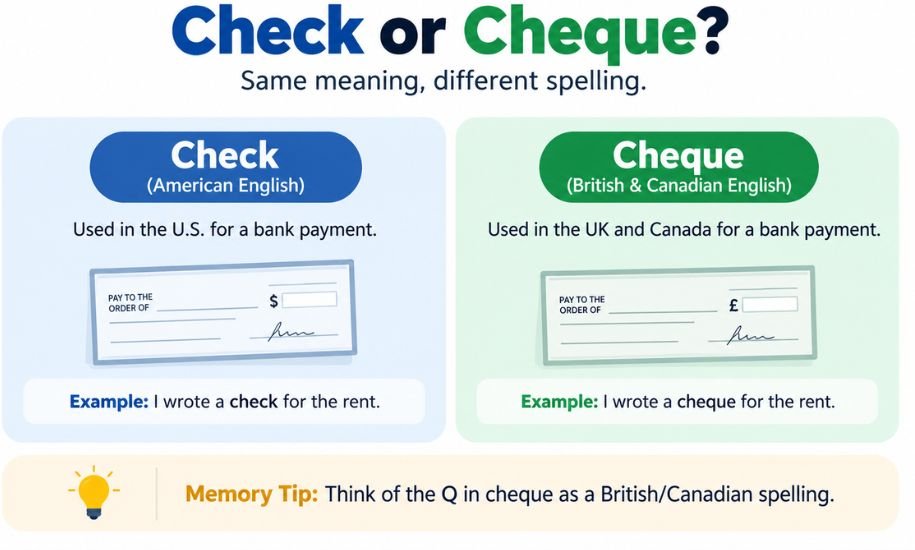
If you are writing about a bank payment, you may wonder whether the correct spelling is check or cheque. The answer depends mainly on the variety of English you are using. Both spellings are correct for the financial document: check is standard in American English, while cheque is used in British English and is also the preferred Canadian spelling. However, check has other meanings, such as “examine” or “verify,” and that spelling is used across English varieties.
Check and cheque are both correct when referring to a bank payment. Check is the standard American spelling, while cheque is standard in British English and commonly preferred in Canadian English. For meanings such as “examine” or “verify,” always use check.
Check vs. Cheque: What’s the Difference?
The main difference is regional spelling, not meaning, when the words refer to a bank payment.
| Form | Main usage | Example |
|---|---|---|
| check | American English; bank payment | I mailed the check yesterday. |
| cheque | British English and Canadian English; bank payment | I mailed the cheque yesterday. |
| check | Examine, verify, inspect | Please check the figures. |
| checking | American banking term | I have a checking account. |
| chequing | Canadian banking term | I have a chequing account. |
Merriam-Webster and Cambridge Dictionary both distinguish check and cheque primarily according to regional English when the word refers to a financial document. The Canadian government’s Language Portal likewise distinguishes cheque for the banking document from check for other meanings.
What Does “Check” Mean?
Check is a noun and a verb with several meanings.
As a noun, it can refer to a written instruction directing a bank to pay money from someone’s account:
I received a check from the company.
She deposited the check this morning.
In American English, check is the normal spelling for this financial document.
As a verb, check means to examine, verify, inspect, or make sure something is correct:
Please check your calculations.
I need to check the address before sending the letter.
The mechanic will check the brakes.
This verbal meaning is important because check remains the correct spelling in British and Canadian English too.
What Does “Cheque” Mean?
Cheque is the British spelling of the financial noun check.
For example:
She wrote a cheque for £250.
The cheque arrived in the post.
Please make the cheque payable to the company.
In this financial sense, cheque is not a misspelling. It is a standard regional spelling.
Cambridge Dictionary identifies cheque as the UK form and gives check as the US equivalent.
One useful detail is that cheque is generally limited to this financial sense. You would not normally write cheque when you mean “examine” or “verify.”
Is It Check or Cheque in American English?
If your audience is in the United States, use check for the banking document.
Correct American examples include:
- I wrote a check for the rent.
- The bank processed my check.
- My checkbook is in the drawer.
- I have a checking account.
- Please send the check by mail.
Using cheque in American writing can make the text look distinctly British or Canadian, although the meaning will generally still be understood.
So, if you are specifically asking “is it check or cheque in USA?”, the answer is check.
What About British English?
British English uses cheque for the financial document.
For example:
I paid by cheque.
The cheque was signed yesterday.
He wrote a cheque to cover the bill.
However, British English still uses check when the word means examine, inspect, or verify:
Please check your email.
Check the figures carefully.
I need to check the information.
This distinction is easy to miss. British English can therefore use both words in the same sentence:
Please check the details on the cheque.
The first check means “verify,” while cheque refers to the bank payment.
What About Canadian English?
Canadian English has an interesting position because it retains cheque for the banking document while also using check for meanings such as examining something.
For example:
I paid the contractor by cheque.
Please check the account number.
Canada also commonly uses chequing account, which corresponds to the American checking account.
The Government of Canada uses chequing accounts in its consumer banking guidance, while its Language Portal explicitly discusses the distinction between check and cheque.
So the common pattern is:
United States: check, checking account
Canada: cheque, chequing account
United Kingdom: cheque, usually current account
Checking or Chequing: Which One Should You Use?
The choice between checking and chequing follows a similar regional pattern, but there is an important difference in British usage.
American English: Checking
Americans commonly use checking account:
I opened a checking account last month.
My checking account balance is low.
Canadian English: Chequing
Canadian English commonly uses chequing account:
I opened a chequing account last month.
You can manage your chequing account online.
Therefore, if you are deciding between checking or chequing, the best choice depends on your intended audience.
For the United States, choose checking.
For Canada, choose chequing.
In the United Kingdom, current account is normally used instead of either expression.
Checkbook or Chequebook?
The same regional spelling difference appears in checkbook and chequebook.
American English:
I ordered a new checkbook.
British and Canadian English:
I ordered a new chequebook.
The pattern is simple:
- check → checkbook
- cheque → chequebook
Likewise, American English uses paycheck, while British and Canadian English may use paycheque.
Examples of Correct Usage
Here are some examples that show when each form belongs.
American English
The landlord asked me to pay by check.
I put the check in the envelope.
She has a checking account at the bank.
British English
The landlord asked me to pay by cheque.
I put the cheque in the envelope.
Please check that the amount is correct.
Canadian English
The landlord asked me to pay by cheque.
The money came from my chequing account.
Please check that the amount is correct.
When “check” means verify
Regardless of regional variety, use check:
Correct: Please check your work.
Incorrect: Please cheque your work.
Correct: Check the address before submitting the form.
Incorrect: Cheque the address before submitting the form.
The spelling cheque should not be substituted for check simply because you are writing in British English.
Why Are Check and Cheque Confused?
The confusion comes from the fact that the two spellings represent the same financial word in different varieties of English.
Someone accustomed to American English may see cheque and assume it is a spelling mistake. Someone accustomed to British English may naturally write cheque where an American writer would use check.
The related banking terms reinforce the distinction:
- American: checking account
- Canadian: chequing account
- British: current account
The key is therefore not to decide that one spelling is universally correct. Instead, choose the spelling that matches your intended variety of English.
Common Mistakes to Avoid
1. Calling “cheque” an incorrect spelling
Cheque is not inherently wrong. It is a standard spelling for the financial document in British English and is also used in Canadian English.
2. Writing “cheque” when you mean “verify”
Even in British English, use check as the verb:
Please check the document.
Not:
Please cheque the document.
3. Mixing regional forms unnecessarily
If you are writing for an American audience, use checkbook and checking account, rather than switching between American and British forms.
Similarly, a Canadian text will normally use cheque and chequing account.
4. Assuming “checking” and “chequing” are interchangeable everywhere
They reflect regional usage. Checking is standard American terminology, while chequing is particularly associated with Canadian banking.
An Easy Way to Remember
Think of the Q in cheque as a clue that you are looking at the British/Canadian spelling of the financial word.
For American English:
check → checking → checkbook
For Canadian English:
cheque → chequing → chequebook
But remember one exception that is not really an exception: check meaning examine or verify stays check in all these varieties.
Frequently Asked Questions
Is “check or cheque” the same word?
When referring to a bank payment, yes. The two spellings represent the same word in different regional varieties of English. Check is standard American English, while cheque is used in British English and commonly in Canadian English.
Is “cheque” British or American?
Cheque is primarily associated with British English and is also standard Canadian usage for a bank payment. American English normally uses check instead.
Is “check” wrong in British English?
No. British English uses check for meanings such as examine, inspect, and verify. It uses cheque specifically for the financial document.
Should I write “checking or chequing”?
Use checking in American English, as in checking account. Chequing is the traditional Canadian form. British English generally uses current account rather than either term.
Is “cheque” acceptable in formal writing?
Yes. It is perfectly acceptable when it matches the regional variety you are writing in. British and Canadian writers can use cheque in formal documents, while American writers should normally use check.
Which spelling should I use in the USA?
Use check when referring to a bank payment. American English also uses checking account, checkbook, and paycheck.
Final Verdict: Check or Cheque?
Both check and cheque are correct, but your choice should match your audience. Use check for American English and cheque for British English and Canadian English when referring to a bank payment. For the verb meaning “examine” or “verify,” always use check. If you want clear answers to confusing spelling and usage questions like this, Grammarifyr follows the simple principle: Know the Difference. Use the Right Words.
You may also Read : Journies or Journeys: Correct Spelling Explained

One Comment