Bougie or Boujee: Meaning and Correct Usage
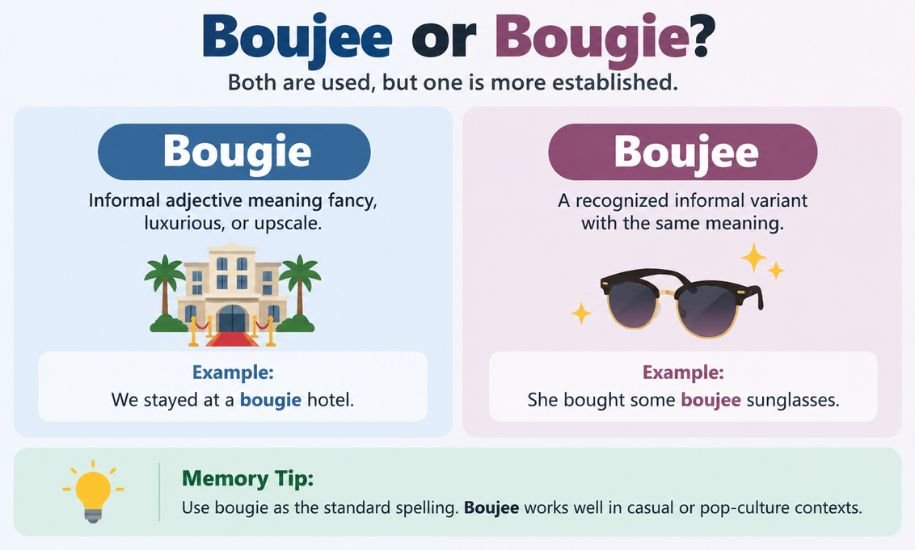
If you have seen both bougie and boujee, you may wonder which spelling is correct. The confusion is understandable because the two forms are pronounced similarly and are generally used with the same slang meaning. Bougie is the more established spelling, while boujee is a recognized informal variant that became especially familiar through popular culture. Neither should automatically be treated as a simple spelling mistake. The right choice depends mainly on the style and context of your writing.
Bougie is the more established spelling, but boujee is also a recognized informal variant. Both usually describe something fancy, luxurious, expensive, or associated with an upscale lifestyle. For general writing, bougie is the safer default; boujee works especially well in casual or slang-heavy contexts.
Bougie vs. Boujee: The Key Difference
The biggest difference is not meaning but spelling and stylistic association.
| Feature | Bougie | Boujee |
|---|---|---|
| Standard modern slang form | Yes | Yes, as a variant |
| Common meaning | Fancy, upscale, luxurious | Fancy, upscale, luxurious |
| Style | Informal, established slang | More casual/pop-culture-oriented |
| Pronunciation | Usually “BOO-zhee” | Usually “BOO-zhee” |
| Best default choice | Yes | Use when the informal style fits |
In ordinary slang usage, you can generally substitute one for the other without changing the basic meaning.
For example:
- “That hotel is bougie.”
- “That hotel is boujee.”
Both suggest that the hotel is stylish, luxurious, expensive, or somewhat upscale.
What Does “Bougie” Mean?
Bougie is an informal adjective used to describe someone or something associated with luxury, wealth, expensive tastes, sophistication, or social status.
Depending on the speaker and context, it can be positive, playful, neutral, or mildly critical.
For example:
We booked a bougie hotel overlooking the ocean.
Here, bougie suggests the hotel is luxurious or upscale.
Her new apartment is pretty bougie.
This could be a compliment about its stylish or expensive appearance.
He has become too bougie for that old café.
In this sentence, the word can have a slightly negative sense, suggesting that the person has developed expensive or pretentious tastes.
The word therefore does not always mean simply “rich.” It often carries an attitude about how someone presents or enjoys wealth, comfort, or status.
Examples of “bougie” in sentences
- We found a bougie little restaurant downtown.
- She loves buying bougie candles for her apartment.
- Their weekend getaway was surprisingly bougie.
- I felt a little bougie ordering room service for breakfast.
What Does “Boujee” Mean?
Boujee generally has the same slang meaning as bougie. It can describe something fancy, luxurious, expensive, stylish, or associated with an affluent lifestyle.
For example:
We’re going to a boujee restaurant tonight.
The speaker means the restaurant is likely upscale or luxurious.
The spelling became particularly recognizable through the 2016 Migos song “Bad and Boujee,” which helped bring boujee into mainstream popular culture.
As a result, boujee often has a particularly casual, playful, or pop-culture flavor. Someone might deliberately choose this spelling because it feels more like contemporary slang.
Examples of “boujee” in sentences
- They planned a boujee dinner for their anniversary.
- Her vacation photos look incredibly boujee.
- We had a boujee brunch at the new hotel.
- He bought some boujee furniture for his new apartment.
Is It Bougie or Boujee?
If you’re asking “is it bougie or boujee?”, the answer is that both forms are used and recognized in modern informal English.
However, they are not equally established.
Bougie is the more traditional and broadly recognized spelling of the slang adjective. Boujee is a recognized variant and is especially associated with casual speech, music, social media, and popular culture.
That means you should not automatically “correct” boujee to bougie when someone is using it intentionally as slang.
For careful explanatory writing, bougie is generally the better choice because it is the established form. In a casual post, lyric discussion, conversation, or pop-culture context, boujee can be entirely appropriate.
How to Spell Boujee or Bougie
The two spellings are:
Bougie: B-O-U-G-I-E
Boujee: B-O-U-J-E-E
If you’re trying to decide which spelling to put in your own sentence, consider your audience and tone.
Choose bougie when:
- You want the established spelling.
- You’re explaining the word in an article or dictionary-style context.
- You prefer a less pop-culture-specific form.
- You want the safest choice for general informal writing.
Choose boujee when:
- You’re writing very casually.
- You’re discussing contemporary slang or popular culture.
- The style intentionally reflects the spelling’s association with music and internet culture.
- You’re quoting or referring to a particular expression that uses boujee.
Neither spelling changes the basic slang meaning.
Why Are These Two Spellings Confused?
The confusion comes from several factors.
First, bougie and boujee sound very similar in ordinary speech. When people hear the word rather than see it written, it isn’t obvious which letters should be used.
Second, the word is slang, and slang often develops multiple spellings. Writers may spell a word according to pronunciation or according to how they encountered it in popular culture.
Third, the spelling boujee received significant attention through the phrase “Bad and Boujee.” People who encountered the word through music or social media may naturally use that form.
Finally, bougie has a longer history as a written form, while boujee has a particularly strong modern slang identity. This gives the two spellings slightly different stylistic impressions even though their meanings overlap.
Is “Boujee” a Misspelling?
No. It is better understood as a recognized variant rather than simply an error.
If you are writing a formal report, however, bougie may still be preferable because both words are informal slang. In formal prose, words such as luxurious, upscale, lavish, high-end, or sophisticated may communicate the idea more appropriately.
For example:
Casual:
That hotel is so bougie.
More formal:
That hotel has a luxurious and sophisticated atmosphere.
The issue here is not that boujee is grammatically incorrect. It is that slang may not suit every writing situation.
Bougie or Boujee Meaning in Different Contexts
The word can take on slightly different shades depending on how it is used.
Positive or playful
Someone may call an expensive dinner bougie because they enjoy the luxury.
This is the most bougie breakfast I’ve ever had, and I love it.
Mildly critical
The term can suggest that someone is overly concerned with appearances, money, or status.
He refuses to stay anywhere that isn’t five-star because he’s getting too bougie.
Self-deprecating
People also use the word humorously about themselves.
I know it’s bougie, but I can’t start my morning without my fancy coffee.
This flexibility is one reason context matters. Calling something bougie does not automatically mean the speaker dislikes it.
Pronunciation of “Bougie” and “Boujee”
In slang usage, both forms are generally pronounced approximately like “BOO-zhee” or “BOO-jee.”
The pronunciation can vary somewhat among speakers, but the important point is that the two spellings are usually pronounced very similarly.
That similarity explains why someone who learns the word through conversation may later be unsure how to write it.
One Important Detail: “Bougie” Has Other Meanings
There is another reason context matters: bougie is not exclusively slang.
The word bougie also exists as a noun. In medical terminology, a bougie can refer to an instrument used to examine or dilate a tubular passage in the body. It can also refer to a candle in certain dictionary definitions.
Those meanings are completely different from the slang adjective.
Compare:
That restaurant is really bougie.
Here, the word is slang for fancy or upscale.
The physician used a bougie during the procedure.
Here, it refers to a medical instrument.
So don’t assume that every appearance of bougie refers to luxury or expensive tastes.
Common Mistakes to Avoid
1. Calling “boujee” simply wrong
Because bougie is the more established spelling, some writers assume boujee must be incorrect. That’s too simplistic. Boujee is a recognized informal variant.
2. Treating “bougie” as a formal synonym for luxurious
Although bougie can mean luxurious or upscale, it is slang. In formal writing, luxurious, high-end, or upscale may be a better choice.
3. Assuming the word always has a negative meaning
It can be critical, but it can also be complimentary or humorous. Context determines the tone.
4. Confusing slang “bougie” with its other noun meanings
The adjective used to describe an upscale lifestyle is different from the noun used in medical terminology or other specialized contexts.
5. Using both spellings inconsistently
If you’re writing a casual article or social post, choose the form that best fits your style and stick with it. For general explanatory writing, bougie is usually the easiest choice.
An Easy Way to Remember
A simple rule is:
Bougie = the established spelling.
Boujee = the more playful slang variant.
If you are unsure which one to use, choose bougie.
If you’re deliberately using a pop-culture or highly casual style, boujee may fit better.
Examples: Correct Usage
Here are a few examples showing how either spelling can work:
Using bougie:
We stayed at a bougie hotel during our vacation.
Using boujee:
She planned a boujee birthday dinner.
Using bougie in a humorous way:
Buying imported sparkling water feels a little bougie.
Using boujee in casual slang:
That new café is seriously boujee.
In each example, the intended idea is essentially the same: fancy, upscale, luxurious, or associated with expensive tastes.
The Bottom Line
So, boujee or bougie? Bougie is the more established spelling and the best default choice for general informal writing. Boujee is also a recognized variant, with a particularly casual and pop-culture-oriented feel. Both can describe something fancy, luxurious, expensive, or associated with an upscale lifestyle.
When in doubt, go with bougie. If the context is deliberately casual or connected to contemporary slang, boujee is perfectly acceptable. For more useful explanations of confusing English words and spellings, Grammarifyr helps you know the difference and use the right words.
Frequently Asked Questions
Is bougie or boujee the correct spelling?
Both are used in modern informal English. Bougie is the more established spelling, while boujee is a recognized variant. For general writing, bougie is the safer default.
Is it boujee or bougie for a fancy lifestyle?
Either can describe a fancy or upscale lifestyle. Bougie is the more established form, while boujee tends to sound more casual and pop-culture-oriented.
What is the meaning of bougie or boujee?
Both generally mean fancy, luxurious, upscale, expensive, or associated with wealth and status. Depending on context, the word can be complimentary, playful, neutral, or mildly critical.
How do you spell bougie?
The established spelling is bougie, spelled B-O-U-G-I-E. Boujee, spelled B-O-U-J-E-E, is a recognized informal variant.
Is boujee acceptable in formal writing?
It is understandable and recognized, but it is slang. In formal writing, alternatives such as luxurious, upscale, lavish, or high-end are usually more appropriate.
Why is boujee spelled with “jee”?
The spelling boujee reflects a popular slang variant that became especially visible through music and popular culture. Its pronunciation is generally similar to bougie, which is why both forms are used.
You may also Read : Sergeant or Sargent: Correct Spelling Explained

One Comment