Whos or Whose: Examples and Grammar Rules
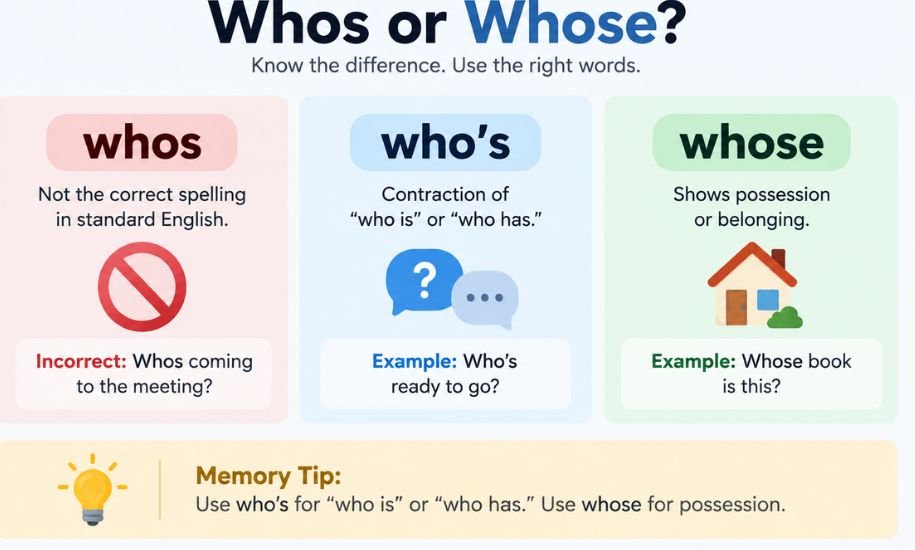
If you are unsure whether to write “whos” or “whose,” there is actually a third form you need to consider: “who’s.” These words look and sound similar, but they serve different grammatical purposes. “Whose” is used to show possession or ask who something belongs to, while “who’s” is a contraction of “who is” or “who has.” Meanwhile, “whos” without an apostrophe is generally not the standard form you want in ordinary English. Understanding this small distinction can prevent frequent mistakes in emails, essays, messages, and other writing.
“Whose” and “who’s” are both correct, but they have different meanings. Whose shows possession, while who’s means “who is” or “who has.” “Whos” without an apostrophe is not the standard spelling for either of these uses.
Whos or Whose: Which Is Correct?
The answer depends on what you are trying to say.
| Form | Correct? | Meaning | Example |
|---|---|---|---|
| whose | Yes | Possession or belonging | Whose keys are these? |
| who’s | Yes | “Who is” or “who has” | Who’s waiting outside? |
| whos | Generally no | Not the standard form in ordinary English | Avoid whos in formal writing |
The important comparison is therefore whose vs. who’s, rather than simply “whos vs. whose.”
For example:
- Whose coat is on the chair? — You are asking who owns the coat.
- Who’s sitting on the chair? — You are asking who is sitting there.
The apostrophe changes the grammatical function completely.
What Does “Whose” Mean?
Whose is a possessive interrogative pronoun and can also function as a possessive relative pronoun.
It is used when you want to ask who something belongs to or identify a person or thing associated with something.
Examples of “whose”
- Whose phone is ringing?
- Whose bicycle is parked outside?
- Whose idea was this?
- Do you know whose bag this is?
In each sentence, whose relates to ownership or association.
It can also introduce a relative clause:
- I met a writer whose books I enjoy.
- She is the teacher whose class we attended.
- They bought a house whose roof needs repairs.
Notice that whose does not mean “who is.” It expresses a possessive relationship.
What Does “Who’s” Mean?
Who’s contains an apostrophe because it is a contraction. It has two possible meanings:
- Who is
- Who has
You can usually identify the correct form by expanding the contraction.
“Who’s” = “Who is”
- Who’s coming with us?
→ Who is coming with us? - Who’s responsible for this project?
→ Who is responsible for this project? - Who’s at the door?
→ Who is at the door?
“Who’s” = “Who has”
- Who’s finished the report?
→ Who has finished the report? - Who’s already eaten?
→ Who has already eaten?
The exact meaning depends on the sentence, but the apostrophe is important because it signals the contraction.
Whose or Who’s: The Simple Difference
The easiest way to distinguish these forms is to ask what the sentence means.
Use whose when the sentence concerns possession, ownership, or association.
Whose laptop is this?
The question is asking who the laptop belongs to.
Use who’s when you can replace it with who is or who has.
Who’s using the laptop?
This means:
Who is using the laptop?
That simple substitution test solves most cases.
Compare these sentences
Whose dog is barking?
The question asks about the dog’s owner.
Who’s barking?
The question means “Who is barking?”
Whose turn is it?
The question asks which person has the turn.
Who’s taking the next turn?
The question means “Who is taking the next turn?”
Why “Whos” Causes Confusion
The form whos is easy to type because English contractions frequently use apostrophes, but people sometimes leave the apostrophe out.
For example, someone may write:
Whos coming to dinner?
The standard form is:
Who’s coming to dinner?
Here, who’s means who is.
Likewise:
Whos jacket is this?
should be:
Whose jacket is this?
This second sentence is asking about possession, so adding an apostrophe would actually make it incorrect.
The confusion comes from the fact that whose and who’s sound alike in ordinary speech. Their pronunciation does not reliably tell you which spelling to use. The grammatical role of the word does.
Who’s or Whose: Examples in Sentences
Seeing the forms side by side makes the distinction easier.
Possession: Use “whose”
- Whose wallet did you find?
- I don’t know whose umbrella this is.
- Whose responsibility is it to lock the door?
- The student whose notebook was missing returned later.
“Who is”: Use “who’s”
- Who’s your new manager?
- Who’s waiting in the lobby?
- Do you know who’s coming tonight?
- Who’s responsible for organizing the meeting?
“Who has”: Use “who’s”
- Who’s completed the assignment?
- Who’s already seen the movie?
- Who’s left their keys on the table?
A useful trick is to expand who’s. If who is or who has works naturally, who’s is probably the right choice.
Is It “Who or Whose”?
The difference between who and whose is slightly different from the difference between who’s and whose.
Who refers to a person and is commonly used when asking about identity:
Who called you?
Whose asks about possession:
Whose phone did you use?
Compare:
- Who wrote this letter? — asking about the person.
- Whose letter is this? — asking who the letter belongs to or who wrote/owns it depending on context.
So if you are deciding between who or whose, focus on whether the sentence asks which person or whose possession/association.
Is It “Who’s or Whose”?
If you are asking “is it who’s or whose?”, use the sentence itself to decide.
Use “who’s” when:
You mean who is:
Who’s your teacher?
You mean who has:
Who’s finished the work?
Use “whose” when:
You mean belonging to whom:
Whose teacher is she?
Or you are introducing a possessive relative clause:
The teacher whose students won the competition was delighted.
This distinction applies regardless of whether the sentence is a question or a statement.
Common Mistakes to Avoid
1. Writing “whos” instead of “who’s”
Incorrect: Whos going to the concert?
Correct: Who’s going to the concert?
The intended meaning is “Who is going?”
2. Using “who’s” to show possession
Incorrect: Who’s car is parked outside?
Correct: Whose car is parked outside?
The sentence asks who owns the car, so whose is needed.
3. Adding an apostrophe to “whose”
Incorrect: Whose’ book is this?
Correct: Whose book is this?
Whose is already the possessive form. It does not need an apostrophe.
4. Assuming an apostrophe always means possession
This is one of the most useful grammar points to remember. Apostrophes can indicate possession in many English nouns, but who’s is different: its apostrophe marks a contraction.
- Sarah’s book → possession
- Who’s here? → “who is”
That is why who’s and whose cannot be distinguished simply by thinking “apostrophe = ownership.”
An Easy Way to Remember the Difference
Use the expansion test.
Step 1: Try “who is”
Who’s at the door?
Who is at the door? ✓
So who’s is correct.
Step 2: Try “who has”
Who’s finished the work?
Who has finished the work? ✓
Again, who’s is correct.
Step 3: If neither works, consider “whose”
Whose shoes are these?
“Who is shoes” and “Who has shoes” do not fit the sentence. The sentence is about possession, so whose is correct.
A short rule to remember is:
Who’s = who is / who has
Whose = belonging to whom
What About “Who’s Whose”?
The phrase “who’s whose” can be grammatically correct when it combines the two forms.
For example:
The seating chart explains who’s whose guest.
Here, who’s means “who is,” while whose indicates possession or association.
Another example:
We need to figure out who’s whose partner for the activity.
The phrase can look strange because the two words are pronounced similarly, but each has a separate grammatical function.
It is important not to treat “who’s whose” as a single word or fixed spelling rule. Always analyze the individual words.
What About “Who’s Better, Ronaldo or Messi?”
A phrase such as “who’s better, Ronaldo or Messi?” uses who’s in the sense of “who is.”
The underlying sentence is:
Who is better, Ronaldo or Messi?
Therefore, who’s is grammatically appropriate when written as a contraction:
Who’s better, Ronaldo or Messi?
The same principle applies to comparison questions about any two people:
- Who’s taller, Alex or Sam?
- Who’s faster, the blue car or the red car?
- Who’s more experienced, the coach or the assistant?
The contraction simply stands for who is.
What About “Who’s Prime Was Better: Peyton Manning or Tom Brady?”
This example requires a slightly different correction.
If you mean to ask about the quality of each player’s prime, the natural sentence is:
Whose prime was better, Peyton Manning’s or Tom Brady’s?
Why whose?
Because you are asking which person’s prime was better. The word whose establishes possession or association with “prime.”
You would not write:
Who’s prime was better…
because who’s would mean who is or who has, neither of which fits before the noun prime.
This is a particularly useful example because it shows why context matters. The correct choice is not determined simply by how the words sound.
How to Choose the Right Form
When writing quickly, use this three-question check:
1. Do I mean “who is”?
Use who’s.
2. Do I mean “who has”?
Use who’s.
3. Am I asking who something belongs to or which person something is associated with?
Use whose.
For example:
Who’s calling?
= Who is calling?
Who’s finished?
= Who has finished?
Whose phone is ringing?
= The phone belongs to whom?
If you cannot expand who’s into who is or who has, stop and check whether whose is the word you need.
Frequently Asked Questions
Is “whos” a correct English word?
In ordinary modern English writing, whos without an apostrophe is not the standard form for the meanings discussed here. Writers generally need either who’s, meaning “who is” or “who has,” or whose, showing possession or association.
Is “whose” or “who’s” correct?
Both are correct, but they cannot normally be substituted for one another. Whose indicates possession, while who’s is a contraction of who is or who has.
How can I quickly tell whether to use “who’s” or “whose”?
Try expanding who’s to who is or who has. If the expanded sentence makes sense, use who’s. If the sentence asks about ownership or association, use whose.
Is “whose” possessive?
Yes. Whose is the possessive form associated with who. It can ask who something belongs to, as in “Whose coat is this?”, and it can introduce a possessive relative clause, as in “the artist whose work won the award.”
Can “who’s” mean “who has”?
Yes. Who’s can contract who has, particularly when has functions as an auxiliary verb: “Who’s finished the report?” means “Who has finished the report?”
Is “who’s” acceptable in formal writing?
Yes. Who’s is a standard English contraction. In highly formal prose, a writer may choose who is or who has instead, but the contraction itself is grammatically correct.
The Bottom Line
When deciding between whos or whose, remember that the standard comparison is really who’s vs. whose. Who’s means “who is” or “who has,” while whose expresses possession or association. The unpunctuated “whos” should generally be avoided in standard writing. If you can replace the word with who is or who has, choose who’s; if you are asking or explaining who something belongs to, choose whose. For more clear explanations of confusing English forms, Grammarifyr helps you know the difference and use the right words.
You may also Read : Wich or Which: Meaning, Examples, and Usage
One Comment