Octopi or Octopuses: Which Plural Is Correct?
If you have ever paused before writing about more than one octopus, you are not alone. The two forms octopuses and octopi both appear in English, and a third form, octopodes, occasionally enters the discussion. The confusion comes largely from the word’s Greek origins and the temptation to treat its -us ending like Latin words such as alumnus. So, which form should you actually use? For most modern English writing, octopuses is the clearest and safest choice, although octopi is also recognized by major dictionaries.
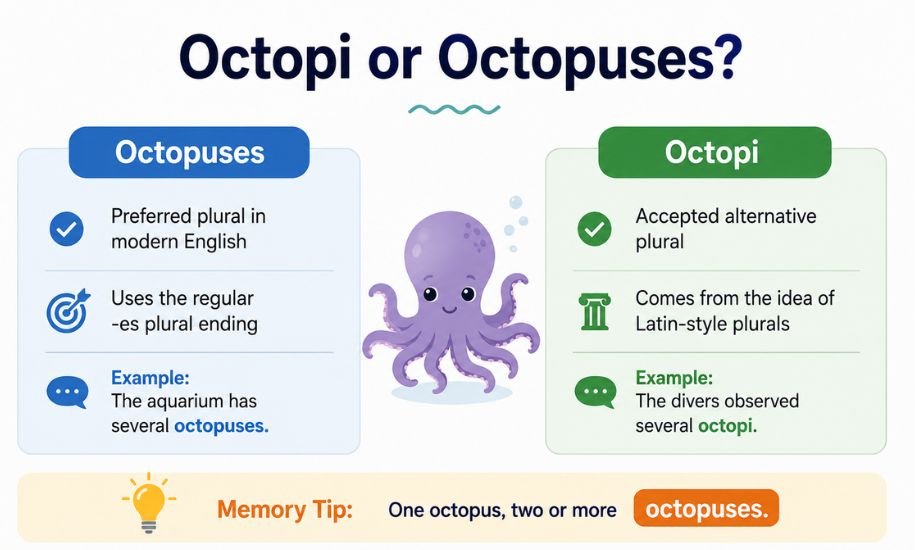
Octopuses is the preferred plural form in most modern English writing. Octopi is also an accepted plural according to major dictionaries, while octopodes is a much rarer form based on the word’s Greek origin. If you want the simplest choice, use octopuses.
Octopi or Octopuses: Which Is Correct?
The short answer is that both octopuses and octopi can be correct, but they do not have exactly the same status in everyday usage.
Octopuses uses the regular English plural ending -es. It is widely used and is the form recommended by some style and language authorities, including the Language Portal of Canada.
Octopi uses the familiar -i ending associated with some Latin nouns. Although the reasoning behind this form is historically complicated, it is established enough that dictionaries such as Merriam-Webster and Dictionary.com list it as a plural of octopus.
So if you are writing an essay, article, report, or general piece of prose and simply want the least controversial option, octopuses is an excellent choice.
Quick comparison
| Form | Correct? | Typical use | Recommendation |
|---|---|---|---|
| octopus | Yes | One animal | Use for singular |
| octopuses | Yes | Standard English plural | Best default choice |
| octopi | Yes/accepted | Established alternative plural | Acceptable, but less straightforward |
| octopodes | Yes, rare | Greek-derived plural | Mostly useful in linguistic discussion |
The important point is that calling octopi an outright spelling mistake is too simplistic. Major dictionaries recognize it.
What Does “Octopuses” Mean?
Octopuses is the plural of octopus. It refers to two or more animals of the octopus group.
The word functions as an ordinary plural noun:
- One octopus was hiding beneath the rock.
- Two octopuses were swimming near the reef.
- The aquarium has several octopuses.
- Scientists observed how the octopuses responded to their environment.
The formation is straightforward:
octopus → octopuses
This follows the English tendency to form many plurals with -s or -es rather than preserving a foreign-language plural.
For readers wondering is it octopuses or octopi, this is the form to choose when you want a natural, conventional English plural.
What Does “Octopi” Mean?
Octopi is also used as the plural of octopus.
For example:
- The divers encountered several octopi near the rocks.
- The researchers recorded the behavior of numerous octopi.
- Several octopi were visible through the aquarium glass.
The interesting part is why this form exists.
English has many words ending in -us whose traditional Latin plurals end in -i, such as:
- alumnus → alumni
- radius → radii
- fungus → fungi
Because octopus ends in -us, speakers historically applied a similar pattern:
octopus → octopi
But that analogy is not as neat as it appears. Octopus ultimately comes from Greek, although it entered English through New Latin. Merriam-Webster explains that octopi arose from the belief that the word should receive a Latin-style plural ending.
That is why the debate over the plural has lasted so long.
Why Are Octopuses and Octopi Both Used?
The confusion comes from the interaction between English grammar and classical word origins.
When English adopts a word from another language, it does not always preserve the original language’s plural system. Sometimes the borrowed word receives an ordinary English plural. Sometimes an older foreign plural survives.
With octopus, several approaches developed.
1. The English approach: octopuses
Treat octopus as an English noun and add the normal plural ending:
octopus → octopuses
This is simple and easy for English speakers to understand.
2. The Latin-style approach: octopi
Treat the ending as though it belonged to a Latin noun and replace -us with -i:
octopus → octopi
This form became established in English despite the word’s ultimate Greek origin. Merriam-Webster describes octopi as the oldest of the three major plural forms.
3. The Greek approach: octopodes
Because octopus ultimately comes from Greek, another plural was formed using a Greek pattern:
octopus → octopodes
This is legitimate but much less familiar in ordinary English. Dictionary.com describes it as rarely used outside discussions of the plural itself.
Octopi or Octopuses or Octopodes?
If you encounter all three forms, here’s the practical distinction:
Octopuses — the best everyday choice.
Octopi — an established alternative that is recognized by major dictionaries.
Octopodes — a rare Greek-derived alternative.
Merriam-Webster’s current dictionary explicitly lists octopuses, octopi, and octopodes as plural forms.
That does not mean all three are equally common or equally useful.
For most readers, octopuses will sound the most natural. If you are writing for a general audience, there is little reason to choose the more unusual octopodes.
Examples: How to Use Each Form
Here are some natural examples.
Using “octopuses”
- The aquarium houses several octopuses.
- We watched two octopuses move across the seafloor.
- The documentary showed how octopuses use camouflage.
- Several octopuses were found in the shallow waters.
Using “octopi”
- The researchers observed several octopi in the laboratory.
- The divers photographed three octopi near the coral.
- The children were fascinated by the octopi at the aquarium.
These sentences are grammatically understandable because octopi is an established plural form recognized by major dictionaries.
Using “octopodes”
- The text discusses the Greek plural octopodes.
- The linguist explained why octopodes appears in dictionaries.
This last form is much more likely to appear when the subject is language, etymology, or grammar rather than marine biology.
Is “Octopi” Wrong?
No—not categorically.
This is one of the most important points to understand. Some grammar resources recommend octopuses and describe it as the correct English plural. For example, Scribbr recommends octopuses, while the Language Portal of Canada explicitly calls it the preferred plural.
However, other authoritative dictionaries accept octopi. Merriam-Webster lists it alongside octopuses, and Dictionary.com also gives both forms.
So the most accurate statement is:
Octopuses is the preferred default for modern general English, while octopi is an accepted alternative.
That is more accurate than saying one is always right and the other is always wrong.
What Should You Use in Formal Writing?
For formal writing, octopuses is generally the safest option.
Choose it for:
- school assignments;
- essays;
- websites and articles;
- scientific or educational writing;
- professional documents;
- general-audience publications.
Why? It follows an ordinary English plural pattern and avoids distracting readers who may regard octopi as questionable.
This does not make octopi unusable. If you encounter it in a quotation, source, or established publication, it should not automatically be treated as an error.
The Language Portal of Canada specifically recommends octopuses, not octopi, while Merriam-Webster recognizes both.
Common Mistakes to Avoid
1. Assuming every -us word becomes -i
This is one of the main reasons people choose octopi. English pluralization is not that predictable.
For example, bonus becomes bonuses, not normally boni. Likewise, campus becomes campuses.
So an -us ending alone does not guarantee an -i plural.
2. Treating “octopi” as unquestionably wrong
Some style guides prefer octopuses, but major dictionaries recognize octopi. Calling it universally incorrect ignores actual English usage and dictionary evidence.
3. Using “octopus” for multiple animals
Don’t write:
Incorrect: The aquarium has five octopus.
Use:
Correct: The aquarium has five octopuses.
Or, where appropriate:
The aquarium has five octopi.
4. Inventing “octopodeses”
If you choose the rare Greek-derived form, the plural is already octopodes. You should not add another English plural ending to it.
Octopodes, not octopodeses.
An Easy Way to Remember the Best Choice
If you don’t want to think about classical languages every time you write the word, use this simple rule:
One octopus → two or more octopuses.
Think of it as the ordinary English option.
If you remember that octopi is an accepted alternative, you will also know why you may occasionally see it in books, articles, or conversation.
Frequently Asked Questions
Is it octopuses or octopi?
Both forms are accepted by major dictionaries, but octopuses is the preferred default in many modern usage guides. If you are unsure which one to use, choose octopuses.
Do you say “octopuses” or “octopi”?
You can say either, although octopuses is the more straightforward choice for general English. The pronunciation of octopuses follows the ordinary English plural pattern, while octopi has the familiar -pie ending.
Is “octopi” grammatically correct?
Yes, it is recognized as a plural of octopus by major dictionaries, including Merriam-Webster and Dictionary.com. However, some language authorities prefer octopuses, particularly for standard English writing.
What is the plural of octopus in British English?
Octopuses is a standard plural in British English, and octopi is also encountered. The choice is not simply an American-versus-British spelling difference. It is primarily a question of plural formation and usage.
Is “octopodes” correct?
Yes. Octopodes is a recognized plural based on the Greek origin of octopus. However, it is considerably less common than octopuses and octopi, so it is not normally the best choice for everyday writing.
Which plural should I use in an article or essay?
Use octopuses unless you have a particular reason to use another form. It is clear, familiar, and recommended by several usage authorities.
The Bottom Line
Octopuses is the best all-purpose choice when you need the plural of octopus. Octopi is not simply a misspelling; it is an established alternative recognized by major dictionaries. Octopodes is also legitimate but rare. When in doubt, keep it simple: one octopus, two octopuses. That straightforward approach fits the practical word-choice guidance readers expect from Grammarify.
You may also Read :Yours or Your's? The Correct Form Explained

One Comment