Is or Are? Simple Grammar Rules and Examples
Choosing between is or are can seem simple until a sentence contains a tricky subject, a compound noun, or an expression such as “there is” or “there are.” Both forms are correct, but they serve different grammatical purposes. The key is to identify whether the subject is singular or plural and, in some cases, whether the subject is treated as a single unit. Once you understand the basic agreement rule, choosing the right form becomes much easier.
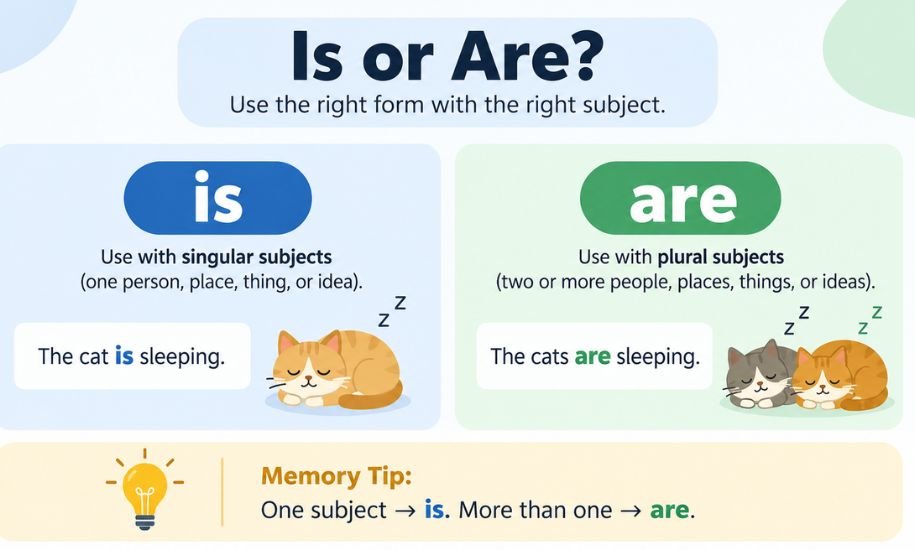
Both is and are are correct forms of the verb “to be.” Use is with singular subjects, such as “The dog is hungry,” and are with plural subjects, such as “The dogs are hungry.” The same principle helps you choose between “there is” and “there are.”
Is or Are: The Basic Difference
The simplest rule is based on subject-verb agreement.
- Is normally goes with a singular subject.
- Are normally goes with a plural subject.
- Are is also used with the pronouns you and we, even though you can refer to one person.
| Subject | Correct form | Example |
|---|---|---|
| He | is | He is tired. |
| She | is | She is ready. |
| It | is | It is cold. |
| The house | is | The house is large. |
| We | are | We are late. |
| You | are | You are correct. |
| They | are | They are busy. |
| The houses | are | The houses are large. |
This rule applies whether is or are is being used as a linking verb or as part of a progressive construction.
For example:
- The child is playing outside.
- The children are playing outside.
- The machine is working.
- The machines are working.
When to Use “Is”
Use is when the subject is singular and is in the third person.
Examples include:
- The computer is expensive.
- My brother is a doctor.
- The weather is pleasant.
- This book is interesting.
- Someone is waiting outside.
You also use is with singular nouns that represent one person, object, place, or idea.
Correct: The information is useful.
Incorrect: The information are useful.
Although information may refer to many facts, it is an uncountable noun and is normally treated as singular in English.
“Is” in questions
The same agreement principle applies to questions:
- Is your sister home?
- Is the restaurant open?
- Is this your bag?
- Is everyone ready?
The question form changes the word order, but it does not change the agreement between the subject and verb.
When to Use “Are”
Use are with plural subjects and with you and we.
Examples:
- The students are ready.
- My parents are visiting.
- The flowers are beautiful.
- We are almost finished.
- You are welcome here.
- They are working together.
For plural nouns, are is generally the correct present-tense form of to be.
Compare:
- The cat is sleeping.
- The cats are sleeping.
The difference is simply that cat is singular while cats is plural.
“Are” in questions
Use are when the subject is plural or when the subject is you or we:
- Are the children asleep?
- Are your parents at home?
- Are these seats available?
- Are you ready?
- Are we on the right road?
There Is or There Are?
One of the most frequent areas of confusion is choosing between there is or there are.
The word there introduces something that exists or is located somewhere. The verb agrees with the noun that follows.
Use there is with a singular noun:
- There is a problem.
- There is a new restaurant nearby.
- There is one chair in the room.
Use there are with a plural noun:
- There are two problems.
- There are several restaurants nearby.
- There are five chairs in the room.
The easiest way to decide is to look at the noun after the verb.
There is + singular noun
There is a book on the table.
There are + plural noun
There are three books on the table.
What about uncountable nouns?
Uncountable nouns normally take is:
- There is some water in the bottle.
- There is enough information available.
- There is plenty of food left.
You would not normally say:
There are some water in the bottle.
That construction does not follow standard subject-verb agreement.
Is There or Are There?
The same rule applies when forming questions.
Use is there before a singular or uncountable noun:
- Is there a problem?
- Is there a bank nearby?
- Is there enough time?
- Is there any milk left?
Use are there before a plural noun:
- Are there any problems?
- Are there two banks nearby?
- Are there enough chairs?
- Are there any tickets available?
So, when deciding between is there or are there, identify the noun that follows.
Compare:
Is there a reason?
and
Are there any reasons?
The first uses singular reason, while the second uses plural reasons.
Are There or Is There? A Simple Test
If you are unsure whether to say are there or is there, temporarily remove there and identify the subject.
For example:
There are several options.
The underlying noun is several options, which is plural. Therefore, are is appropriate.
Another example:
There is one option.
One option is singular, so is is correct.
This simple technique works particularly well when sentences become longer:
There are several important reasons for the change.
The words several important may distract you, but the main noun is reasons, which is plural.
What About “And Is or Are”?
When two subjects are joined by and, the verb is generally plural, so are is normally required.
Examples:
- Sarah and Tom are friends.
- The manager and assistant are available.
- The dog and cat are outside.
- Time and money are important.
The reason is that two separate subjects create a plural subject.
However, there are situations where two words joined by and represent one combined idea, item, or unit. In those cases, a singular verb can be appropriate.
For example:
Fish and chips is my favorite meal.
Here, fish and chips is being treated as one dish.
Another example is:
Bread and butter is a simple breakfast.
The exact choice can depend on meaning and context, so the safest approach is to ask whether the two nouns represent two separate things or one combined concept/unit.
Subjects That Look Plural but Take “Is”
Not every noun ending in a plural-looking form takes are.
Some nouns are grammatically singular despite referring to a collection, concept, or field.
Examples:
- Mathematics is difficult for some students.
- The news is surprising.
- Economics is an important subject.
Similarly, indefinite pronouns such as everyone, everybody, someone, somebody, nobody, each, and everything generally take is.
Examples:
- Everyone is invited.
- Someone is calling you.
- Nobody is available.
- Each student is responsible for the work.
The important point is that grammatical number does not always correspond to the number of people or things being discussed.
Collective Nouns: Is or Are?
Collective nouns such as team, family, committee, government, class, and company can create uncertainty because they refer to groups.
In American English, a collective noun is commonly treated as singular when the group is considered one unit:
The team is ready.
The committee is meeting today.
British English can sometimes use a plural verb when the individual members of the group are being emphasized:
The team are discussing their individual roles.
The choice therefore depends partly on the variety of English and the intended meaning. In formal writing, consistency is important.
Is or Are With “Either…Or” and “Neither…Nor”
Sentences using either…or and neither…nor require extra attention.
When both subjects are singular, use is:
Either John or Maria is responsible.
When both are plural, use are:
Either the teachers or the students are responsible.
When one subject is singular and the other plural, writers often make the verb agree with the subject closest to it:
Either the manager or the employees are responsible.
Either the employees or the manager is responsible.
For formal writing, however, it can be clearer to restructure a complicated sentence rather than create an awkward agreement pattern.
Common Mistakes With Is and Are
1. Choosing the verb based on a nearby noun
A long phrase between the subject and verb can make agreement confusing.
Incorrect:
The box of old books are on the floor.
The noun closest to the verb is books, but the actual subject is box, which is singular.
Correct:
The box of old books is on the floor.
2. Using “are” with everyone
Although everyone refers to many people, it is grammatically singular.
Incorrect: Everyone are ready.
Correct: Everyone is ready.
3. Confusing “there is” and “there are”
Incorrect: There is three reasons.
Correct: There are three reasons.
The noun reasons is plural.
4. Forgetting that “you” takes “are”
Even when you refers to one person, standard English uses are:
You are very helpful.
Not:
You is very helpful.
5. Treating uncountable nouns as plural
Words such as information, advice, furniture, and equipment normally take is.
Correct: The information is accurate.
Correct: The furniture is expensive.
An Easy Way to Remember the Difference
Use this quick pattern:
One → IS
More than one → ARE
For example:
- One apple is fresh.
- Two apples are fresh.
Then remember the special pronouns:
I → am
You → are
We → are
They → are
He/She/It → is
This gives you a simple present-tense pattern:
I am
You are
He is
She is
It is
We are
They are
When a sentence feels confusing, identify the subject first. Once you know whether that subject is singular or plural, the correct form usually becomes obvious.
Is or Are Examples in Everyday English
Here are some practical examples:
Singular
- The phone is on the desk.
- My friend is busy.
- The movie is starting.
- There is a mistake in this sentence.
Plural
- The phones are on the desk.
- My friends are busy.
- The movies are starting.
- There are several mistakes in this sentence.
Questions
- Is there a problem?
- Are there any problems?
- Is your brother coming?
- Are your brothers coming?
With “and”
- Jack and Emma are here.
- The teacher and students are preparing for the event.
These examples demonstrate the basic principle without requiring complicated grammar terminology.
Frequently Asked Questions
Is “is” singular or plural?
Is is normally the singular present-tense form of to be for third-person subjects. For example, “The car is new” and “She is happy.” It is also used with singular indefinite pronouns such as everyone and someone.
Is “are” singular or plural?
Are is normally used with plural subjects, as in “The cars are new.” It is also used with you and we, even when you refers to one person.
Which is correct: “there is” or “there are”?
Both are correct, but they are used with different subjects. Use there is with a singular or uncountable noun and there are with a plural noun: “There is a problem” but “There are several problems.”
Which is correct: “is there” or “are there”?
Use is there with a singular or uncountable noun: “Is there a reason?” Use are there with a plural noun: “Are there any reasons?” The noun following the phrase determines the form.
Should I use “is” or “are” after “and”?
When and joins two separate subjects, use are: “The boy and girl are outside.” If the two words describe one combined item or concept, a singular is may sometimes be appropriate, depending on the sentence.
How can I quickly choose between the two?
Find the subject and ask whether it is singular or plural. Singular subjects generally take is, while plural subjects generally take are. Remember that you and we take are, and I takes am.
Final Verdict: Is or Are?
Both forms are correct—the right choice depends on the subject. Is generally accompanies singular third-person subjects, while are accompanies plural subjects as well as you and we. The same rule explains the difference between there is/there are and is there/are there. When you are unsure, identify the subject before choosing the verb. For more clear explanations of confusing English forms, Grammarifyr helps you know the difference and use the right words.
You may also Read : Signer or Signor: Meaning, Examples, and Usage

One Comment