Were or Where: Meaning, Uses, and Examples
Were and where are two different English words that are easy to confuse because they look and sound similar. However, they serve completely different grammatical purposes. Were is a past-tense form of the verb be, while where relates to a place, position, or location. Once you identify what the sentence is trying to express—an action or state in the past, or a location—the correct choice becomes much easier.
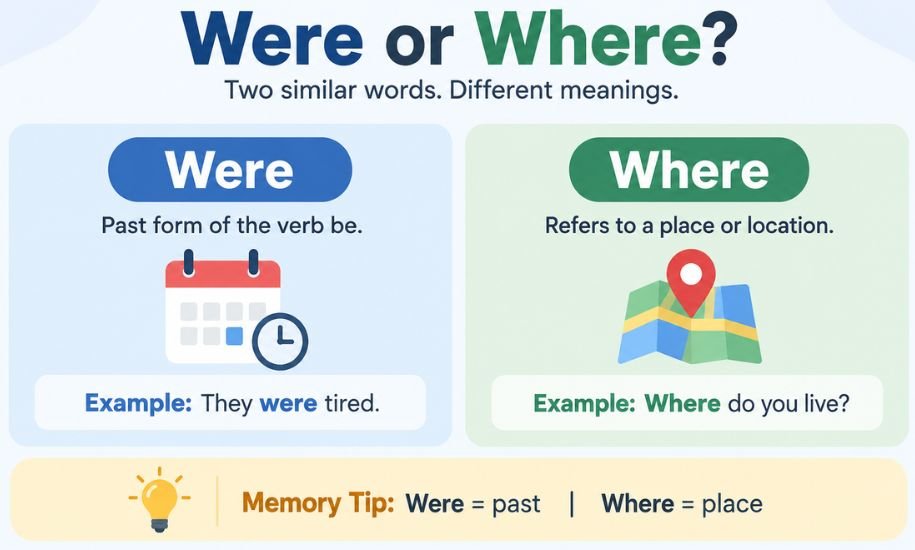
Were is a past form of be, as in “They were tired.” Where refers to a place or position, as in “Where do they live?” Both words are correct, but they cannot normally be substituted for each other.
Were or Where: The Basic Difference
The easiest way to distinguish these words is to ask what role the word plays in the sentence.
| Word | Part of Speech | Main Meaning | Example |
|---|---|---|---|
| were | Verb | Past form of be | They were excited. |
| where | Adverb, conjunction, or pronoun | Place, position, or location | Where are they? |
Were tells us about a past state, condition, identity, or situation. It is commonly used with you, we, they, and plural nouns.
Where deals with a location or position. It can be used in direct questions, indirect questions, and clauses that identify a place or situation.
For example:
- We were at the library.
- Where were you?
- I remember where we met.
Notice that the last two sentences can contain both words. They have different jobs, so there is no conflict between them.
What Does “Were” Mean?
Were is a past-tense form of the verb be. It is commonly used with:
- You
- We
- They
- Plural nouns
Examples include:
- You were right.
- We were ready to leave.
- They were at the restaurant.
- The children were asleep.
- The books were on the desk.
In these sentences, were connects the subject with a past condition, identity, location, or description.
“Were” in hypothetical situations
There is another important use of were in hypothetical or unreal statements:
If I were you, I would wait.
Here, were is used even though the subject is singular (I). This is a traditional form of the subjunctive mood, particularly common in expressions such as “If I were you.”
Other examples include:
- If she were here, she could help us.
- I wish it were easier.
- If he were more careful, this would not happen.
This use is different from simply describing something that happened in the past.
What Does “Where” Mean?
Where is primarily associated with place or position.
It is often used to ask about location:
- Where do you live?
- Where is my phone?
- Where did they go?
- Where can I find the information?
It can also introduce a clause:
- I know where she works.
- This is the house where I grew up.
- Do you remember where we parked?
Importantly, where does not always refer to a physical place. It can sometimes identify a point, situation, or stage:
We reached a point where we had to make a difficult decision.
The word still establishes a relationship to a particular point or circumstance.
“They Where or Were”: Which One Is Correct?
When talking about a past state or action involving they, the correct word is usually were.
Correct: They were happy with the result.
Incorrect: They where happy with the result.
More examples:
- They were late for class.
- They were working yesterday.
- They were surprised by the news.
- They were outside when I called.
However, where can appear with they when the sentence concerns location:
- Where are they?
- Where were they yesterday?
- I don’t know where they went.
The sentence “Where were they?” is especially useful for understanding the difference. Where asks about the place, while were functions as the verb.
“Were You Able” or “Where You Able”?
The correct expression is:
Were you able to finish the assignment? ✅
Not:
Where you able to finish the assignment? ❌
The phrase “were you able” uses were as part of a question about someone’s ability or success in the past.
Examples:
- Were you able to contact the doctor?
- Were you able to solve the problem?
- Were you able to attend the meeting?
- Were you able to find your wallet?
By contrast, where is appropriate when asking about a place:
- Where were you yesterday?
- Where were you able to park?
- Where were you able to buy the tickets?
So if the intended meaning is “Did you manage to…?” or “Could you…?”, were is the appropriate word in the construction “were you able to.”
Where or Were: Examples in Real Sentences
Seeing the words in different contexts makes the distinction easier to remember.
Using “were”
- We were tired after the journey.
- You were very helpful.
- They were at home last night.
- The students were prepared for the test.
- The flowers were beautiful.
Using “where”
- Where is the nearest store?
- Where did you put the keys?
- Tell me where you found it.
- Do you know where she lives?
- This is the park where we first met.
Using both words
- Where were you last night?
- Where were the documents kept?
- Do you remember where we were sitting?
- I don’t know where they were going.
- Where were the children playing?
These examples show why choosing between the two is not always an either-or decision. A sentence can legitimately require both.
Why Are These Words So Easy to Confuse?
The main difficulty is their similar appearance and pronunciation. In ordinary conversation, were and where can sound close enough that it is easy to rely on sound rather than grammar.
Spelling can also cause confusion when someone is writing quickly. Because both words contain similar letters and are short, a typing error can easily go unnoticed.
The best solution is to focus on the meaning and grammatical function rather than pronunciation.
Ask yourself:
Am I talking about a past state or situation?
If yes, were may be the right choice.
Am I asking about or referring to a place or position?
If yes, where is likely correct.
An Easy Way to Remember the Difference
A simple memory rule is:
Were = past
Where = place
For example:
They were tired.
This describes their condition in the past.
Where are they?
This asks about their location.
You can also associate where with location-related words such as here and there. If the sentence is concerned with where something is, where is probably the word you need.
For were, look for a sentence describing what someone or something was like or where they were in the past.
Common Mistakes to Avoid
1. Writing “they where”
Incorrect: They where excited.
Correct: They were excited.
The sentence describes a past condition, so it needs the verb were.
2. Using “were” when asking about location
Incorrect: Were is the station?
Correct: Where is the station?
The question asks for a place, so where is required.
3. Confusing “where” with “were” in indirect questions
Incorrect: I don’t know were she lives.
Correct: I don’t know where she lives.
The sentence refers to her location.
4. Mixing up “were you able” and “where you able”
Incorrect: Where you able to finish?
Correct: Were you able to finish?
Here, the sentence asks about ability in the past.
5. Assuming the words cannot appear together
They absolutely can:
Where were you when I called?
There is no repetition or error. Each word performs a separate grammatical function.
Were, Where, and “We’re”
A third word sometimes adds to the confusion: we’re.
We’re is a contraction of we are.
Compare:
- We were tired. → past
- Where are we? → location
- We’re tired. → we are
The pronunciation of these words can be similar in some contexts, but their meanings and grammatical roles are different.
A useful three-way test is:
Were → past form of be
Where → place or position
We’re → we are
For example:
We were at the office.
Where are we now?
We’re at the office.
Learning these three together can prevent a large number of spelling and grammar mistakes.
Is It “Where” or “Were” in a Question?
The answer depends on what the question asks.
If you are asking about location, use where:
Where is your brother?
If you are asking about a past state or condition, use were:
Were you tired?
If you ask about someone’s past location, you may need both:
Where were you yesterday?
This is why there is no single rule saying that one word belongs in questions and the other does not. Their function within the sentence determines the correct choice.
A Simple Test Before You Write
When you’re unsure, replace the word mentally with a related phrase.
If you can substitute “in what place?”, you probably need where:
Where did they go?
→ In what place did they go?
If you can substitute a past form of “are” or “be,” you probably need were:
They were nervous.
→ They were in a nervous state.
For the expression “were you able to,” think of it as asking:
Did you manage to…?
That makes the correct spelling much easier to recognize.
Frequently Asked Questions
Is “were or where” the same as “where or were”?
Yes. Both expressions refer to the same distinction between the two words. The order does not change the grammatical difference: were is a form of be, while where refers primarily to place or position.
Is “they where” ever correct?
In standard English, “they where” is normally incorrect when where is intended as the verb. The correct sentence is “They were…” For example, “They were ready” is correct. Where can appear later in a sentence involving they, such as “I don’t know where they went.”
Is “were you able” or “where you able” correct?
“Were you able” is correct when asking whether someone managed to do something. For example, “Were you able to finish the report?” Where would only be appropriate if the sentence concerns location.
Can “were” and “where” be in the same sentence?
Yes. In fact, this is very common. In “Where were you?”, where asks about location and were is the past-tense verb. Their different grammatical functions make the sentence completely correct.
What is the easiest way to remember the difference?
Remember “were = past” and “where = place.” If the sentence describes a past state, condition, or situation, consider were. If it asks about or identifies a location or position, use where.
The Bottom Line
The choice between were and where becomes much easier when you focus on what the sentence means. Use were as a past form of be, as in “They were ready.” Use where when referring to a place, position, or location, as in “Where are they?” And when you see both together—“Where were you?”—remember that each word has a different job. For more clear, practical explanations of confusing English words and grammar choices, Grammarifyr helps you know the difference and use the right words.
You may also Read : Defence or Defense: Meaning and Correct Usage
One Comment