Sargent or Sergeant: Correct Spelling Explained
It is easy to hesitate between sargent and sergeant, especially because the word’s pronunciation does not make its spelling obvious. If you are writing about a military or police rank, however, there is a clear standard form. The correct spelling is sergeant. The form sargent is normally a misspelling in this context, although Sargent can be perfectly valid when it appears as a surname or other proper name. Understanding this small distinction can help you avoid an easy spelling mistake in formal writing.
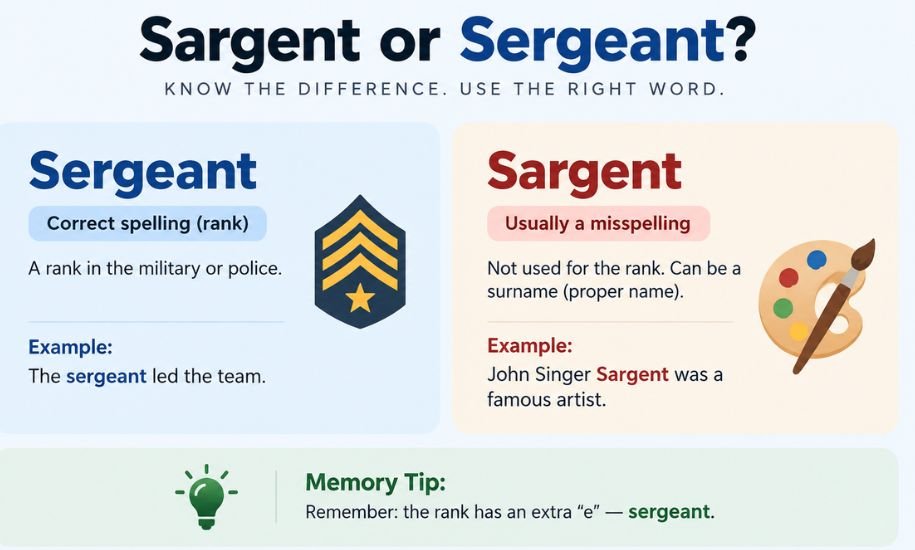
Sergeant is the correct spelling for the military or police rank. Sargent is generally a misspelling when used to mean that rank, but “Sargent” can be correct as a surname or proper name.
Sergeant vs. Sargent: What’s the Difference?
The distinction is straightforward:
| Form | Correct for a rank? | Typical use |
|---|---|---|
| sergeant | Yes | Military and police rank |
| sargent | No | Common misspelling of sergeant |
| Sargent | Not as a rank | Surname or proper name |
| Sgt. | Yes | Abbreviation of sergeant |
If you mean a person holding the rank, use sergeant.
For example:
The sergeant addressed the new recruits.
If Sargent is someone’s surname, retain that spelling:
John Singer Sargent was a well-known American artist.
So, although the two forms look similar, they do not normally have the same function.
What Does “Sergeant” Mean?
Sergeant is a noun referring to a rank in military and police organizations. The exact responsibilities and position of a sergeant vary depending on the organization and country.
In military contexts, a sergeant is generally a noncommissioned officer. Police departments can also use the rank to identify an officer with supervisory or other responsibilities.
Here are some natural examples:
- The sergeant checked the equipment before the exercise.
- She was promoted to sergeant after several years of service.
- The police sergeant spoke with the officers at the station.
- The drill sergeant gave instructions to the recruits.
The word can also appear as part of longer rank titles, such as staff sergeant, master sergeant, and sergeant major.
The abbreviation
The common abbreviation is Sgt.
For example:
Sgt. Miller reported to the station at 7 a.m.
In formal prose, however, spelling out sergeant is often preferable when there is no reason to abbreviate it.
Is “Sargent” a Real Word?
This is where the answer becomes slightly more interesting.
Sargent can be a real and correct word when it is a surname. It should not automatically be treated as a spelling error simply because it does not contain the e found in sergeant.
A famous example is John Singer Sargent, the American painter.
Therefore, the correct spelling depends on what you are referring to:
The sergeant entered the room.
Sargent was his family name.
In the first sentence, sergeant is a rank. In the second, Sargent is a proper name.
This distinction is especially important when proofreading names. You should never “correct” someone’s surname from Sargent to Sergeant.
Police Sergeant or Sargent?
If you are referring to the police rank, the correct expression is:
police sergeant
Not:
police sargent
For example:
The police sergeant interviewed the witnesses.
The same rule applies to other police-related expressions:
- police sergeant
- sergeant in the police department
- detective sergeant
- supervising sergeant
The spelling does not change simply because the rank belongs to a police organization rather than a military one.
Sergeant or Sargent in the Military
For military writing, sergeant is the standard spelling.
You will encounter the word in titles and descriptions such as:
- Army sergeant
- staff sergeant
- master sergeant
- sergeant major
- drill sergeant
- gunnery sergeant
Examples:
The army sergeant organized the training exercise.
She hoped to become a staff sergeant.
The drill sergeant explained the procedure carefully.
Writing sargent in these sentences would be considered a spelling error if you intend the military rank.
Why Are These Words So Often Confused?
The main difficulty is that sergeant has an unusual relationship between its spelling and pronunciation.
Depending on the variety of English, it is pronounced approximately like “SAR-jənt” rather than being pronounced exactly as its letters might suggest. Because the spoken form does not clearly reveal the spelling, writers may naturally produce phonetic alternatives such as sargent.
There is also a visual reason for the mistake. The sequence -ergea- in sergeant is unusual, while sargent looks simpler and may seem more intuitive.
The important point is that pronunciation is not a reliable way to reconstruct the spelling. When referring to the rank, memorize the standard written form: sergeant.
How to Spell “Sergeant” Correctly
If you are unsure how to spell the word, remember these letters:
S-E-R-G-E-A-N-T
A useful approach is to break it into two parts:
SER + GEANT
Then remember that the complete word is:
SERGEANT
Another practical memory trick is to associate the unusual spelling with the rank itself:
SERGEANT = military or police rank
You can also remember the abbreviation Sgt., which confirms that the full word is sergeant, not sargent.
Correct and Incorrect Examples
Seeing the forms side by side makes the distinction easier.
Correct
The sergeant inspected the vehicle.
The police sergeant arrived shortly afterward.
He was promoted to sergeant.
The staff sergeant briefed the team.
Sgt. Davis signed the report.
Incorrect when referring to the rank
The sargent inspected the vehicle.
The police sargent arrived shortly afterward.
He was promoted to sargent.
The staff sargent briefed the team.
In all of these examples, sergeant is the required spelling.
Correct as a surname
The painting was created by John Singer Sargent.
Here, Sargent is correct because it is part of a person’s name.
Common Mistakes to Avoid
1. Writing “sargent” for the rank
This is the most common error. If you mean a military or police rank, always use sergeant.
2. Assuming pronunciation determines spelling
The pronunciation can make the word sound as though it should be spelled sargent. English spelling does not always follow pronunciation closely, so this is a word worth memorizing.
3. Changing a person’s surname
If someone’s surname is Sargent, don’t change it to Sergeant. Proper names retain their established spelling.
4. Misspelling related ranks
The same spelling should be retained in compound titles:
- staff sergeant, not staff sargent
- sergeant major, not sargent major
- drill sergeant, not drill sargent
How Do You Pronounce “Sergeant”?
Pronunciation can vary somewhat between English-speaking regions, but the word generally sounds roughly like “SAR-jənt.”
This is one reason spelling the word from sound can be difficult.
The pronunciation should therefore not lead you to write sargent. The standard written form remains sergeant.
How to Choose the Right Form
When deciding between the two spellings, ask what the word represents.
If it is a rank:
Use sergeant.
The sergeant spoke to the recruits.
If it is a surname:
Use Sargent if that is the person’s actual name.
Sargent exhibited his work in several galleries.
If you are using an abbreviation:
Use Sgt.
Sgt. Brown led the patrol.
This simple context-based rule covers most situations.
Frequently Asked Questions
Is it sargent or sergeant?
For the military or police rank, sergeant is correct. Sargent is normally a misspelling in that context. However, Sargent can be a legitimate surname, so the spelling is not inherently invalid in every situation.
Is “sargent” ever correct?
Yes, when Sargent is a proper name, particularly a surname. For example, John Singer Sargent’s surname is spelled with an a. It is not the standard spelling of the military or police rank.
Is it “police sergeant” or “police sargent”?
The correct expression is police sergeant. When referring to the police rank, sergeant must be spelled with the e after the initial s.
Is “sergeant” a military rank?
Yes. Sergeant is used as a military rank in various armed forces, although its exact position and responsibilities differ between countries and services. The word is also used for police ranks.
How do you spell sargent or sergeant?
If you mean the rank, spell it sergeant: S-E-R-G-E-A-N-T. The form sargent should not be used for the rank.
What is the abbreviation for sergeant?
A common abbreviation is Sgt. For example, “Sergeant Miller” may be abbreviated as “Sgt. Miller” where an abbreviation is appropriate.
Final Verdict: Sargent or Sergeant?
When you’re talking about a military or police rank, the correct spelling is sergeant. The spelling sargent is a common error caused partly by the word’s pronunciation. The one important exception is when Sargent is someone’s proper surname, as in John Singer Sargent. Keeping that distinction in mind makes the choice easy. For more straightforward explanations of confusing English words and spellings, Grammarifyr helps you know the difference and use the right words.
You may also Read : Were or Where: Meaning, Uses, and Examples
One Comment