Useable or Usable: Difference and Correct Usage
When you’re writing about something that can be used, you may hesitate between useable and usable. The two spellings look almost identical, and both have appeared in English for a long time. So is one wrong, or can you use either? The short answer is that both forms are accepted, but usable is the preferred and more common spelling in modern standard English. Useable is a legitimate variant, although it is less common. Knowing this distinction helps you choose the form that will look most natural in professional, academic, and everyday writing.
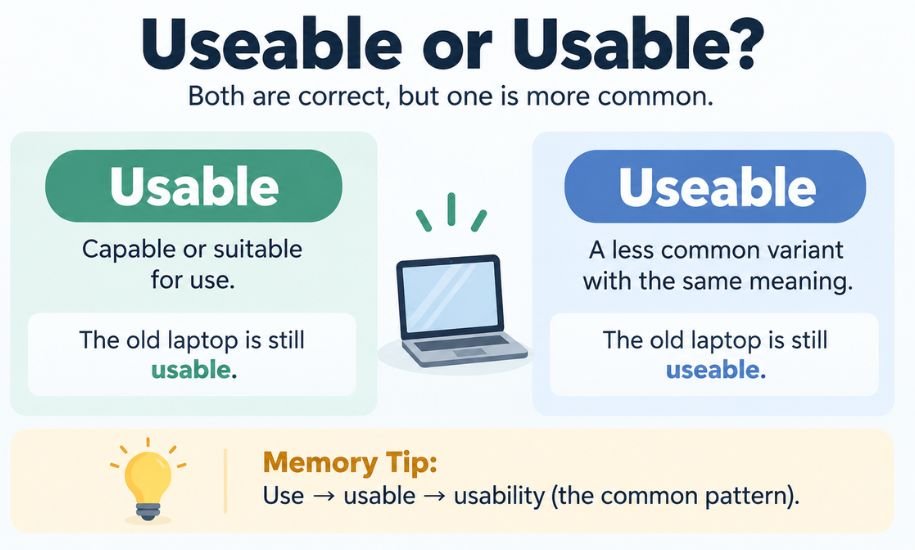
Usable is the preferred spelling in modern English. Useable is also a valid variant, but it is less common. Both forms generally mean “capable of being used” or “fit for use.”
Useable or Usable: The Quick Difference
There is no major difference in meaning between the two forms. Both are adjectives describing something that can be used or is suitable for use.
| Feature | Usable | Useable |
|---|---|---|
| Correct spelling? | Yes | Yes |
| Meaning | Capable or suitable for use | Capable or suitable for use |
| Part of speech | Adjective | Adjective |
| Frequency | Preferred/common | Less common variant |
| Best choice for most writing | Yes | Usually no |
If you’re deciding which form to put in an essay, report, website, email, or other formal text, usable is generally the safest choice.
What Does “Usable” Mean?
Usable is an adjective meaning that something is capable of being used, suitable for use, or practical enough to be useful.
For example:
- The old laptop is still usable.
- We need usable information before making a decision.
- The room has very little usable space.
- Is this printer still usable?
- The application has a simple and usable interface.
The word can describe physical objects, information, spaces, systems, tools, software, designs, and many other things.
There is also an important distinction between usable and useful. Something can be usable without being particularly useful. For example, an old calculator might still work and therefore be usable, even though you have little reason to use it.
Is “Useable” a Real Word?
Yes. Useable is a real word, not simply a spelling mistake.
Major dictionaries recognize it as a variant of usable. However, it is not the form most writers would normally choose today. The spelling usable is more established as the standard choice in contemporary English.
For example, both of these sentences are understandable and grammatically acceptable:
The damaged equipment is still usable.
The damaged equipment is still useable.
The first version will generally look more natural to modern readers.
This is why it is better to describe useable as a less common variant rather than saying that it is always incorrect.
Why Do People Confuse the Two Spellings?
The confusion comes largely from the way use combines with the suffix -able.
When forming words with -able, English spelling sometimes changes the original word slightly. Writers may therefore wonder whether the final e in use should remain:
use + able → usable
or:
use + able → useable
Both patterns can be encountered in English, which explains why the alternative spelling has remained in use.
For practical writing, however, you do not need to work out the spelling every time. Simply remember that usable is the preferred form.
Usable or Useable in a Sentence
Because both spellings carry essentially the same meaning, the choice usually comes down to standard usage and consistency.
Preferred
The instructions are clear and usable.
We found several usable pieces of equipment.
The data isn’t usable in its current form.
This storage area provides more usable space.
Variant
The instructions are clear and useable.
We found several useable pieces of equipment.
The second set is not necessarily grammatically wrong. It simply uses the less common spelling.
In polished professional writing, usable is normally the better option.
What Is the Difference Between “Usability” and “Useability”?
The same spelling question appears with the related noun forms usability and useability.
Usability is the preferred form.
It refers to how easy, practical, or effective something is to use. The term is especially common when discussing products, websites, software, interfaces, and systems.
Examples:
- The website has excellent usability.
- We tested the app to improve its usability.
- Good usability makes a product easier to understand.
- The redesign significantly improved the system’s usability.
Useability is also found as a variant, but it is much less common. If you are writing for a general audience, usability is the form to choose.
So the practical pattern is:
usable → usability
rather than:
useable → useability
The less common variants exist, but the first pair is the conventional choice for modern writing.
Is It “Usable or Useable” in Formal Writing?
For formal writing, choose usable.
This includes:
- Academic assignments
- Business reports
- Professional emails
- Technical documentation
- Website content
- Product descriptions
- Research writing
- General published material
Using usable does not mean that useable is incomprehensible or inherently wrong. Rather, it follows the spelling that readers are more accustomed to seeing.
If you’re editing an existing document, consistency also matters. If an organization or publication has a particular style guide, follow that guide throughout the document.
A Simple Way to Remember the Preferred Spelling
A useful memory trick is to think of the common word pair:
use → usable
The shorter spelling is the one you will most often want.
You can also remember the related noun:
usable → usability
If you’re unsure while writing, usable is the straightforward default.
This doesn’t mean that useable needs to be treated as a spelling error in every context. It simply means that usable is the better choice when you want the most conventional modern form.
Common Mistakes to Avoid
1. Calling “useable” completely incorrect
This is the biggest mistake when explaining the difference. Since dictionaries recognize useable as a variant, calling it universally wrong is unnecessarily absolute.
2. Assuming the two words have different meanings
They generally do not. Both describe something that can be used or is suitable for use.
3. Using “useability” when “usability” is expected
Although useability exists as a variant, usability is the conventional form and should normally be preferred.
4. Confusing “usable” with “useful”
These words are related but not identical.
Usable means something can be used or is fit for use.
Useful means something provides a benefit or helps accomplish a purpose.
For example:
The old computer is still usable, but it isn’t particularly useful for modern software.
Usable vs. Useful: A Helpful Distinction
The difference becomes clearer with a practical example.
Imagine you have an old chair. If the chair is stable enough to sit on, it is usable. If it is also comfortable and helpful for your needs, you might call it useful.
Likewise, a piece of information can be technically usable without being particularly useful.
Consider:
The spreadsheet contains usable data, but very little of it is useful for our current project.
Here, usable describes whether the information can be used, while useful describes its value or benefit.
Frequently Asked Questions
Is “usable” or “useable” correct?
Both are accepted spellings. However, usable is the preferred and more common form in modern standard English. Useable is a legitimate variant but is less frequently used.
Is “useable” a misspelling?
Not necessarily. Dictionaries recognize useable as a variant of usable. It is therefore better described as a less common spelling rather than an outright misspelling.
Is “usable” American or British English?
Usable is used in both American and British English. It is not exclusively an American spelling. Useable can also be found, particularly as a variant, but usable is generally the safer choice for an international audience.
Is it “usability” or “useability”?
Usability is the preferred form. Useability is also found as a variant, but it is much less common. In professional and technical writing, usability is normally the best choice.
Is “usable” an adjective?
Yes. Usable is an adjective. It describes something that can be used, is fit for use, or is practical enough to use.
Which spelling should I use in formal writing?
Choose usable. While useable is recognized, usable is the conventional modern form and will generally be the most natural choice in formal, academic, business, and professional writing.
Final Verdict: Useable or Usable?
Usable is the best spelling to choose in most situations. Useable is not simply a mistake—it is a recognized alternative spelling with the same basic meaning—but it is less common. The same principle applies to usability, which is preferred over useability. When in doubt, remember use → usable → usability. For clear and conventional English, Grammarifyr recommends using the standard forms that readers will recognize most readily.
You may also Read : Sargent or Sergeant: Correct Spelling Explained
One Comment