Catalog or Catalogue: Meaning and Correct Usage
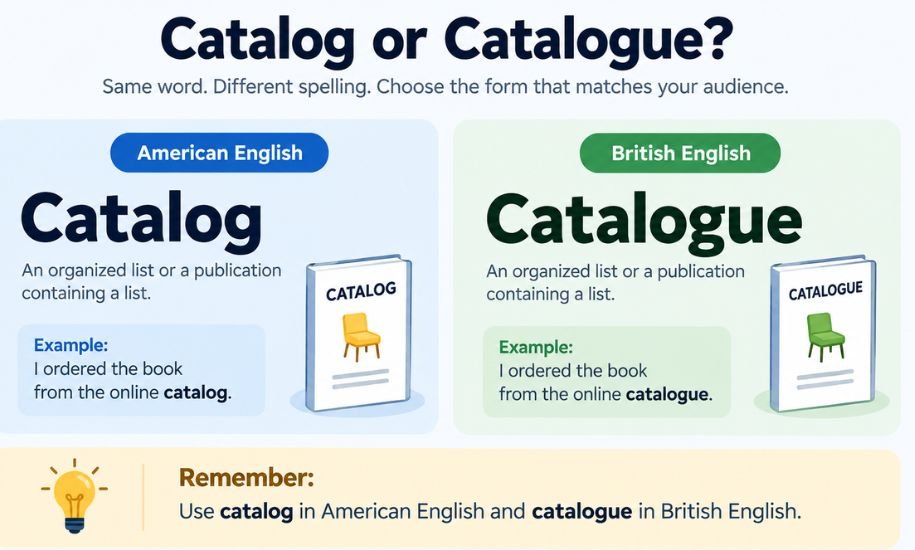
If you have ever wondered whether to write catalogue or catalog, you are dealing with a difference between English varieties rather than a simple right-versus-wrong spelling. Both forms are correct, but the preferred spelling depends largely on your audience. Catalog is standard in American English, while catalogue is the usual British English form. The same regional distinction appears in related forms such as cataloged/catalogued and cataloging/cataloguing. Understanding the pattern makes it much easier to choose the right spelling and use it consistently.
Both catalog and catalogue are correct. Catalog is preferred in American English, while catalogue is preferred in British English and is also common in other varieties influenced by British usage. Choose the form that matches your intended variety of English and remain consistent.
Catalog vs. Catalogue: What’s the Difference?
The central difference is regional spelling, not meaning.
| Feature | Catalog | Catalogue |
|---|---|---|
| Standard usage | American English | British English |
| Part of speech | Noun and verb | Noun and verb |
| Basic meaning | An organized list or a publication containing a list | An organized list or a publication containing a list |
| Example | The store released its new product catalog. | The store released its new product catalogue. |
| Related past form | cataloged | catalogued |
| Related -ing form | cataloging | cataloguing |
In other words, you generally do not change the meaning when you change the spelling. The choice is mainly about which regional standard you are following.
For a US audience, catalog will usually look more natural. For a UK audience, catalogue is the conventional choice.
What Does “Catalog” Mean?
Catalog can be a noun or a verb.
As a noun, it refers to an organized list of items, often with information about each item. A retail business might publish a product catalog, while a library might maintain a catalog of its books.
Examples:
- I ordered the chair from the company’s online catalog.
- The library’s catalog contains thousands of titles.
- The museum published a catalog of the exhibition.
As a verb, catalog means to arrange, record, classify, or list items systematically.
Examples:
- The librarian will catalog the new arrivals.
- Researchers cataloged the specimens before beginning the study.
- The archive is cataloging historical photographs.
The spelling without -ue is especially associated with American English.
What Does “Catalogue” Mean?
Catalogue has the same basic meanings as catalog. It can also be used as both a noun and a verb.
Examples as a noun:
- The company sent customers its latest product catalogue.
- I checked the university catalogue before choosing my courses.
- The gallery produced a catalogue for the exhibition.
Examples as a verb:
- The librarian is cataloguing the new books.
- Staff carefully catalogued the museum’s collection.
- The archive is cataloguing documents from the nineteenth century.
The important point is that catalogue is not a different concept from catalog. It is primarily the British spelling of the same word.
Is It “Catalog or Catalogue” in American English?
If you are writing in American English, catalog is normally the preferred spelling.
For example:
- The bookstore published a new catalog.
- Students can search the online catalog.
- The company sent me a product catalog.
- The museum has cataloged its collection.
American English commonly drops the -ue ending in this word.
That does not mean catalogue is meaningless to American readers. Americans will generally recognize it, particularly in international or British contexts, but catalog is the normal American spelling.
Is It “Catalogue or Catalog” in British English?
In British English, catalogue is the traditional and standard spelling.
For example:
- The university published its course catalogue.
- Please consult the library catalogue.
- The retailer’s Christmas catalogue arrived yesterday.
- The museum has catalogued its paintings.
British English retains the -ue ending, following the spelling pattern seen in several words of this type.
If you are writing for readers in the United Kingdom, using catalogue consistently is generally the safest choice.
Cataloged or Catalogued: Which Is Correct?
Both cataloged and catalogued are correct forms, with the same American/British distinction.
- cataloged → American English
- catalogued → British English
For example:
American English:
The librarian cataloged all the new books.
British English:
The librarian catalogued all the new books.
The verb is the same. Only the spelling changes.
This is useful to remember because readers sometimes assume that one of these forms must be a spelling mistake. It is not. The correct choice depends on the variety of English being used.
The pattern in context
American English:
The museum cataloged its collection in digital form.
British English:
The museum catalogued its collection in digital form.
Both sentences are grammatically correct.
Cataloguing or Cataloging: What About the -ing Form?
The same pattern continues with the present participle or gerund:
- cataloging → American English
- cataloguing → British English
Examples:
The team is cataloging thousands of historical records.
The team is cataloguing thousands of historical records.
Again, neither form is universally “wrong.” The spelling should match the English variety used in the surrounding text.
This gives you a simple three-part pattern:
American English
- catalog
- cataloged
- cataloging
British English
- catalogue
- catalogued
- cataloguing
Why Are These Spellings Different?
The difference is largely connected to the spelling conventions used by American and British English.
American English has developed a number of spelling preferences that differ from traditional British forms. Words ending in -ogue sometimes have shorter American variants ending in -og.
The same general pattern can be seen in words such as:
- dialogue → dialog
- analogue → analog
- catalogue → catalog
However, these pairs do not always behave identically in every context or style guide. For catalog/catalogue, the regional distinction is particularly well established.
The important practical lesson is not to treat the shorter form as an error. Catalog is a legitimate standard spelling, just as catalogue is.
Examples: How to Use Both Forms Correctly
Here are some natural examples showing how the spelling changes according to regional English.
American English
- I found the product in the online catalog.
- The library has updated its digital catalog.
- Researchers cataloged the artifacts.
- The team is cataloging the photographs.
British English
- I found the product in the online catalogue.
- The library has updated its digital catalogue.
- Researchers catalogued the artifacts.
- The team is cataloguing the photographs.
Notice that the grammar and meaning remain unchanged. Only the spelling convention differs.
What Should You Use in Formal Writing?
The best choice depends on your audience and your chosen style of English.
If you are writing for an American publication, company, school, or general audience, use:
catalog → cataloged → cataloging
If you are writing for a British audience, use:
catalogue → catalogued → cataloguing
The most important principle is consistency. Avoid switching between American and British spellings without a reason.
For example, if an article is otherwise written in American English, writing catalogue in one paragraph and catalog in another can make the text look inconsistent. The same applies to cataloged and catalogued.
Common Mistakes to Avoid
1. Treating “catalogue” as incorrect
It is incorrect to say that catalogue is simply a misspelling. It is a standard spelling, particularly in British English.
2. Treating “catalog” as incorrect
Likewise, catalog is not a mistake. It is the standard American English form.
3. Mixing regional forms unnecessarily
Using catalog in one sentence and catalogued in the next may create an inconsistent style if there is no contextual reason for the switch.
4. Assuming the verb forms have different meanings
Cataloged and catalogued mean the same thing. The spelling reflects regional convention rather than a difference in tense or meaning.
5. Thinking “cataloguing” is a different grammatical form
It is simply the British spelling corresponding to American cataloging. Both are forms of the verb.
An Easy Way to Remember the Difference
A simple rule is:
US English = shorter form
UK English = -ue form
So:
US: catalog, cataloged, cataloging
UK: catalogue, catalogued, cataloguing
When you are unsure, first ask yourself: Who am I writing for?
If the intended readers primarily use American English, choose catalog. If they use British English, choose catalogue.
Frequently Asked Questions
Is “catalog” or “catalogue” correct?
Both are correct. Catalog is the standard American English spelling, while catalogue is the standard British English spelling. They have the same basic meaning and can both be used as nouns and verbs.
Is catalogue American or British English?
Catalogue is primarily associated with British English and other varieties that follow British spelling conventions. American English generally uses catalog instead.
Is catalog a British spelling?
Catalog is widely recognized in British English, but catalogue is the conventional British spelling. The shorter form is particularly characteristic of American English.
Is “catalogued or cataloged” correct?
Both forms are correct. Cataloged is the usual American English spelling, while catalogued is the usual British English spelling.
Which is correct: cataloguing or cataloging?
Both are correct regional forms. Cataloging is standard in American English, whereas cataloguing is standard in British English.
Can I use “catalogue” in American English?
Yes, readers in the United States will generally understand catalogue, but catalog is the normal American spelling. If you are following American English style, use catalog consistently.
The Bottom Line
When deciding between catalogue or catalog, there is no universal winner. Catalog is the preferred American English spelling, while catalogue is preferred in British English. The same distinction applies to cataloged/catalogued and cataloging/cataloguing. Choose according to your audience, then keep the spelling consistent throughout your writing. That simple approach will help you use the right form with confidence—and that is exactly the kind of practical distinction Grammarifyr is designed to make clear.
You may also Read : Colour or Color: US and UK Spelling Explained

One Comment