Eyeing or Eying: Difference, Meaning and Examples
If you are unsure whether to write “eyeing” or “eying,” you are not alone. The confusion comes from the unusual spelling of the verb eye when it takes the -ing ending. The good news is that this is not a simple case of one spelling being right and the other being wrong. Both “eyeing” and “eying” are accepted forms, although “eyeing” is often the clearer choice for general writing. Understanding how each form works will help you use it confidently in sentences.
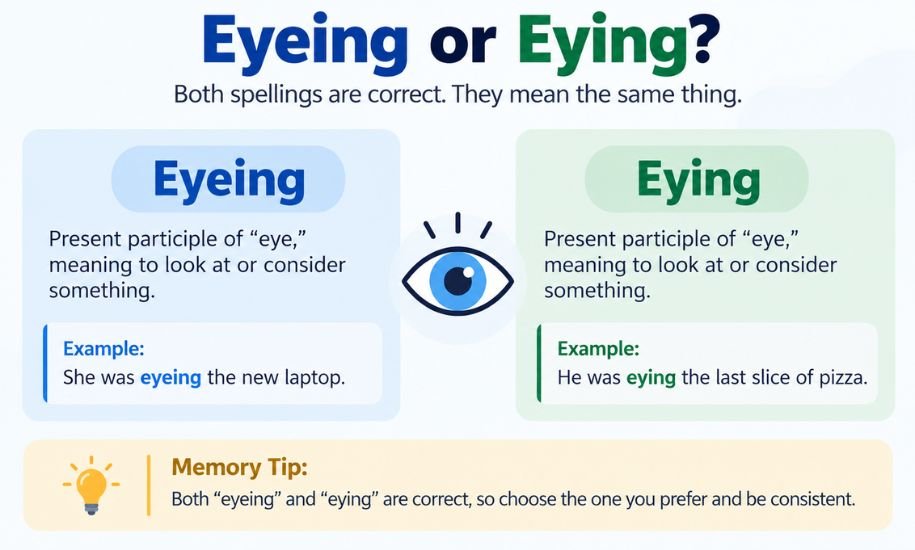
Both “eyeing” and “eying” are correct spellings. They are present-participle forms of the verb “eye,” meaning to look at, watch, consider, or show interest in something. For most general English writing, “eyeing” is a clear and familiar choice.
Eyeing or Eying: What’s the Difference?
There is no major difference in meaning between the two spellings. Both come from the verb eye.
The verb eye can mean to look at someone or something carefully or with particular interest. It can also mean to consider or target something, especially in expressions such as eyeing a promotion or eyeing a new opportunity.
Both forms can therefore be used in sentences such as:
- She was eyeing the last slice of pizza.
- She was eying the last slice of pizza.
- The company is eyeing international expansion.
- The company is eying international expansion.
The meaning remains essentially the same.
Quick comparison
| Feature | Eyeing | Eying |
|---|---|---|
| Correct spelling? | Yes | Yes |
| Base verb | Eye | Eye |
| Grammatical form | Present participle | Present participle |
| Basic meaning | Looking at or considering | Looking at or considering |
| Suitable for general writing | Yes | Yes |
| Meaning difference | None | None |
What Does “Eyeing” Mean?
Eyeing is the present participle of eye. Depending on context, it can mean looking at something attentively, watching something closely, or considering something as a possibility.
For example:
- The child was eyeing the colorful toy.
- He kept eyeing the clock during the meeting.
- The athlete is eyeing another championship.
- The company is eyeing a larger share of the market.
The word does not necessarily imply ordinary looking. Often, it suggests particular attention or interest.
For instance, if someone says, “She was eyeing the new laptop,” the sentence may suggest that she was looking at it because she was interested in buying it.
Is “Eying” a Real Word?
Yes. Eying is a legitimate spelling, so it should not automatically be treated as a misspelling.
This is an important distinction because people sometimes assume that the only possible form is eyeing. Major English dictionaries recognize eying as a form of the verb eye.
That means these sentences are both acceptable:
He was eyeing the expensive watch.
He was eying the expensive watch.
The first version may look more immediately familiar to many readers, but the second is not inherently grammatically incorrect.
Why Are These Spellings Confusing?
The unusual spelling pattern is the main reason for the uncertainty.
When adding -ing to many English verbs, the final silent e is removed:
- make → making
- write → writing
- take → taking
- use → using
Following that familiar pattern, someone might naturally expect:
eye → eying
However, eye is an unusual verb because its spelling is closely associated with the noun eye. The form eyeing keeps the full word visually recognizable.
As a result, both eyeing and eying have become established spellings.
This is one of those cases where applying a simple spelling rule does not tell the entire story.
When Should You Use “Eyeing”?
Eyeing is an excellent default choice when you want your writing to be immediately clear to a broad English-speaking audience.
It is particularly natural in expressions involving interest, attention, or ambition.
Looking at something
- The dog was eyeing the food on the table.
- She stood by the window, eyeing the crowd below.
Showing interest
- He was eyeing the new sports car.
- The shopper was eyeing a jacket in the display.
Considering an opportunity
- The player is eyeing a place in the starting lineup.
- The company is eyeing a new market.
Targeting an achievement
- The runner is eyeing another gold medal.
- The team is eyeing its third consecutive victory.
In these contexts, eyeing can mean much more than physically looking.
When Can “Eying” Be Used?
Eying can be used in the same grammatical situations.
For example:
- The cat was eying the bird.
- She was eying the new apartment.
- Investors are eying the company closely.
- The team is eying a place in the final.
There is no special meaning that makes eying fundamentally different from eyeing.
If you encounter eying in edited English, it should not automatically be corrected to eyeing simply because it looks unusual.
Eyeing or Eying in Formal Writing
For formal writing, eyeing is a sensible default because its connection to the verb eye is immediately obvious.
For example:
The organization is eyeing opportunities for further growth.
This is straightforward and natural.
However, eying is also an established form, so its use does not automatically make a sentence grammatically incorrect or informal.
The most important consideration is consistency. If you are writing a document, article, or publication and choose eyeing, continue using that spelling rather than switching between forms without a reason.
Correct and Incorrect Examples
Because both spellings are accepted, it is more useful to distinguish acceptable usage from genuinely incorrect forms.
Correct
- She was eyeing the dessert menu.
- She was eying the dessert menu.
- The company is eyeing overseas markets.
- The company is eying overseas markets.
Incorrect
A form such as “eyingg” is not a standard spelling.
Similarly, don’t confuse the verb with unrelated words simply because they look similar.
The key point is:
eye → eyeing / eying
Both forms function as present participles.
Eyeing vs. Eying in Different Contexts
The two spellings can occur in essentially the same contexts.
| Context | Example with “eyeing” | Example with “eying” |
|---|---|---|
| Looking | He was eyeing the door. | He was eying the door. |
| Interest | She was eyeing the dress. | She was eying the dress. |
| Business | The firm is eyeing expansion. | The firm is eying expansion. |
| Competition | They are eyeing the title. | They are eying the title. |
There is therefore no rule such as “use eyeing for physical looking and eying for figurative meaning.” That distinction would be incorrect.
Don’t Confuse This With Other “Eye” Questions
The word eye appears in many unrelated expressions, which can sometimes create confusion when researching its meaning.
For example, OD is an abbreviation used in eye care for the Latin oculus dexter, meaning the right eye. This is a medical abbreviation and has nothing to do with the spelling of eyeing or eying.
Likewise, questions such as “is the evil eye good or bad” concern a cultural belief rather than English spelling or grammar.
Questions about whether blue eyes are dominant or recessive or whether hazel eyes are dominant or recessive belong to the field of genetics. Eye color inheritance is more complicated than a simple one-gene dominant/recessive model.
These topics may contain the word eye, but they should not be confused with the grammatical question of how to spell the present participle of eye.
Easy Way to Remember the Correct Forms
A simple way to remember this pair is:
Eye → eyeing or eying
Think of eyeing as the spelling that keeps the complete word eye visible:
eye + ing = eyeing
At the same time, remember that eying is also an accepted form.
If you are writing for a broad audience and want the spelling that looks most immediately familiar, eyeing is a practical choice.
Common Mistakes to Avoid
1. Assuming “eying” is always wrong
It isn’t. Eying is an accepted spelling, so automatically marking it as an error can be misleading.
2. Assuming both forms have different meanings
They generally do not. Both represent the present participle of eye.
3. Applying the silent-e rule too rigidly
Although many verbs drop their final e before -ing, English contains exceptions and established spelling patterns. Eyeing is one example worth remembering.
4. Changing between forms unnecessarily
If you choose eyeing in a document, there is usually no reason to alternate between eyeing and eying. Consistent spelling makes your writing cleaner.
5. Treating every unusual spelling as a typo
Some English words have multiple accepted spellings. Before correcting an unfamiliar form, it is worth checking a reliable dictionary.
Frequently Asked Questions
Is “eyeing” or “eying” correct?
Both are correct. Eyeing and eying are accepted present-participle forms of the verb eye. For general writing, eyeing is a straightforward and familiar choice, but eying is not automatically an error.
Does “eyeing” mean looking at something?
Yes. Eyeing can mean looking at someone or something with particular attention or interest. It can also mean considering, targeting, or showing interest in an opportunity, goal, object, or outcome.
Is “eying” a misspelling?
No. Eying is a recognized spelling of the present participle of eye. Although eyeing may be more familiar to many readers, eying should not simply be classified as a spelling mistake.
Can “eyeing” mean considering something?
Yes. In contexts such as “The company is eyeing expansion,” the word means that the company is considering or targeting expansion rather than literally looking at it.
Which spelling should I use in an article?
Eyeing is a good default for a general-audience article because it makes the relationship to the verb eye immediately clear. However, eying is also grammatically acceptable.
Final Verdict: Eyeing or Eying?
Eyeing and eying are both correct. They are two accepted spellings of the present participle of eye, and they generally have the same meaning. If you want the clearest default for general English writing, choose eyeing. The alternative eying is still a legitimate form and should not automatically be treated as an error. For more practical answers to confusing English words and spelling questions, Grammarifyr helps you know the difference and use the right words.
You may also Read : Burry or Bury: The Correct Word Explained