What to Say Instead of “Family Emergency”: Professional & Polite Alternatives
Sometimes you need to explain an unexpected absence without sharing private family details. In those situations, knowing what to say instead of family emergency can help you sound professional, polite, and appropriately discreet.
Depending on the situation, you could say “urgent family matter,” “urgent personal matter,” “private family matter,” “unexpected family situation,” or “personal emergency.” These expressions are not all identical, though. Some communicate urgency, while others simply indicate that something important requires your attention.
Here are the most natural choices and how to use them.
What Does “Family Emergency” Mean?
A family emergency usually describes an unexpected and serious situation involving a family member that requires immediate attention. For example, someone might need to leave work suddenly because a relative has become ill or because an urgent family situation has developed.
However, you may not want to disclose the details. You also may not consider the situation a true emergency. In those cases, a less dramatic or more private expression can be a better choice.
For example:
“I need to take the afternoon off because of an urgent family matter.”
This communicates the essential information without requiring you to explain what happened.
Other Ways to Say “Family Emergency”
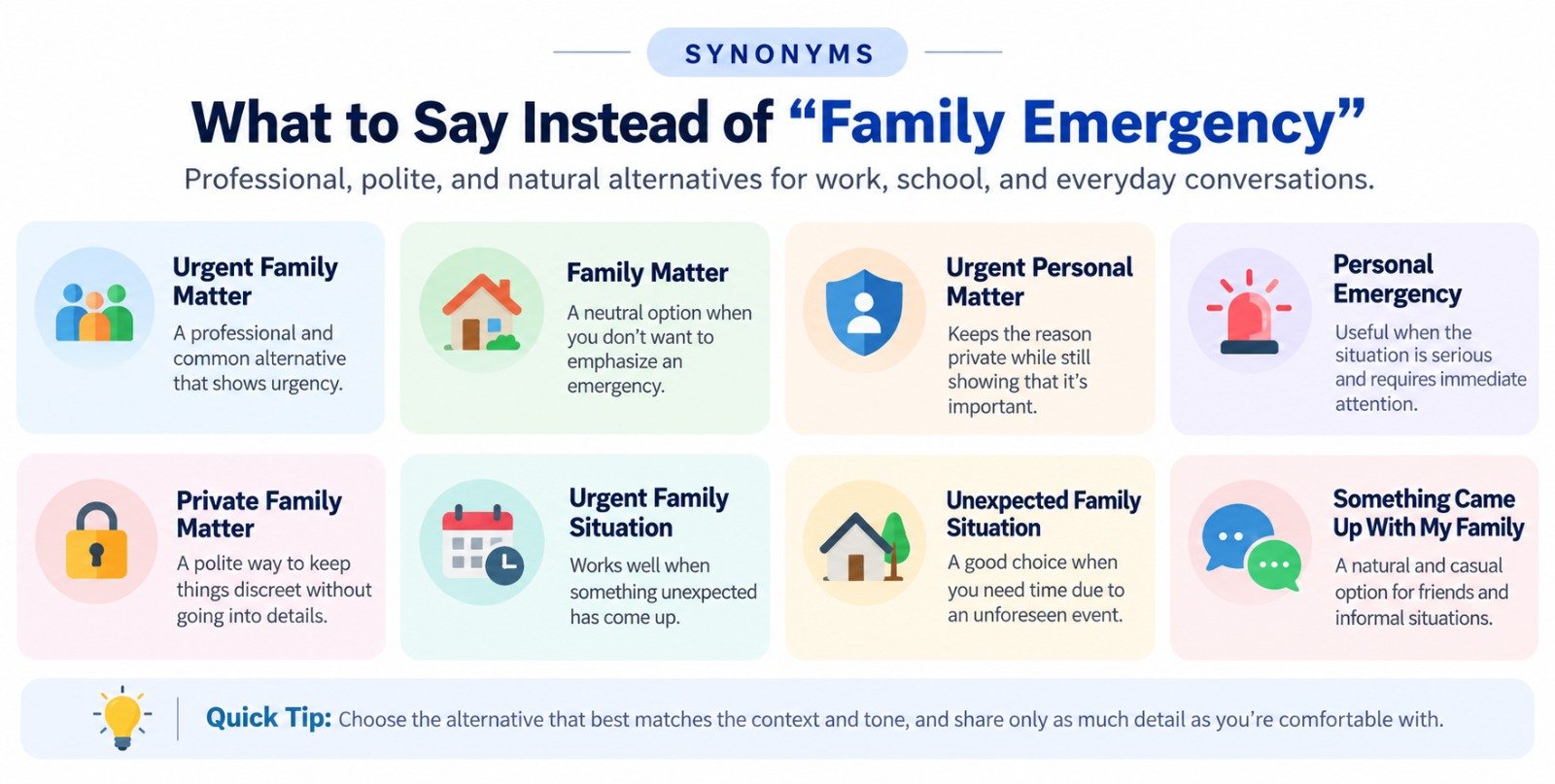
Urgent Family Matter
“Urgent family matter” is one of the best alternatives when speaking professionally. It preserves the idea that something needs immediate attention but sounds slightly more discreet than “family emergency.”
Example:
“I need to leave early today due to an urgent family matter.”
This works particularly well with managers, coworkers, teachers, and other professional contacts.
Family Matter
“Family matter” is broader and more neutral. It doesn’t necessarily suggest that something serious or unexpected has happened.
Example:
“I have a family matter to attend to this afternoon.”
Use this when you want to maintain privacy without emphasizing an emergency.
Urgent Personal Matter
When you don’t want to mention your family at all, “urgent personal matter” is a useful choice.
Example:
“I’m sorry for the short notice, but I have an urgent personal matter to deal with.”
This is especially suitable for workplace communication because it keeps the reason private.
Personal Emergency
“Personal emergency” communicates urgency while removing the family-specific detail.
Example:
“I won’t be able to come in today because of a personal emergency.”
Use it when the situation genuinely requires immediate attention. If the matter isn’t particularly urgent, “personal matter” may be more accurate.
Private Family Matter
“Private family matter” emphasizes discretion rather than urgency.
Example:
“I need to take some time away to deal with a private family matter.”
This is a good option when you want to politely signal that you don’t wish to discuss the details.
Urgent Family Situation
“Urgent family situation” is another natural professional expression. It sounds serious but doesn’t specify the circumstances.
Example:
“An urgent family situation has come up, so I need to leave work early.”
It works especially well when the situation developed suddenly.
Unexpected Family Situation
If something happened unexpectedly but you don’t want to call it an emergency, try “unexpected family situation.”
Example:
“An unexpected family situation has come up, and I need to take the day off.”
This phrase is useful when urgency exists but “emergency” feels too strong.
Family Obligation
“Family obligation” has a different emphasis. Rather than suggesting a crisis, it describes a responsibility that requires your attention.
Example:
“I have a family obligation that I need to take care of tomorrow.”
Don’t use this as a direct replacement if the situation is genuinely an emergency.
Urgent Situation at Home
If you prefer to avoid mentioning your family, “urgent situation at home” can work.
Example:
“An urgent situation at home requires my attention, so I’ll need to leave early.”
It is deliberately vague while still communicating why you need to step away.
Something Came Up With My Family
For casual conversations, “something came up with my family” sounds much more natural than a formal expression.
Example:
“Sorry, I can’t make it tonight. Something came up with my family.”
This is appropriate for friends and informal messages but may be too casual for a formal workplace email.
Professional Alternatives at Work
When communicating with a boss, manager, HR department, or coworker, brevity is usually helpful. You generally don’t need to provide a detailed explanation unless your workplace requires one.
Here are several options:
“I have an urgent family matter to attend to.”
This is perhaps the closest professional substitute for “family emergency.”
“I need to deal with an urgent personal matter.”
This provides even more privacy.
“An unexpected family situation requires my attention.”
This sounds professional and explains why you need to be absent without revealing personal information.
“I need to take some time away for a private family matter.”
This is useful when you want to politely establish a boundary around personal details.
“I have an urgent situation at home that I need to handle.”
This is broader and doesn’t identify the nature of the situation.
What to Say Instead of “Family Emergency” in an Email
An email usually benefits from clear, respectful wording rather than an elaborate explanation.
Formal:
“I’m writing to let you know that I need to take leave today due to an urgent family matter. I apologize for the short notice and appreciate your understanding.”
Concise:
“I have an urgent personal matter to attend to and will be unable to work this afternoon.”
Privacy-focused:
“Due to a private family matter, I need to take some time away from work today.”
Unexpected absence:
“An unexpected family situation has come up, and I need to be away from work today.”
The best option depends on how much information you are comfortable sharing.
What to Say to Your Boss
When talking directly to your boss, natural and straightforward wording is usually better than overly formal language.
You could say:
- “I have an urgent family matter I need to take care of.”
- “Something unexpected has come up with my family.”
- “I need to deal with a private family matter.”
- “I have an urgent personal matter to handle.”
- “I need to step away because of an unexpected situation at home.”
For example:
“I’m sorry for the short notice, but an urgent family matter has come up. I need to leave early today.”
This gives your manager enough information without unnecessarily revealing private details.
Casual Ways to Say “Family Emergency”
Not every conversation requires professional wording. With friends or relatives, more relaxed expressions often sound better.
Something Came Up With My Family
“I can’t come tonight because something came up with my family.”
Something Came Up at Home
“I’ll have to cancel. Something came up at home.”
I Need to Take Care of Something at Home
“I’m sorry, but I need to take care of something at home.”
I Need to Be With My Family
“I need to be with my family right now, so I won’t be able to make it.”
I’ve Got Some Family Stuff to Deal With
“I’ve got some family stuff to deal with today.”
This last option is quite informal, so it is better suited to friends than professional contacts.
Comparing the Best Alternatives
| Phrase | Tone | Urgency | Best Used For |
|---|---|---|---|
| Urgent family matter | Professional | High | Work, school, formal messages |
| Family matter | Neutral | Low–Medium | General professional communication |
| Urgent personal matter | Professional | High | Workplace privacy |
| Personal emergency | Formal | Very high | Serious urgent situations |
| Private family matter | Formal | Medium | Situations where privacy matters |
| Urgent family situation | Professional | High | Sudden family circumstances |
| Unexpected family situation | Neutral | Medium–High | Sudden but not necessarily critical events |
| Family obligation | Neutral | Low–Medium | Responsibilities and commitments |
| Urgent situation at home | Neutral | High | Home-related circumstances |
| Something came up with my family | Casual | Unclear | Friends and informal conversations |
Family Matter vs. Family Emergency
These two phrases are related, but they aren’t interchangeable in every situation.
Family emergency strongly suggests an urgent and serious event.
Family matter is much broader. It could refer to an appointment, responsibility, disagreement, caregiving need, or another private situation.
Compare:
“I have a family emergency and need to leave immediately.”
with:
“I have a family matter to attend to this afternoon.”
The first sentence creates a strong sense of urgency. The second simply establishes that a family-related responsibility requires attention.
If there is no genuine emergency, “family matter” may be the more accurate choice.
Personal Emergency vs. Urgent Personal Matter
These expressions are also slightly different.
Personal emergency suggests that something serious and immediate has happened.
Urgent personal matter communicates urgency but is more discreet and less dramatic.
For example:
“I’m unable to attend because of a personal emergency.”
sounds more serious than:
“I’m unable to attend because of an urgent personal matter.”
Choose the second expression when you want to communicate the need for time away without making the situation sound more severe than it is.
What to Say Instead of “Family Emergency” at School
Students and parents may sometimes need to explain an absence to a teacher, professor, or school administrator.
Appropriate options include:
- “I have an urgent family matter to attend to.”
- “An unexpected family situation has come up.”
- “I need to attend to an important family matter.”
- “I have an urgent personal matter.”
- “There is a situation at home that requires my attention.”
For example:
“I’m sorry I missed class today. An unexpected family situation required my attention.”
This is respectful without providing unnecessary personal information.
How to Choose the Right Expression
The best alternative depends mainly on urgency, privacy, and audience.
If the situation is genuinely urgent and involves your family, “urgent family matter” is a strong choice.
If you want maximum privacy, use “urgent personal matter.”
If the situation is important but isn’t an emergency, “family matter” is more appropriate.
If you’re speaking casually with a friend, “something came up with my family” sounds natural.
And if the issue is serious enough to warrant the word “emergency,” “personal emergency” can communicate urgency without identifying who is involved.
What to Avoid Saying
Some expressions may be technically understandable but aren’t ideal in professional communication.
Avoid phrases such as:
- “Family drama”
- “Family stuff”
- “Some crazy thing happened”
- “Something bad happened with my family”
- “I’ve got problems at home”
They can sound overly casual, emotional, or vague.
Instead, choose a simple phrase that communicates what the recipient actually needs to know.
You also shouldn’t invent an emergency to justify an absence. If the situation isn’t an emergency, choose accurate wording such as “family matter” or “personal matter.”
Examples for Different Situations
Calling in Sick or Absent From Work
“I need to take today off due to an urgent family matter.”
Asking to Leave Early
“An unexpected family situation has come up, and I need to leave early.”
Requesting Time Off
“I’d like to request some time off to attend to a private family matter.”
Sending a Text to Your Manager
“Hi, I’m sorry for the short notice. I have an urgent personal matter to deal with and won’t be able to come in today.”
Messaging a Friend
“Sorry, I can’t make it tonight. Something came up with my family.”
Explaining a School Absence
“I was unable to attend class because of an urgent family matter.”
Frequently Asked Questions
What is the most professional way to say “family emergency”?
“Urgent family matter” is one of the most professional alternatives. It communicates that something requires your attention without requiring you to reveal personal details.
What can I say instead of “family emergency” at work?
You can say “urgent family matter,” “urgent personal matter,” “private family matter,” or “unexpected family situation.” Choose based on how much information you want to disclose.
Is “family matter” the same as “family emergency”?
No. “Family matter” is broader and doesn’t necessarily indicate an emergency. “Family emergency” strongly suggests an urgent and serious situation.
Can I say “personal emergency” instead of “family emergency”?
Yes. “Personal emergency” is useful when you need to communicate urgency without explaining whether the situation involves a family member, your home, or another personal issue.
What is a polite way to explain a family-related absence?
You can say, “I need to take some time away due to an urgent family matter.” It is polite, concise, and appropriately private.
What can I say casually instead of “family emergency”?
For friends, natural options include “something came up with my family,” “something came up at home,” or “I need to take care of something at home.”
Do I have to explain the details of a family emergency?
Not necessarily. In many everyday communications, a brief statement such as “I have an urgent family matter to attend to” is enough. Specific workplace or school policies may have their own documentation requirements.
Final Thoughts
The best phrase depends on how serious the situation is and who you’re speaking to. “Urgent family matter” is a reliable professional choice, while “urgent personal matter” offers greater privacy. For less urgent circumstances, “family matter” may be more accurate, and casual conversations can use phrases such as “something came up with my family.”
Choosing precise wording helps you communicate your needs respectfully without sharing more personal information than necessary. Grammarifyr makes these small differences in tone and meaning easier to understand, so you can choose the expression that fits the situation naturally.
You may also Read : Other Ways to Say “Please See Attached”: Professional Email Alternatives
One Comment