What Does TYSM Mean in Text? Meaning, Uses, Examples and How to Reply
When someone sends you “TYSM” in a text, chat, or social media message, they’re simply saying “Thank You So Much.” It’s a popular abbreviation used to express gratitude quickly and casually.
Understanding what does tysm mean in text is straightforward, but the tone can vary depending on the conversation. “TYSM!” might sound enthusiastic, while “tysm 😊” can feel warm and friendly. In this article, you’ll learn what TYSM means, how it works in text language, when to use it, and how to respond naturally.
Quick Answer
TYSM means “Thank You So Much.” It is an informal texting and internet abbreviation used to show gratitude or appreciation. You’ll commonly see it in text messages, chats, DMs, comments, and social media posts.
What Does TYSM Stand For?
TYSM is an abbreviation for “Thank You So Much.”
Each letter represents part of the phrase:
- T = Thank
- Y = You
- S = So
- M = Much
For example:
“TYSM for helping me with my homework!”
This means:
“Thank you so much for helping me with my homework!”
TYSM saves time and makes a message feel casual. It is especially common when people are communicating through phones, social media, gaming chats, and messaging apps.
What Does TYSM Mean in Texting?
If you’re wondering what does tysm mean in texting, the answer is the same: “Thank You So Much.”
The abbreviation is generally used when someone wants to express stronger gratitude than a simple “ty” or “thanks.”
For example:
Person A: “I sent you the notes from today’s class.”
Person B: “TYSM! You saved me.”
Here, TYSM communicates sincere appreciation in a relaxed conversational style.
Capitalization doesn’t normally change the meaning. TYSM, tysm, and sometimes Tysm all refer to “thank you so much.”
What Does TYSM Mean in Text Language?
In text language, TYSM is considered informal shorthand. It belongs to the same general family of abbreviations as:
- TY — Thank you
- THX — Thanks
- TQ — Thank you
- YW — You’re welcome
- NP — No problem
- OMG — Oh my God
- LOL — Laughing out loud
However, these abbreviations don’t all communicate the same feeling.
TY is shorter and more neutral, while TYSM adds extra emphasis to the gratitude. Someone writing “TYSM!” is generally making it clear that they really appreciate what the other person did.
TYSM vs. TY vs. Thanks
Although these expressions are related, they aren’t always interchangeable.
| Expression | Meaning | Tone | Best Used For |
|---|---|---|---|
| TYSM | Thank you so much | Warm, enthusiastic | Texts, chats, social media |
| TY | Thank you | Brief, casual | Quick replies |
| Thanks | Thank you | Casual, natural | Everyday conversations |
| Thank you | Thank you | Neutral | Most situations |
| Thank you so much | Strong appreciation | Warm, sincere | Personal and professional situations |
| Much appreciated | Appreciation | Polite, professional | Work and business messages |
For example, “TY” may be perfectly adequate when someone sends you a quick piece of information. If someone goes out of their way to help you, “TYSM!” can communicate more enthusiasm.
When Do People Use TYSM?
TYSM is useful in many casual situations. Someone might send it after receiving:
Help
“You explained that perfectly. TYSM!”
A Gift
“The package arrived today. TYSM!”
A Compliment
“Aww, tysm! That’s so sweet of you.”
Useful Information
“TYSM for sending me the address!”
Support
“TYSM for being there for me.”
A Favor
“You picked up my order? TYSM!”
The common thread is gratitude. The exact tone comes from the surrounding words, punctuation, emojis, and relationship between the people communicating.
What Does TYSM Mean With an Exclamation Mark?
“TYSM!” usually sounds more enthusiastic than plain “TYSM.”
Compare:
- “TYSM.” — Thank you; potentially calm or straightforward.
- “TYSM!” — More enthusiastic and appreciative.
- “TYSM!!” — Very excited or emotionally expressive.
- “tysm 😊” — Warm, friendly, and appreciative.
- “TYSM ❤️” — Can feel especially affectionate, depending on the relationship.
The punctuation doesn’t change the literal meaning, but it can influence how the message feels.
Does TYSM Mean Something Romantic?
Not necessarily.
TYSM simply means “thank you so much.” It doesn’t automatically indicate romantic interest.
For instance:
“TYSM for sending me the notes!”
is simply an expression of gratitude.
Likewise:
“Aww, tysm ❤️”
could sound affectionate, but the heart emoji and the relationship between the people provide the additional emotional context.
It’s therefore better not to assume that TYSM has a romantic meaning just because someone sends it to you.
What Does TYSM Mean From a Girl?
If a girl sends you “TYSM,” she is generally saying “thank you so much.”
The abbreviation alone doesn’t tell you whether she is being friendly, affectionate, formal, or romantic. You need to consider the conversation around it.
For example:
“TYSM for helping me study!”
is straightforward gratitude.
But:
“Aww tysm 🥰”
may have a warmer or more affectionate tone. Even then, the surrounding conversation matters more than the abbreviation itself.
What Does TYSM Mean From a Guy?
The same basic rule applies when a guy sends TYSM.
It means “thank you so much.” The message doesn’t automatically carry romantic or flirtatious meaning.
For example:
“TYSM for covering my shift!”
simply expresses appreciation.
A message such as:
“Tysm, you’re honestly the best 😊”
sounds warmer, but the additional wording—not TYSM itself—creates that tone.
How to Respond to TYSM
The best response depends on the situation and how close you are to the person.
Casual Responses
- “You’re welcome!”
- “No problem!”
- “Anytime!”
- “Of course!”
- “You got it!”
- “No worries!”
Friendly Responses
- “Of course! 😊”
- “Anytime, happy to help!”
- “You’re very welcome!”
- “Glad I could help!”
- “Absolutely!”
Professional Responses
If someone uses TYSM in a workplace conversation, you can respond more professionally:
- “You’re very welcome.”
- “My pleasure.”
- “Happy to help.”
- “Of course.”
- “Glad I could assist.”
You don’t necessarily have to match their abbreviation. If the conversation is professional, a complete phrase can sound more appropriate.
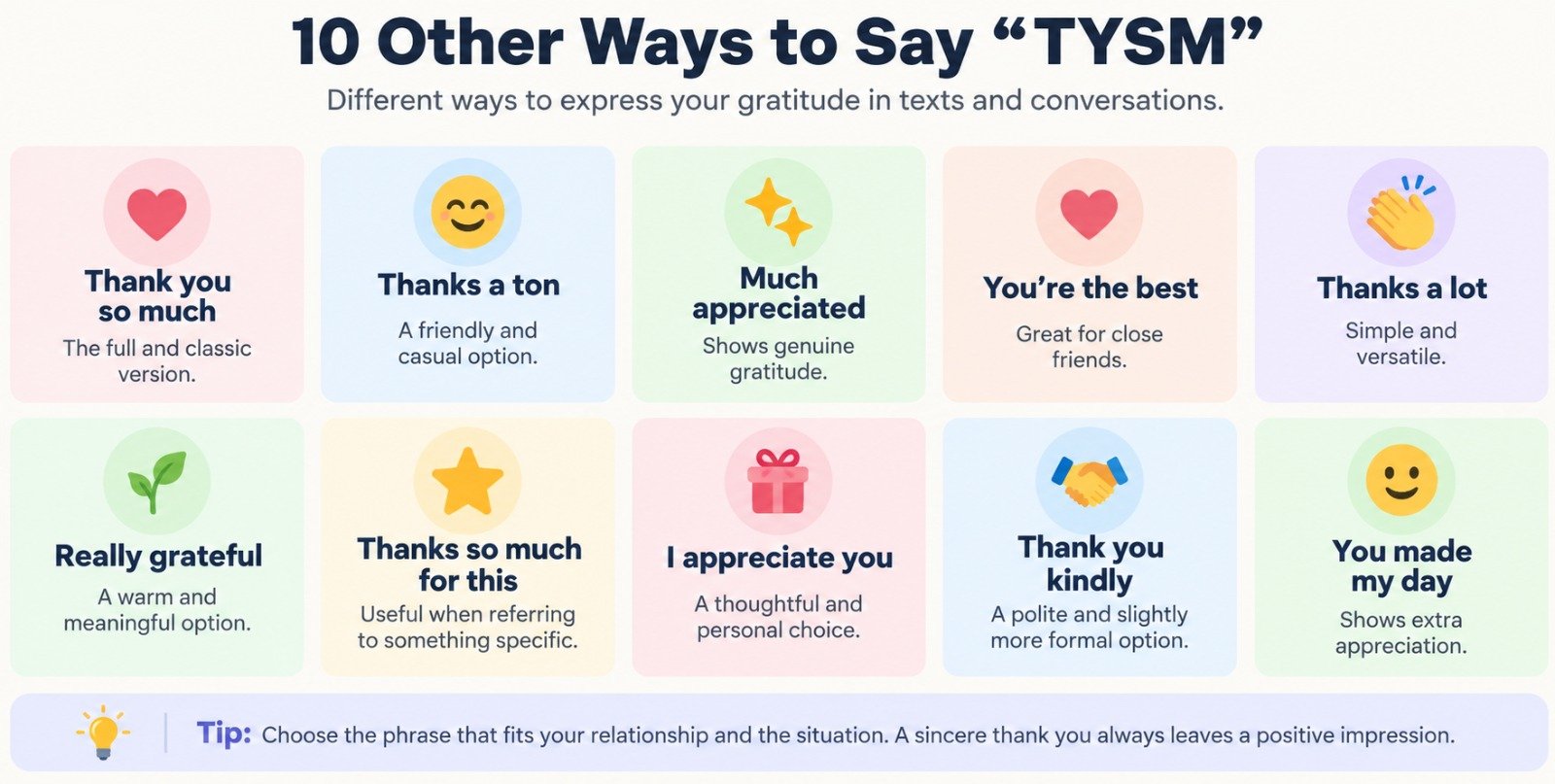
H3: Other Ways to Say “Thank You So Much” in a Text
If you want alternatives to TYSM, choose one based on the relationship and tone.
“Thanks a ton!”
This is casual and enthusiastic.
“Thanks a ton for picking me up!”
“Thanks so much!”
This is probably one of the most natural alternatives in everyday conversation.
“Thanks so much for your help!”
“I really appreciate it!”
This sounds sincere and works in both personal and professional settings.
“I really appreciate you taking the time to help.”
“You’re the best!”
This is friendly and expressive, especially with close friends.
“You found my lost charger? You’re the best!”
“Much appreciated!”
This is concise and somewhat more professional.
“Much appreciated for getting this done so quickly.”
“I can’t thank you enough!”
This communicates particularly strong gratitude.
“I can’t thank you enough for helping me through this.”
“You’re a lifesaver!”
This is informal and often used when someone’s help solves a difficult or urgent problem.
“You brought an extra charger? You’re a lifesaver!”
“I’m so grateful!”
This sounds more heartfelt than a simple abbreviation.
“I’m so grateful for everything you’ve done.”
These expressions aren’t perfect replacements in every context. “You’re the best!”, for example, adds praise, while “Much appreciated!” has a more professional feel. Choose according to the message you’re trying to send.
H3: Other Ways to Say TYSM Casually
For friends and casual conversations, these options can sound natural:
- Thanks a bunch!
- Thanks a ton!
- Thanks so much!
- You’re the best!
- I really appreciate you!
- You’re a lifesaver!
- I owe you one!
- Seriously, thank you!
- You’re awesome!
- Thanks a million!
For example:
“You remembered my birthday? Thanks a bunch!”
or:
“You helped me finish this in time. Seriously, thank you!”
These alternatives can feel more conversational than simply repeating TYSM.
H3: Other Ways to Say TYSM in a Professional Message
TYSM is understandable, but it may be too casual for formal workplace communication. Consider:
- Thank you very much.
- Thank you for your assistance.
- I really appreciate your help.
- I appreciate your time.
- Many thanks.
- Much appreciated.
- Thank you for your support.
- I sincerely appreciate it.
For example:
“I really appreciate your help with the presentation.”
sounds more appropriate for a colleague, client, or manager than:
“TYSM for the presentation help!”
The right choice depends on your relationship and the formality of the communication.
H3: Other Ways to Say TYSM in a Warm or Heartfelt Text
Sometimes you want your gratitude to sound more personal than a short abbreviation.
Try:
- I’m really grateful.
- That means so much to me.
- I truly appreciate you.
- I can’t thank you enough.
- That was so kind of you.
- You have no idea how much I appreciate this.
- Thank you from the bottom of my heart.
For example:
“That was incredibly kind of you. It means so much to me.”
This communicates more emotional depth than simply writing “TYSM.”
Is TYSM Formal or Informal?
TYSM is informal.
It’s perfectly normal in:
- Text messages
- Group chats
- Social media
- DMs
- Gaming conversations
- Conversations with friends
- Casual online communities
It is less suitable for:
- Formal letters
- Academic assignments
- Official documents
- Formal business correspondence
- Professional applications
For formal writing, spell out “thank you so much” or choose a professional alternative such as “I really appreciate your assistance.”
Is TYSM Rude?
No. TYSM is not inherently rude.
It is normally a friendly and appreciative abbreviation. However, as with any shorthand, context matters.
For example:
“TYSM.”
could appear somewhat brief in a serious conversation, while:
“TYSM!! I really appreciate it 😊”
sounds much warmer.
If you’re communicating with someone you don’t know well or writing professionally, spelling out the phrase is usually the safer choice.
TYSM in Social Media and Online Chats
TYSM is particularly common in fast-moving online conversations because abbreviations make replies quicker.
You may see it in:
- Instagram comments
- TikTok comments
- Facebook messages
- Snapchat chats
- Discord conversations
- Gaming chats
- Group messages
- Online communities
Someone might comment:
“TYSM for sharing this!”
or reply:
“Aww, tysm!”
The meaning remains “thank you so much,” even when the context changes.
Common Examples of TYSM in Text
Here are some realistic examples:
After receiving help:
“TYSM for explaining that to me!”
After receiving a compliment:
“Tysm! That’s really sweet.”
After receiving a recommendation:
“TYSM for recommending this restaurant!”
After getting important information:
“TYSM, I was looking everywhere for that.”
After receiving emotional support:
“TYSM for listening. I really needed that.”
After receiving a gift:
“TYSM for the birthday gift! I love it.”
Each example uses the same abbreviation, but the surrounding words create the specific tone.
Should You Write TYSM in Uppercase or Lowercase?
Both are acceptable.
TYSM can look slightly more noticeable or emphatic:
“TYSM for your help!”
tysm often feels more relaxed and conversational:
“tysm for helping me!”
There is no major difference in meaning. The choice usually comes down to personal texting style.
TYSM vs. “Thank You So Much”
The full phrase and the abbreviation have the same basic meaning, but they create different impressions.
TYSM is:
- Short
- Casual
- Informal
- Fast
- Common in digital communication
Thank you so much is:
- More polished
- Suitable for a wider range of situations
- Appropriate in both personal and professional contexts
- More natural in formal writing
If you’re chatting with a friend, TYSM works well. If you’re writing an important email to a client, “Thank you so much” or “I really appreciate your assistance” is usually a better choice.
Frequently Asked Questions
What does TYSM mean in text?
TYSM means “Thank You So Much.” It is an informal abbreviation commonly used in text messages, chats, DMs, and social media.
What does TYSM mean in texting?
In texting, TYSM means “Thank You So Much.” It expresses gratitude and is generally casual and friendly.
What does TYSM mean in text language?
In text language, TYSM is shorthand for “Thank You So Much.” It is an internet and messaging abbreviation used to make communication quicker.
Is TYSM the same as thank you?
Yes, but TYSM is more specifically equivalent to “thank you so much.” It usually expresses a little more emphasis or enthusiasm than a simple “TY.”
What is the difference between TY and TYSM?
TY means “thank you,” while TYSM means “thank you so much.” TYSM generally communicates stronger appreciation.
How should I respond when someone says TYSM?
You can respond with “You’re welcome,” “No problem,” “Anytime,” “Of course,” or “Happy to help.” In professional situations, “You’re very welcome” or “My pleasure” works well.
Is TYSM appropriate for work?
It can be acceptable in casual workplace chats with colleagues, but it may be too informal for formal emails or communication with clients. In those situations, write “Thank you so much” or “I really appreciate your help.”
Does TYSM have a romantic meaning?
Not by itself. TYSM simply means “thank you so much.” Any romantic or affectionate meaning comes from the surrounding conversation, relationship, emojis, and other wording.
Can TYSM be written as tysm?
Yes. TYSM, tysm, and Tysm generally have the same meaning. Lowercase “tysm” often gives a more casual texting feel.
Conclusion
So, what does tysm mean in text? It means “Thank You So Much.” It’s a convenient, informal way to express gratitude in texts, chats, social media, and other casual digital conversations.
While TYSM works perfectly well with friends and online contacts, a complete phrase such as “Thank you so much” is usually better for formal or professional communication. And if you want your message to sound warmer, more personal, or more professional, alternatives such as “I really appreciate it,” “You’re the best,” or “Much appreciated” may fit better.
Choosing the right expression is ultimately about matching your words to the relationship and situation. That kind of small but meaningful distinction is exactly what Grammarifyr is designed to make easier.
You may also Read : What to Say Instead of “Family Emergency”: Professional & Polite Alternatives
One Comment