Ves or Vez: Meaning and Differences Explained
If you are learning Spanish, you may come across ves and vez and wonder which spelling is correct. The confusion is understandable because the two words can sound identical in much of the Spanish-speaking world. However, they are not interchangeable. Ves is a form of the verb ver, meaning “you see,” while vez is a noun referring to a time, occasion, or turn. Understanding their grammatical roles makes the difference much easier to remember.
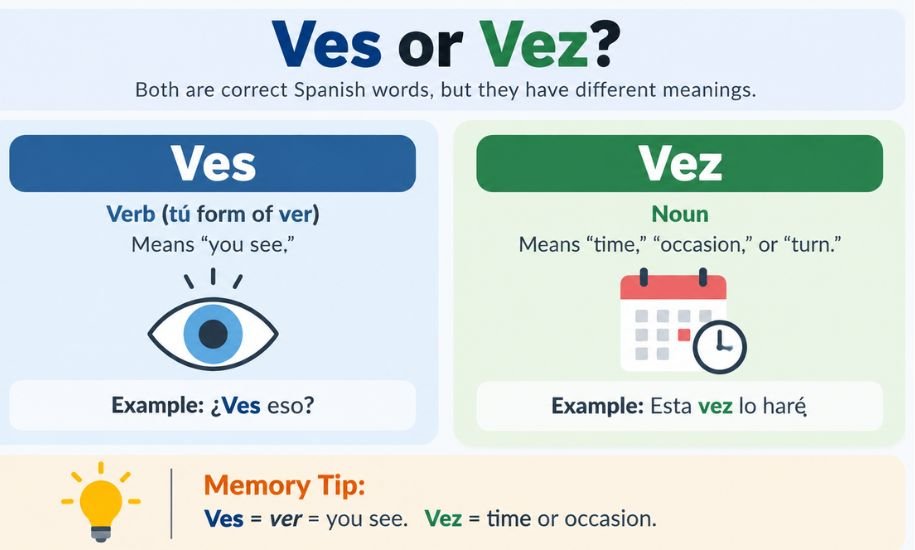
Both “ves” and “vez” are correct Spanish words, but they have different meanings. Ves is the “tú” form of ver and means “you see,” while vez is a noun meaning “time,” “occasion,” or “turn.” For example, ¿Ves eso? means “Do you see that?” and Esta vez means “This time.”
Ves or Vez: What’s the Difference?
The simplest way to distinguish them is to look at their grammatical function.
| Word | Part of speech | Basic meaning | Example |
|---|---|---|---|
| ves | Verb | you see | ¿Ves el coche? |
| vez | Noun | time, occasion, turn | Esta vez será diferente. |
So, vez or ves is not a question of choosing one spelling universally. The correct form depends on what you want to say.
If you are talking about the act of seeing or perceiving something, use ves. If you are talking about an occasion, instance, time, or turn, use vez.
What Does “Ves” Mean?
Ves is the second-person singular present-tense form of the Spanish verb ver, which means “to see.”
The conjugation is:
- Yo veo — I see
- Tú ves — you see
- Él/ella ve — he/she sees
- Nosotros vemos — we see
- Vosotros veis — you all see
- Ellos ven — they see
Therefore, when a sentence means “you see,” the spelling is ves.
Examples with “ves”
- ¿Ves aquella montaña?
- ¿Ves lo que está pasando?
- Tú ves las cosas de forma diferente.
- Como ves, todo está listo.
- ¿Ves a María en la fotografía?
In each case, ves is connected to the verb ver.
It can describe literal sight, but ver can also have broader meanings such as noticing, understanding, observing, or realizing something.
For example:
¿Ves lo que quiero decir?
Here, the speaker is essentially asking, “Do you understand what I mean?”
What Does “Vez” Mean?
Vez is a feminine noun. Its meaning depends on the context, but common translations include time, occasion, instance, or turn.
For example:
Esta vez voy a llegar temprano.
Here, vez means “time.”
Another example is:
Es mi primera vez en Madrid.
In this sentence, it means “first time.”
The plural form is veces, meaning “times” or “occasions.”
- una vez — once / one time
- dos veces — twice / two times
- varias veces — several times
- muchas veces — many times
Examples with “vez”
- Esta vez lo haré correctamente.
- Es la primera vez que veo ese lugar.
- Lo intenté tres veces.
- Cada vez aprendo algo nuevo.
- Volvió otra vez al mismo restaurante.
Notice that none of these examples refers to “you see.” They refer to an occasion or repetition.
Is It “Ves” or “Vez” in Spanish?
If you are asking which form should be used in Spanish, the answer is both. They are different words.
Use ves when it is the verb ver:
¿Ves ese perro?
Use vez when you mean an occasion or time:
La próxima vez tendré más cuidado.
A useful substitution test can help. If you can replace the word with “you see,” choose ves. If you can replace it with “time,” “occasion,” or “turn,” choose vez.
Compare these sentences
¿Ves mi teléfono?
= Do you see my phone?
Esta vez traje mi teléfono.
= This time I brought my phone.
The pronunciation may be similar, but the grammatical roles are completely different.
Why Are These Words Confused?
The main source of confusion is pronunciation. In many varieties of Spanish, particularly throughout much of Latin America, s and z are pronounced alike or very similarly. As a result, ves and vez can sound exactly the same to a listener.
Spelling therefore has to communicate the difference.
There is also a grammatical reason for the confusion: both words are short and commonly used, but their meanings are unrelated.
A learner who remembers only the sound may write vez when the sentence requires the verb ves, or write ves when the noun vez is needed.
The solution is to focus on meaning and grammar rather than pronunciation alone.
“Ya Ves” or “Ya Vez”?
The correct expression is “ya ves”, with an s.
Ya ves contains the verb ver. Depending on context, it can mean something like “you see,” “there you see,” or “as you can see.”
Examples include:
- Ya ves, todo terminó bien.
- Ya ves que tenía razón.
- Ya ves, no era tan complicado.
- Ya ves cómo cambian las cosas.
“Ya vez” is not the standard spelling for this expression.
The key is simple: ya ves → you see.
Common Expressions With “Vez”
Once you understand that vez refers to an occasion, time, or turn, several common expressions become easier to recognize.
Una vez
Una vez means “once” or “one time.”
Fui allí una vez.
Otra vez
Otra vez means “again” or “another time.”
Inténtalo otra vez.
Esta vez
Esta vez means “this time.”
Esta vez quiero hacerlo solo.
Cada vez
Cada vez means “each time” or “every time.”
Cada vez que lo veo, sonrío.
A la vez
A la vez means “at the same time.”
No puedo hacer las dos cosas a la vez.
De vez en cuando
This expression means “from time to time” or “occasionally.”
Voy al cine de vez en cuando.
En vez de
En vez de means “instead of.”
Tomé agua en vez de café.
Tal vez
Tal vez means “perhaps” or “maybe.”
Tal vez vayamos mañana.
These expressions consistently use vez, not ves, because they are based on the noun referring to an occasion, instance, or related concept.
Correct and Incorrect Examples
Seeing the two forms side by side is one of the easiest ways to learn the distinction.
Example 1
Correct: ¿Ves ese edificio?
Incorrect: ¿Vez ese edificio?
The correct choice is ves because the sentence asks whether someone can see the building.
Example 2
Correct: Esta vez voy contigo.
Incorrect: Esta ves voy contigo.
The correct choice is vez because the sentence means “this time.”
Example 3
Correct: ¿Ves lo que quiero decir?
Incorrect: ¿Vez lo que quiero decir?
Again, ves comes from ver.
Example 4
Correct: Lo hice dos veces.
Incorrect: Lo hice dos veses.
The plural of vez is veces, not veses.
Example 5
Correct: Ya ves, no había problema.
Incorrect: Ya vez, no había problema.
The expression requires ves, the verb form of ver.
An Easy Way to Remember Ves vs. Vez
Try this two-part rule:
VES = VER = YOU SEE
If you can translate the word as “you see,” use ves.
¿Ves la diferencia?
VEZ = TIME / OCCASION / TURN
If you can translate it as “time,” “occasion,” or “turn,” use vez.
Esta vez será diferente.
Another useful clue is the plural:
una vez → varias veces
If you are talking about something happening one time, another time, several times, or each time, you will generally need vez/veces.
Common Mistakes to Avoid
1. Writing “vez” for the verb “you see”
Incorrect:
¿Vez el coche?
Correct:
¿Ves el coche?
The verb ver produces ves for tú.
2. Writing “ves” when you mean “time”
Incorrect:
Esta ves es diferente.
Correct:
Esta vez es diferente.
Here, the word means “time,” so vez is required.
3. Confusing “veces” with “ves”
The plural of vez is veces.
Lo he visto muchas veces.
The word ves does not become veces because it is a verb, not the plural of vez.
4. Spelling “ya ves” as “ya vez”
The established expression is ya ves because it uses the verb ver.
A Simple Decision Rule
When you are unsure, ask yourself one question:
Am I talking about seeing, or am I talking about a time or occasion?
- Seeing → ves
- Time/occasion/turn → vez
For example:
¿Ves la película?
I am asking about seeing.
¿Cuántas veces has visto la película?
I am asking about the number of occasions.
This distinction also shows why the two words can appear together in the same sentence:
¿Ves lo que ocurre cada vez?
The first word comes from ver, while the second is a noun meaning “time.”
Frequently Asked Questions
Is “ves” a Spanish word?
Yes. Ves is the second-person singular present indicative form of ver. It means “you see” and can also relate to noticing, observing, or understanding depending on context.
Is “vez” a Spanish word?
Yes. Vez is a feminine noun meaning “time,” “occasion,” “instance,” or “turn,” depending on the sentence. Its plural is veces.
Is it “ya ves” or “ya vez”?
The standard expression is ya ves. It uses ves, the tú form of ver. For example, “Ya ves, todo está bien” can be translated as “You see, everything is fine.”
Which is correct: “vez or ves”?
Both are correct, but they cannot normally be substituted for one another. Ves means “you see” as a verb form, while vez refers to a time, occasion, or turn.
How do I remember the difference?
Connect ves with ver: tú ves = “you see.” Connect vez with “time” or “occasion”: una vez = “once,” otra vez = “again,” and esta vez = “this time.”
Final Verdict: Ves or Vez?
Ves and vez are both legitimate Spanish words, but their meanings and grammatical functions are different. Choose ves when it comes from ver and means “you see.” Choose vez when you mean a time, occasion, instance, or turn. Remembering “ves = ver” and “vez = time/occasion” will help you choose the correct form quickly. For more clear explanations of confusing word choices and grammar distinctions, Grammarifyr is built around one simple principle: know the difference and use the right words.
You may also Read : Access or Acess: Correct Spelling and Usage


One Comment