What Does Ash Mean in Text? Slang Meaning, Examples & Other Ways to Say It
If someone texts you “I’m tired ash” or “that’s funny ash,” you may wonder what “ash” means in that sentence. In texting and internet slang, “ash” usually means “as hell” or “as heck.” It works as an intensifier, adding emphasis to an adjective and meaning something like “very” or “extremely.”
The meaning can change with context, though. “Ash” can also be a person’s name, the residue left after burning something, or a less common abbreviation. Here’s how to recognize the slang meaning and understand the closest alternatives.
What Does Ash Mean in Text?
The most common slang meaning of ash in texting is “as hell.” It is generally placed after an adjective to make the description stronger.
For example:
- “I’m tired ash.” → I’m extremely tired.
- “That food was good ash.” → That food was extremely good.
- “It’s cold ash outside.” → It’s extremely cold outside.
- “She’s funny ash.” → She’s very funny.
- “This homework is hard ash.” → This homework is extremely difficult.
In this usage, ash doesn’t refer to actual ash from a fire. It is internet slang that functions as an intensifier.
What Does Ash Mean in Texting?
In casual texting, ash is usually a shortened slang form of “as hell.” Some people also interpret it as “as heck,” especially when they want a less profane interpretation.
The important clue is the surrounding sentence. When ash follows an adjective, the slang meaning is usually intended.
For instance:
“I’m hungry ash.”
Here, “ash” strengthens “hungry,” so the sentence means “I’m extremely hungry.”
Ash Meaning in Text Slang: How It Works
The slang form generally follows this pattern:
Adjective + ash
| Texting expression | Meaning | Tone | Example |
|---|---|---|---|
| tired ash | extremely tired | Very casual | “I’m tired ash today.” |
| funny ash | extremely funny | Very casual | “That video was funny ash.” |
| cold ash | extremely cold | Very casual | “It’s cold ash tonight.” |
| busy ash | extremely busy | Very casual | “I’ve been busy ash lately.” |
| expensive ash | extremely expensive | Very casual | “That restaurant is expensive ash.” |
| cute ash | extremely cute | Very casual | “That puppy is cute ash.” |
This construction is mainly associated with casual online communication. It isn’t suitable for formal essays, professional emails, business documents, or other situations where standard English is expected.
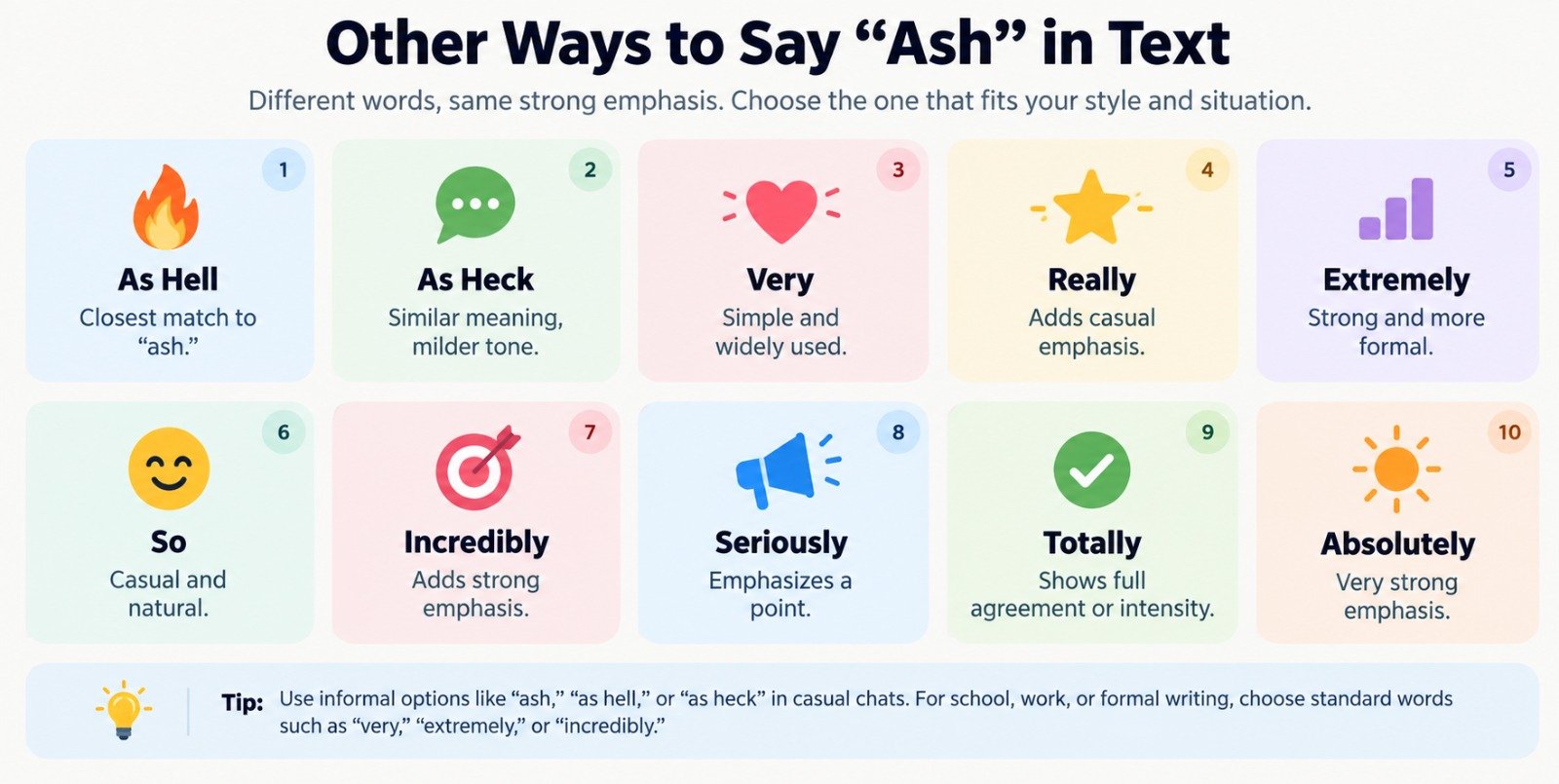
Other Ways to Say “Ash” in Text
Because ash is slang rather than a conventional adjective, there aren’t always direct one-to-one replacements. Instead, you can replace the emphasis it provides.
“As Hell”
“As hell” is the closest equivalent because this is the expression that “ash” commonly represents.
- “I’m tired ash.”
- “I’m tired as hell.”
Both express strong emphasis, although “as hell” is still informal and can sound somewhat stronger or more blunt.
“As Heck”
“As heck” provides a similar emphasis without the profanity associated with “hell.”
- “That was funny ash.”
- “That was funny as heck.”
It works well in casual conversations when you want a playful or relatively mild expression.
“Very”
“Very” is a standard English alternative and is much more neutral.
- “I’m tired ash.”
- “I’m very tired.”
Unlike “ash,” very works in both everyday and many formal contexts.
“Really”
“Really” is another natural alternative for casual or neutral communication.
- “That movie was good ash.”
- “That movie was really good.”
It sounds considerably more conventional than internet slang.
“Extremely”
“Extremely” communicates a high degree of intensity and is more formal than “ash.”
- “The weather is hot ash.”
- “The weather is extremely hot.”
It is a better choice for professional or academic writing.
“So”
“So” can add emphasis in everyday speech and texting.
- “I’m tired ash.”
- “I’m so tired.”
The exact emotional effect is slightly different, so these expressions shouldn’t always be treated as perfectly interchangeable.
“Incredibly”
“Incredibly” adds strong emphasis and can sound more polished.
- “She’s talented ash.”
- “She’s incredibly talented.”
This is especially useful when you want expressive language without slang.
“Seriously”
“Seriously” can emphasize a statement, although it doesn’t always have exactly the same grammatical function as “ash.”
- “That test was hard ash.”
- “That test was seriously hard.”
It adds an emphatic, conversational feel.
Casual Alternatives vs. Standard English
The best replacement depends on where you’re communicating.
| Expression | Formality | Strength | Best context |
|---|---|---|---|
| ash | Very informal | Strong | Texts, memes, social media |
| as hell | Informal | Strong | Casual conversations |
| as heck | Informal | Strong | Casual, playful conversations |
| really | Neutral | Moderate | Everyday conversation |
| very | Neutral | Moderate | General and professional writing |
| extremely | Formal/neutral | Very strong | Academic or professional writing |
| incredibly | Neutral/formal | Strong | Writing and conversation |
| seriously | Casual/neutral | Strong | Conversational emphasis |
These aren’t all direct substitutes in every sentence. “Ash,” “as hell,” and “as heck” are slang-style intensifiers, while “very” and “extremely” are standard adverbs. The sentence may need slight adjustment when switching between them.
Examples of “Ash” in Text Messages
Seeing the expression in context makes its meaning easier to recognize.
Example 1
“I’m sleepy ash.”
Meaning: I’m extremely sleepy.
Example 2
“That concert was loud ash.”
Meaning: That concert was extremely loud.
Example 3
“You’re funny ash 😂”
Meaning: You’re extremely funny.
Example 4
“This bag is expensive ash.”
Meaning: This bag is extremely expensive.
Example 5
“I’m hungry ash right now.”
Meaning: I’m extremely hungry right now.
The slang is especially common in casual digital communication where people use shortened or unconventional spellings to make messages quick and expressive.
Is “Ash” a Bad Word?
When ash is being used as slang for “as hell,” it can carry a mildly profane or edgy tone because “hell” itself can be considered inappropriate in some settings.
However, ash isn’t inherently a bad word. Its meaning depends on context.
For example:
- “The fireplace was full of ash.” — literal meaning
- “Ash is coming over later.” — possibly a person’s name
- “That song is good ash.” — slang meaning
So you should always look at the complete sentence before deciding what someone means.
How to Tell Which Meaning of “Ash” Someone Intended
Context is the easiest way to distinguish the meanings.
If ash follows an adjective, it probably functions as slang:
“That car is fast ash.”
If someone is talking about a fire, smoke, volcano, or burning material, the ordinary noun meaning is more likely:
“There was ash on the floor.”
If Ash is capitalized and appears to refer to a person, it may be a name:
“Ash said they would call me later.”
This simple context check can prevent misunderstandings.
Is “Ash” Appropriate in Formal Writing?
Generally, no.
Because ash in the “as hell” sense is internet slang, avoid it in:
- Academic essays
- Business emails
- Job applications
- Resumes
- Formal reports
- Professional correspondence
- Official documents
Instead, use words such as very, extremely, highly, particularly, remarkably, or incredibly, depending on the sentence.
For example:
Texting:
“The meeting was boring ash.”
Professional:
“The meeting was extremely long and unengaging.”
The second version communicates the idea more appropriately in a professional setting.
What Does “Ash” Mean on Social Media?
On platforms such as messaging apps and social media, ash can be used as a quick intensifier. The meaning is usually understood from the adjective immediately before it.
You might see:
- “cute ash”
- “mad ash”
- “tired ash”
- “busy ash”
- “cold ash”
- “funny ash”
Social-media slang changes quickly, so individual users may occasionally give ash a different meaning. When in doubt, consider the rest of the message rather than assuming one definition applies everywhere.
When Should You Use “Ash”?
Use ash only when the situation is clearly casual and the people involved are comfortable with internet slang.
It can fit:
- Text messages with friends
- Group chats
- Casual social-media comments
- Memes
- Informal online conversations
It is better to avoid it when speaking to a client, teacher, employer, customer, or someone you don’t know well.
When Should You Use “Very” or “Extremely” Instead?
Choose standard intensifiers when clarity and professionalism matter.
Use “very” when you want simple, natural emphasis:
“I’m very tired.”
Use “extremely” when you want stronger emphasis:
“I’m extremely tired.”
Use “really” for relaxed everyday communication:
“I’m really tired.”
These options communicate the same general idea without relying on internet slang.
Frequently Asked Questions
What does ash mean in text?
In texting, ash usually means “as hell” or “as heck.” It is used after an adjective to emphasize how strong a quality or feeling is.
What does ash mean in texting?
Ash is informal slang used as an intensifier. For example, “hungry ash” means “extremely hungry.”
What is the ash meaning in text slang?
The most common slang interpretation is “as hell.” It is typically placed after an adjective, such as “tired ash” or “funny ash.”
Is ash short for as hell?
Yes. In internet slang, ash is commonly used as a shortened form of “as hell.” Some people use or interpret it as “as heck.”
Is ash appropriate for professional messages?
Usually not. Ash is very informal slang, so “very,” “really,” “extremely,” or another standard intensifier is a better choice for professional communication.
What does “tired ash” mean?
“Tired ash” means “extremely tired” or “very tired.” The word “ash” intensifies the adjective “tired.”
Can ash have a meaning other than slang?
Yes. Ash can refer to the powdery material left after something burns, and Ash can also be a person’s name. Context determines the intended meaning.
Is “ash” the same as “AF”?
They can serve a similar purpose because both can add strong emphasis, but they are not identical expressions. “Ash” generally represents “as hell,” while “AF” is an abbreviation of a different slang phrase. Both are highly informal.
Final Thoughts
When you see “ash” in a text, check what comes immediately before and after it. If it follows an adjective such as “tired,” “funny,” “cold,” or “cute,” it most likely means “as hell” and simply adds strong emphasis. For formal communication, standard alternatives such as very, really, extremely, or incredibly are safer choices.
Understanding small differences like this can make online conversations much easier to interpret. Grammarifyr helps you make sense of informal expressions while also showing when standard English is the better choice.
You may also Read : What Does TYSM Mean in Text? Meaning, Uses, Examples and How to Reply
One Comment