Inact or Enact: Meaning, Spelling and Usage
The words “inact” and “enact” look similar enough to cause confusion, especially when someone is trying to describe making a law, introducing a rule, or putting a decision into effect. The confusion becomes even greater with forms such as “inacted” and “enacted.” In standard modern English, enact is the correct verb for these meanings. Inact is not normally used as its modern equivalent, although the form has appeared in historical Scots usage. Understanding the distinction also helps separate enacted from the incorrect inacted and inactive from the much less common word enactive.
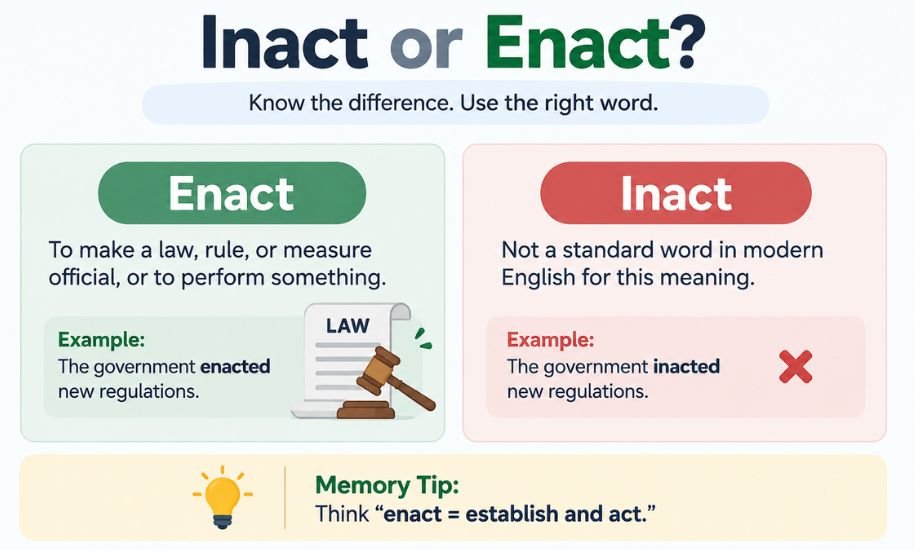
Enact is the standard modern English spelling when you mean to make something law, establish a rule, put a measure into effect, or perform something. Inact is generally not used in standard modern English for these meanings. The correct past form is enacted, not “inacted.”
Enact or Inact: What’s the Difference?
The main distinction is simple: enact is a standard modern English word, while inact is generally not the word you want in ordinary contemporary English.
Enact is a verb. It commonly means:
- to make a bill or proposal into law;
- to establish something officially;
- to put a policy or measure into effect;
- to perform or act out a scene or role.
For example:
The government decided to enact new environmental regulations.
Here, enact means to establish the regulations officially.
By contrast, writing inact in the same sentence would be considered nonstandard:
❌ The government decided to inact new environmental regulations.
The appropriate form is:
✅ The government decided to enact new environmental regulations.
Quick comparison
| Form | Standard modern usage | Meaning |
|---|---|---|
| enact | Yes | Establish officially, make law, put into effect, or perform |
| enacted | Yes | Past tense/past participle of enact |
| inact | Generally no | Not the normal modern equivalent of enact |
| inacted | Generally no | Not the standard past form of enact |
| inactive | Yes | Not active or functioning |
| enactive | Yes, but uncommon | Relating to enactment or, in specialist contexts, action-based processes |
What Does “Enact” Mean?
Enact is a verb with several related uses.
The most important meaning is to officially establish something, particularly a law.
Parliament enacted the new legislation.
In this sentence, enacted means that the legislation was formally made law.
The word can also refer to putting a rule, policy, or measure into effect:
The organization enacted stricter safety procedures.
A further meaning relates to performance. To enact something can mean to perform or act out an event, story, scene, or role.
The students enacted a scene from the historical drama.
So, depending on context, enact can involve either formal establishment or performance.
Common forms of the verb
| Form | Example |
|---|---|
| Base form | enact |
| Third-person singular | enacts |
| Past tense | enacted |
| Past participle | enacted |
| Present participle | enacting |
Examples:
- They enact new regulations.
- The government enacts laws through the legislative process.
- The council enacted the measure last year.
- The agency is enacting new procedures.
Is “Inact” a Real Word?
For ordinary contemporary English, inact should generally be avoided when you mean enact.
Modern dictionaries and spelling references treat enact as the established form for the meanings discussed above. However, it would be too broad to claim that inact has never existed. Historical Scots sources record inact with senses connected to entering something into an official record or enacting, ordaining, or decreeing it.
That historical usage does not make inact an appropriate substitute for enact in present-day standard English.
Therefore, if you are writing an email, article, essay, report, legal explanation, or other modern English text, use enact.
Correct
The legislature enacted the new law.
Avoid
The legislature inacted the new law.
The second sentence uses a form that readers will generally recognize as an error or nonstandard usage.
Inact or Enact Meaning in Modern English
If you encounter the question “inact or enact meaning,” the safest practical answer is to focus on enact.
It means to formally establish or put something into effect. In legal contexts, it is especially associated with legislation.
For example:
The government enacted a law requiring clearer product labels.
It can also mean to perform or act something out:
The actors enacted the final scene.
The exact meaning therefore depends on context, but the spelling remains enact.
Inacted or Enacted: Which One Is Correct?
This is one of the most important related spelling questions.
The correct past tense and past participle of enact is enacted.
The verb follows the regular pattern:
enact → enacted
Not:
inact → inacted
For example:
✅ The law was enacted last year.
❌ The law was inacted last year.
Similarly:
✅ The committee enacted the new policy.
❌ The committee inacted the new policy.
Why “inacted” looks tempting
English contains several words beginning with in-, including inactive, inaccurate, and incomplete. A writer may therefore assume that inact could mean something like “put into action.”
But English vocabulary does not always work by simply combining familiar prefixes and roots. The established verb for this meaning is enact.
The easiest rule is:
enact → enacted → enacting
Inactive or Enactive: These Are Different Words
The comparison between inactive and enactive is different from the spelling issue above because both forms can exist, but they have very different uses.
What does “inactive” mean?
Inactive is a common adjective meaning not active, not operating, or not currently involved in an activity.
Examples:
My old account is inactive.
The machine has remained inactive for several months.
The volcano is currently inactive.
It can describe people, accounts, equipment, organizations, systems, and many other things.
What does “enactive” mean?
Enactive is a legitimate but relatively uncommon adjective. In general usage, it can mean relating to enactment or having the power to enact.
The word also occurs in specialist contexts, including discussions of cognition and learning, where enactive can relate to knowledge or understanding developed through action or experience.
Therefore, don’t treat enactive as an alternative spelling of inactive.
Compare:
The account is inactive.
This means the account is not active.
The process has an enactive component.
This is a specialized use connected with action or enactment.
For ordinary writing, inactive is far more common when the intended meaning is “not active.”
Why Do People Confuse Enact and Inact?
The spelling confusion is understandable because enact visually resembles a word that could be interpreted as the opposite of inactive or as a combination of a prefix and the word act.
The pronunciation and spelling of the related forms can also contribute to mistakes. Once someone incorrectly assumes that inact is the verb, it seems natural to form inacted.
But the standard verb has its own established forms:
- enact
- enacts
- enacted
- enacting
Learning the complete word family is more useful than trying to construct the word from act.
Examples of Enact in Sentences
Here are several natural examples showing different uses:
- The government enacted a new consumer-protection law.
- The council plans to enact stricter parking regulations.
- The policy was enacted after months of discussion.
- The company enacted new procedures for handling customer complaints.
- The actors enacted the final scene with great energy.
- The school enacted a new rule concerning student safety.
Notice that the word works naturally with laws, regulations, policies, rules, measures, and scenes.
Common Mistakes to Avoid
1. Using “inact” instead of “enact”
❌ The legislature will inact the bill.
✅ The legislature will enact the bill.
2. Using “inacted” as the past tense
❌ The regulation was inacted last month.
✅ The regulation was enacted last month.
3. Confusing “inactive” with “enact”
These words have completely different grammatical functions.
Inactive = not active.
Enact = establish officially or perform.
You cannot replace one with the other.
4. Assuming “enactive” means “active”
Enactive is not simply the opposite of inactive. It has specialized meanings associated with enactment or action.
5. Using “enact” when “implement” is more precise
Although these verbs can overlap in some contexts, enact emphasizes formally establishing something, while implement often emphasizes carrying a policy, plan, or decision into practical operation.
For example:
The government enacted the new law.
Officials implemented the new law.
The two actions are related but emphasize different stages.
Enact vs. Implement
This distinction is particularly useful in formal writing.
Enact means to formally establish something, especially a law or official measure.
Implement means to put a plan, policy, system, or decision into practical operation.
Consider:
The legislature enacted the new regulation.
This focuses on formal establishment.
Then:
The department implemented the new regulation.
This focuses on putting it into practice.
Using the right verb makes the sentence more precise.
An Easy Way to Remember the Correct Form
A simple rule can help:
When the meaning is “make official” or “put into effect,” think ENACT.
Remember the sequence:
enact → enacted → enacting
If you are tempted to write inact or inacted, check whether you actually mean enact or enacted.
For the separate adjective, remember:
inactive = not active
That distinction prevents several common spelling and vocabulary mistakes.
Frequently Asked Questions
Is “inact” or “enact” correct?
Enact is the standard modern English form when you mean to establish a law, rule, policy, or measure, or to perform something. Inact is generally not used as the modern equivalent and should normally be avoided in formal writing.
Is “inacted” a correct word?
If you mean the past tense of enact, the correct form is enacted. For example, “The law was enacted in 2026” is correct. Inacted is not the standard modern past form.
What is the meaning of “enacted”?
Enacted is the past tense and past participle of enact. It can mean that something was formally established, particularly a law or regulation, or that something was performed or acted out.
What is the difference between inactive and enactive?
Inactive means not active, operating, or engaged. Enactive is a much less common adjective relating to enactment or action and is also used in specialist fields. They are not interchangeable.
Can “inact” be found in older English?
Yes. Historical sources, particularly Scots usage, contain inact with meanings related to recording, decreeing, or enacting. That historical evidence does not make it the normal spelling for contemporary standard English.
What is the past tense of enact?
The past tense is enacted. The complete basic pattern is enact – enacted – enacted.
Final Verdict: Inact or Enact?
For modern standard English, choose enact when you mean to formally establish a law, rule, policy, or measure, or to act something out. Its past form is enacted, not inacted. Inactive is a separate word meaning “not active,” while enactive has uncommon and specialized meanings. For clear, accurate word choices, Grammarifyr follows the simple principle behind its tagline: Know the Difference. Use the Right Words.
You may also Read : Sale or Sell: Meaning and Correct Usage
One Comment