Anyway or Anyways: Correct Usage Explained
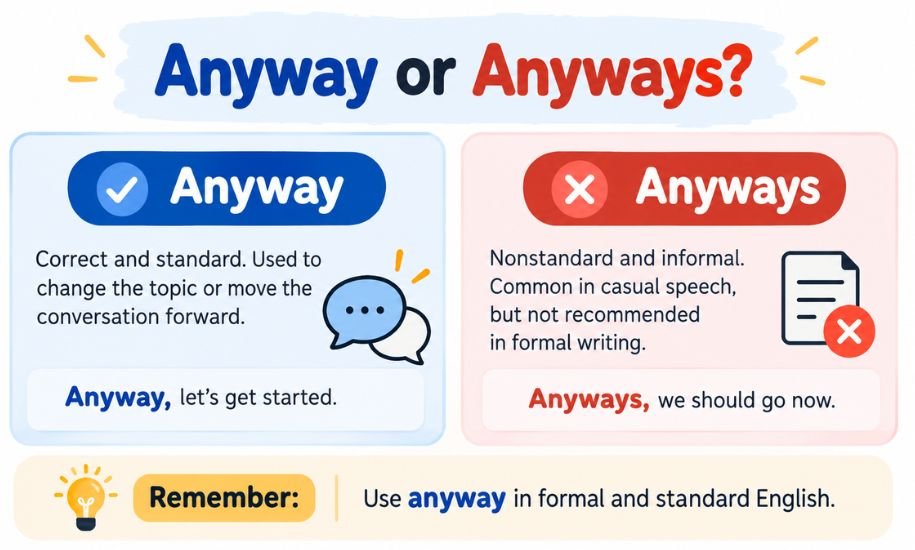
The words anyway and anyways are easy to confuse because they are used in very similar ways. Both can appear when someone changes the subject, dismisses an earlier point, or means “regardless.” The main difference is not usually meaning but style and standard usage. Anyway is the standard form and works in both formal and informal English. Anyways is also a recognized word, but it is generally informal and is more common in casual speech and writing.
Anyway is the standard form and the best choice for formal, academic, and professional writing. Anyways is an informal variant with essentially the same meaning and is common in casual conversation. If you are unsure which one to use, choose anyway.
Anyway vs. Anyways: The Key Difference
Both forms are adverbs and can express ideas such as “regardless,” “in any case,” or “despite that.” The important distinction is their register, or level of formality.
| Feature | Anyway | Anyways |
|---|---|---|
| Standard form | Yes | Informal variant |
| Basic meaning | Regardless; in any case | Generally the same |
| Formal writing | Recommended | Usually avoid |
| Casual conversation | Common | Common in some varieties |
| British English | Standard choice | Generally informal/non-standard |
| American English | Standard choice | Used informally |
| Example | “I went anyway.” | “I went anyways.” |
So, if you’re writing an essay, report, business email, or other formal text, anyway is the safer choice.
What Does “Anyway” Mean?
Anyway is an adverb with several closely related uses. It can mean regardless, in any case, or despite what has just been mentioned.
For example:
- “It was raining, but we went anyway.”
- “I didn’t really want to go, but I went anyway.”
- “The restaurant was expensive, but we enjoyed it anyway.”
In these sentences, anyway shows that the result happened despite a previous circumstance.
It can also be used to return to a subject or move a conversation forward:
“Anyway, let’s get back to the main point.”
“Anyway, what were you saying?”
Here, it functions as a conversational transition.
Another common use is to add a reason that makes something less important or relevant:
“I didn’t need the tickets anyway.”
The word therefore has several practical uses, but its central idea is often “regardless” or “in any case.”
What Does “Anyways” Mean?
Anyways generally has the same basic meaning as anyway. The difference is that it is more informal.
For example:
“Anyways, let’s get started.”
“I was tired, but I went anyways.”
“It doesn’t matter anyways.”
These sentences can be understood easily, particularly in casual conversation. However, anyways has a less formal tone than anyway.
Major dictionaries recognize anyways, although they do not all describe its status in exactly the same way. Cambridge labels it an informal form of anyway, while other references describe it as non-standard or dialectal in some contexts.
That means it is better to think of anyways as a real but informal variant, rather than simply calling it a spelling mistake.
Is “Anyways” Correct?
The answer depends on what you mean by correct.
If you mean “Is anyways recognized and used in English?” the answer is yes.
If you mean “Is anyways the preferred form in standard formal English?” the answer is generally no.
For example, this is appropriate in formal writing:
“The evidence was incomplete, but the researchers continued anyway.”
In a casual text message, you might see:
“Anyways, I’ll see you tomorrow.”
The second sentence is understandable and natural in informal conversation, but the first version is preferable when you want conventional formal English.
Therefore, anyways is not simply an impossible word. It is a form whose acceptability depends heavily on context and style.
Anyway or Anyways in British English
In British English, anyway is the normal standard form.
For formal British writing, use:
“Anyway, we should discuss the next issue.”
Rather than:
“Anyways, we should discuss the next issue.”
You may encounter anyways in British conversations, informal writing, dialogue, or speech influenced by other varieties of English. However, it is not normally the form you would choose for polished standard British English.
If your audience expects British English and you want a neutral, conventional style, anyway is the clear choice.
How Is It Used in American English?
American English also uses anyway as the standard form.
However, anyways is relatively familiar in informal American speech and writing. You may encounter it in casual conversations, text messages, social media posts, and fictional dialogue.
For example:
“Anyways, what are we doing tonight?”
The same idea in a more neutral style would be:
“Anyway, what are we doing tonight?”
Neither sentence is difficult to understand. The choice mainly communicates a difference in tone.
It is therefore useful to distinguish standard usage from actual informal usage. A form can be common in conversation without being the preferred choice in formal edited writing.
Any Way vs. Anyway
There is another distinction that is easy to overlook: any way is different from both anyway and anyways.
When written as two words, any way usually refers to a method, manner, or possible means of doing something.
Compare:
“You can solve the problem any way you like.”
Here, any way means in any manner you choose.
Now compare:
“The problem was difficult, but I solved it anyway.”
Here, anyway means despite that or regardless.
More examples:
Any way:
- “Is there any way to repair the device?”
- “You can arrange the books any way you want.”
- “I’ll help you in any way I can.”
Anyway:
- “I didn’t have much time, but I finished anyway.”
- “Anyway, let’s continue.”
- “She wasn’t feeling well, but she came anyway.”
A useful test is to ask whether the phrase refers to a method or manner. If it does, any way may be the correct choice.
Examples of “Anyway” in Sentences
Here are several natural examples showing different uses:
- “It was getting late, but we decided to stay anyway.”
Here, anyway means despite the situation. - “Anyway, let’s move on to the next question.”
Here, it changes or redirects the conversation. - “I don’t think he’ll agree, but I’ll ask him anyway.”
The action will happen regardless of the expected result. - “We didn’t need the extra chairs anyway.”
The word adds a reason that makes something less important. - “Anyway, where did you put my keys?”
It can introduce a new or returning topic.
Examples of “Anyways” in Sentences
Because anyways is informal, these examples are most suitable for casual contexts:
- “Anyways, I’ll call you later.”
- “I didn’t want to go anyways.”
- “Anyways, what happened after that?”
- “We were already there, so we stayed anyways.”
- “It probably wouldn’t have worked anyways.”
In each example, anyway could replace anyways without substantially changing the meaning:
“Anyway, I’ll call you later.”
“I didn’t want to go anyway.”
The difference is mainly one of style.
“But Anyway” or “But Anyways”?
But anyway is the more standard expression.
For example:
“I was going to explain the problem, but anyway, let’s move on.”
This construction is common in conversational English and is also acceptable in writing when the tone is appropriate.
But anyways is possible in casual speech:
“But anyways, what are we doing tonight?”
However, if you are writing formally, but anyway is the better choice.
You do not need anyways simply because but comes before it. The same standard form remains anyway.
Common Mistakes to Avoid
1. Assuming “anyways” is always a spelling error
It is better not to treat anyways as a simple misspelling. Dictionaries recognize the form, although they generally mark it as informal or non-standard in certain contexts.
2. Using “anyways” in formal writing
Even though readers will understand it, it can make formal writing sound unnecessarily conversational.
Prefer:
“The plan was difficult, but we continued anyway.”
3. Confusing “any way” with “anyway”
These forms can have completely different meanings.
“You can do it any way you want.”
means you can choose whatever method you prefer.
“You can do it anyway.”
means you can do it regardless.
4. Thinking the extra “s” changes the basic meaning
In most ordinary uses, anyways does not introduce a completely different definition. It is primarily a variant of anyway used in informal contexts.
An Easy Way to Remember the Difference
When you are unsure, remember this simple rule:
Formal or neutral → anyway
Casual conversation → anyways can occur
And remember that:
Any way = any method or manner
For example:
- “I’ll do it anyway.” = I’ll do it regardless.
- “I’ll do it any way you prefer.” = I’ll use whichever method you prefer.
- “I’ll do it anyways.” = informal variant of anyway.
If you only want to remember one spelling for everyday and formal writing, remember anyway.
Anyway or Anyways: Which Should You Use?
Choose anyway when you want your writing to sound standard, neutral, and polished. It works naturally in academic writing, professional communication, edited articles, and everyday conversation.
Use anyways when the context is deliberately informal and conversational. It can be appropriate in dialogue, casual messages, social media, or writing that intentionally reflects informal speech.
The choice is therefore not simply about “right” versus “wrong.” It is largely about standard usage and register.
Frequently Asked Questions
Is “anyways” a real word?
Yes. Anyways appears in major dictionaries and is used in English, particularly in informal speech and writing. However, it is generally treated as an informal, non-standard, or dialectal variant of anyway, depending on the dictionary and variety of English.
Is “anyway” or “anyways” better for formal writing?
Anyway is the better choice for formal writing. It is the standard form and works across formal and informal contexts, while anyways has a more casual tone.
Is “anyways” correct in British English?
Anyways can be encountered in British English, particularly in informal contexts, but anyway is the standard choice. For formal British English, use anyway.
Do “anyway” and “anyways” have the same meaning?
Usually, yes. Both can mean “regardless” or “in any case,” and both can be used as conversational transitions. The main distinction is that anyways is more informal.
What is the difference between “any way” and “anyway”?
Any way means any method or manner, while anyway usually means regardless or in any case. For example, “You can do it any way you want” refers to a method, while “You can do it anyway” means you can do it regardless.
Should I use “anyway” or “anyways” in an essay?
Use anyway. It is the standard form and is appropriate for academic and other formal writing. Anyways can make an essay sound unnecessarily informal.
The Bottom Line
Anyway is the standard form and the best all-purpose choice. Anyways is a recognized informal variant that can sound natural in casual conversation but is usually avoided in formal writing. Also remember that any way is a separate two-word expression meaning “by any method” or “in any manner.”
When in doubt, choose anyway. For clear explanations of confusing English words and usage choices, Grammarifyr helps you know the difference and use the right words.
You may also Read : Whom or Who? Grammar Rules Explained