Bingeing or Binging: Meaning, Spelling and Examples
When writing about watching several episodes of a TV series, enjoying a Netflix marathon, or spending hours on an activity, you may wonder whether bingeing or binging is the correct spelling. Both forms look right, but their slightly different spelling can make it difficult to know which one to use. The good news is that both are accepted in standard English and have the same meaning. The difference comes down to how the verb binge forms its -ing version. Understanding this simple spelling variation can help you write more confidently in everyday conversations, articles, emails, and formal writing.
Quick Answer
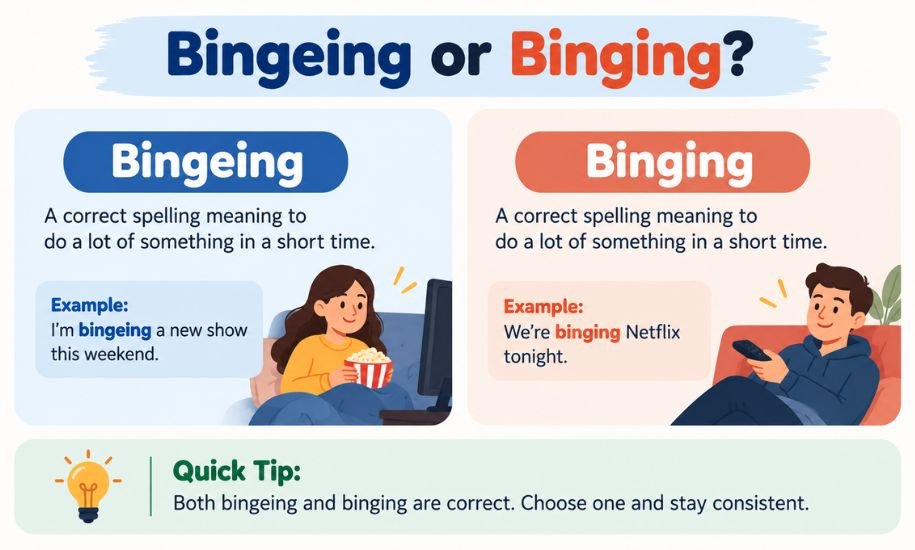
Both bingeing and binging are correct spellings of the present participle of binge. They mean engaging in an activity excessively or for an extended period, such as watching multiple episodes of a show. The two forms have the same pronunciation and meaning, so you can use either, although consistency is important.
Bingeing or Binging: What’s the Difference?
The main difference between bingeing and binging is their spelling, not their meaning or grammatical function. Both words are present participles of the verb binge, which means to do something excessively or consume a large amount of something in a short period.
Bingeing retains the final e from the original verb, while binging removes it before adding -ing. Both forms are recognized in English dictionaries.
| Feature | Bingeing | Binging |
|---|---|---|
| Correct spelling | Yes | Yes |
| Base verb | Binge | Binge |
| Part of speech | Present participle | Present participle |
| Meaning | Engaging in a binge | Engaging in a binge |
| Pronunciation | BIN-jing | BIN-jing |
| Usage | Standard English | Standard English |
| Example | She is bingeing a series. | She is binging a series. |
For example:
- She is bingeing her favourite television series this weekend.
- She is binging her favourite television series this weekend.
Both sentences are grammatically correct and communicate exactly the same idea.
What Does Bingeing Mean?
Bingeing is the present participle of binge. It describes engaging in an activity excessively, often by doing or consuming a large amount within a relatively short period.
The word can be used in different situations, including entertainment, eating, drinking and other activities. Its meaning depends on the context.
Examples:
- Watching: Olivia is bingeing a new crime drama on television.
- Reading: My brother is bingeing a collection of mystery novels.
- Eating: He was bingeing on snacks while watching a film.
- Gaming: They have been bingeing on their favourite video game all weekend.
The word can also appear in different grammatical constructions. For instance, in “She is bingeing on documentaries,” it forms part of the present continuous tense. In “Bingeing on television shows can take up an entire evening,” it functions as a gerund, acting as the subject of the sentence.
Is Binging a Real Word?
Yes, binging is a real word and an accepted spelling of the present participle of binge. It follows the common English spelling pattern of dropping a final silent e before adding -ing.
For example:
- Make → Making
- Write → Writing
- Bake → Baking
- Binge → Binging
However, English spelling also permits bingeing, which retains the final e. Both forms are established, so binging should not be treated as a misspelling.
You can use either version in casual writing, articles and other standard English contexts. If you are following a particular dictionary, publication or style guide, use the spelling it prefers throughout your work.
Why Are the Two Spellings Confused?
The confusion arises because English has more than one spelling pattern for verbs ending in a silent e when adding -ing.
In many cases, the final e is dropped, as in write becoming writing. However, some verbs have accepted variations, and binge is one of them.
Both spellings are pronounced identically, which makes the difference less noticeable in spoken English. Readers may encounter bingeing in one article and binging in another, leading them to question whether one is incorrect.
The important point is that neither form changes the meaning or grammatical role of the word.
Bingeing or Binging a Show or Netflix
When discussing television and streaming platforms, both spellings are correct. They describe watching several episodes of a series consecutively, often over a short period.
This activity is also commonly called binge-watching. The term specifically refers to watching multiple episodes of a television programme or series in succession.
Examples:
- We spent Saturday night bingeing a popular Netflix series.
- My friends were binging a comedy show during their holidays.
- She has been bingeing episodes of her favourite drama.
- They are binge-watching an entire season this weekend.
- I finished bingeing the series before the new season arrived.
You can also say binging on Netflix or bingeing on Netflix in informal English. Both are understandable ways to describe spending an extended period watching content on the streaming service.
For clarity, binge-watching is often the most specific expression when the activity involves watching several episodes back-to-back.
How to Use Bingeing and Binging in Sentences
Both forms can be used in different grammatical situations. The choice does not affect the sentence’s meaning.
Examples with bingeing:
- I am bingeing my favourite series after finishing my exams.
- They were bingeing on documentaries throughout the weekend.
- Bingeing on television shows has become a regular weekend activity for him.
- She enjoys bingeing on mystery novels during her free time.
Examples with binging:
- We are binging a new show that everyone recommended.
- He spent the evening binging on his favourite sitcom.
- They have been binging on movies since the holidays started.
- Binging on television can make it easy to lose track of time.
Both forms work with auxiliary verbs such as is, are, was and have been, depending on the tense and sentence structure.
Related Forms of Binge
Understanding the other forms of the verb can help you use it correctly.
| Verb form | Example |
|---|---|
| Base form: Binge | I sometimes binge on documentaries. |
| Third-person singular: Binges | She binges on television shows. |
| Past tense: Binged | We binged the entire series yesterday. |
| Present participle: Bingeing / Binging | They are bingeing a new drama. |
| Past participle: Binged | He has binged the whole season. |
Notice that the past tense and past participle are both spelled binged. The spelling variation applies to the present participle.
Bingeing or Binging: Which Should You Use?
Since both forms are correct, your choice can depend on personal preference, audience and editorial consistency.
Bingeing retains the final e, making the connection to the base verb binge visually clear. Binging follows the familiar pattern of dropping a final silent e before adding -ing.
Neither spelling is exclusively American or British English. Both may be encountered across different varieties of English.
For blog articles, academic assignments, professional emails or other formal writing, choose the form accepted by your preferred dictionary or style guide. If there is no specific requirement, either is suitable. The most important thing is to avoid switching between the two forms unnecessarily within the same piece of writing.
Common Mistakes to Avoid
Although both spellings are correct, a few related errors are worth avoiding.
- Treating binging as incorrect: It is an accepted spelling, not a grammatical mistake.
- Assuming the words have different meanings: Both forms express the same action and are pronounced identically.
- Using binged incorrectly: Binged is the past tense and past participle, while bingeing and binging are present participles.
- Mixing spellings unnecessarily: Using both forms throughout one article may distract readers. Choose one and remain consistent.
Frequently Asked Questions
1. Is bingeing or binging the correct spelling?
Both bingeing and binging are correct spellings in standard English. They are alternative present participle forms of the verb binge. Neither is universally considered incorrect, and both can be used in everyday and formal writing.
2. Is bingeing more correct than binging?
No. Both forms are accepted. Some dictionaries or editorial style guides may prefer one spelling, but that does not make the alternative incorrect. Follow your preferred reference or publication guidelines when consistency is required.
3. Is it bingeing or binging a show?
Both are grammatically correct when describing watching multiple episodes of a television series in a short period. For example, “We are bingeing a new show” and “We are binging a new show” have exactly the same meaning.
4. What is the meaning of bingeing on Netflix?
Bingeing on Netflix means watching a large number of episodes, films or other programmes over an extended period, often in one sitting or across a short period. The phrase is an informal way to describe prolonged streaming.
5. How do you pronounce bingeing and binging?
Both words are pronounced identically, as BIN-jing, with the stress on the first syllable. The spelling difference does not affect how either word is spoken.
6. Is binging acceptable in formal writing?
Yes, binging is an accepted spelling and can be used in formal writing. However, if you are writing for a publication, university or organisation that follows a particular style guide, check its preferred spelling and use it consistently.
Final Verdict: Bingeing or Binging?
Both bingeing and binging are correct, and there is no difference in their meaning, pronunciation or grammatical function. The two forms simply follow different spelling patterns for the same verb.
You can confidently use either when writing about watching a show, streaming Netflix, reading or other activities. Choose the spelling that suits your preferred style and use it consistently. At Grammarifyr, our aim is to make these small English differences easier to understand so you can choose the right words with confidence.
You may also Read : Theater or Theatre: American vs British English