Nor vs Or: Meaning, Usage, and Examples
The words nor and or can both connect alternatives, but they do not work in exactly the same way. The confusion becomes especially common in negative sentences, where writers may wonder whether to say “I don’t want tea or coffee” or “I don’t want tea nor coffee.” The key is to look at the sentence structure: or normally connects alternatives, while nor is especially associated with negative constructions such as neither … nor and with a second negative clause.
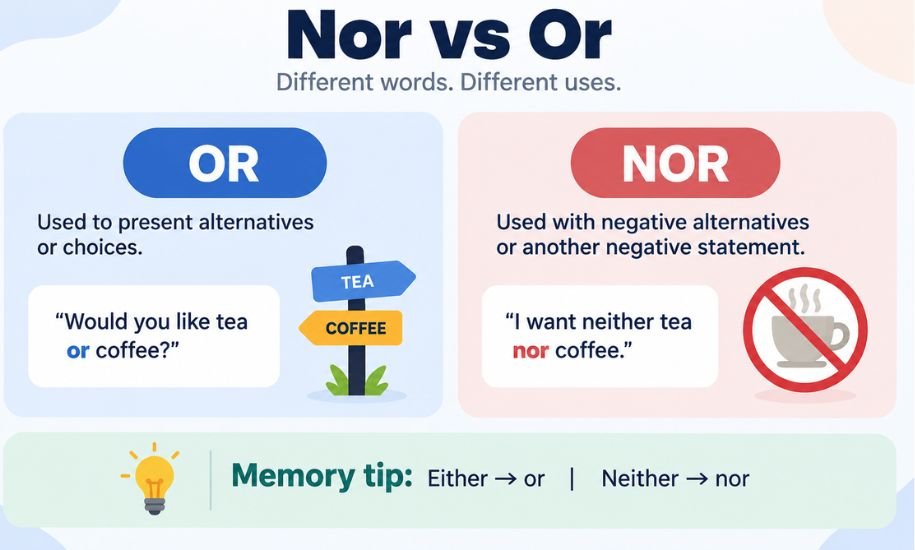
Both nor and or are correct words, but they have different grammatical uses. Use or to present alternatives and after a negative verb when that same negative applies to both choices. Use nor especially in neither … nor constructions or to introduce another negative clause, such as “I didn’t call, nor did I text.”
Nor vs Or: What’s the Difference?
The simplest distinction is:
- Or introduces an alternative or choice.
- Nor connects negative alternatives or adds another negative statement.
Compare these sentences:
Would you like tea or coffee?
I want neither tea nor coffee.
Here, or presents a choice, while nor works with neither to exclude both possibilities.
However, there is an important detail: or can also appear in negative sentences.
I don’t want tea or coffee.
This sentence is standard because don’t want applies to both tea and coffee.
| Feature | Or | Nor |
|---|---|---|
| Main function | Presents alternatives | Connects negative alternatives/statements |
| Common pattern | either … or | neither … nor |
| Can follow a negative verb? | Yes | Yes, in appropriate constructions |
| Example | Tea or coffee? | Neither tea nor coffee. |
| Can introduce a new negative clause? | Not normally in this role | Yes |
| Example | — | I didn’t call, nor did I text. |
What Does “Or” Mean?
Or is a coordinating conjunction used to connect alternatives. It can present choices, possibilities, or different options.
For example:
Would you like cake or fruit?
We can meet on Tuesday or Wednesday.
You can walk or take the bus.
The alternatives do not necessarily have to be positive. A negative sentence can still use or:
I don’t eat meat or fish.
The negative verb don’t eat applies to both alternatives.
Another example is:
She hasn’t called or sent an email.
The negative hasn’t covers both actions.
This is why the simple rule “or is positive and nor is negative” is not accurate. The grammatical structure matters.
What Does “Nor” Mean?
Nor is a conjunction associated with negative alternatives or an additional negative statement.
It is particularly common in the structure:
neither + alternative + nor + alternative
For example:
Neither Emma nor Daniel attended the meeting.
The room was neither large nor comfortable.
He speaks neither Spanish nor Italian.
In these sentences, nor helps connect things that are both excluded or negated.
Nor can also introduce another negative clause:
I didn’t complain, nor did I ask for a refund.
Sarah wasn’t invited, nor was her brother.
He can’t swim, nor can his sister.
Notice the word order after nor:
nor did I
nor was he
nor can she
This inversion is an important part of the standard construction.
When to Use Nor vs Or
A practical way to choose between the two is to examine what the sentence is doing.
Use “or” for alternatives
Use or when you are giving someone a choice or presenting possibilities.
Do you want apples or oranges?
We could leave now or wait until later.
Is the meeting on Monday or Tuesday?
You can also use or after a negative verb:
I don’t want apples or oranges.
He didn’t call or write.
Here, the negative verb applies to both alternatives.
Use “nor” with “neither”
The most familiar pattern is:
neither … nor
Examples:
Neither the manager nor the assistant was available.
She is neither tired nor hungry.
We bought neither bread nor cheese.
A useful grammatical pairing is:
either … or
You can either stay or leave.
neither … nor
You can choose neither the red one nor the blue one.
Use “nor” to add another negative clause
Nor can connect a second independent negative clause.
I didn’t see Mark, nor did I see Sarah.
The restaurant wasn’t open, nor was the café.
She hasn’t replied, nor has she explained why.
In this structure, nor is not simply replacing or. It introduces an additional negative statement.
Why “I Don’t Like Coffee or Tea” Is Correct
One of the most common points of confusion is whether a negative sentence should use or or nor.
Consider:
I don’t like coffee or tea.
This is correct. The verb phrase don’t like is negative, and the negative applies to both coffee and tea.
You can express essentially the same idea with a different structure:
I like neither coffee nor tea.
Both sentences are grammatically sound, but their structures differ.
Compare:
Negative verb + or
I don’t like coffee or tea.
Neither + nor
I like neither coffee nor tea.
A common mistake is to combine the two patterns unnecessarily:
I don’t like coffee nor tea.
In formal standard English, I don’t like coffee or tea is generally the clearer construction when one negative verb governs both alternatives.
When Can “Nor” Be Used Without “Neither”?
Nor does not always need to follow neither.
This is an important part of understanding the use of nor vs or.
For example:
I didn’t call, nor did I send a message.
There is no neither here, but nor is appropriate because it introduces another negative clause.
More examples include:
He wasn’t interested, nor was he willing to participate.
They haven’t arrived, nor have they contacted us.
I can’t drive, nor can my brother.
The second clause generally uses auxiliary-before-subject word order:
nor + auxiliary + subject + verb
For example:
nor did she respond
nor has he arrived
nor can we stay
This pattern is different from ordinary coordination with or.
Neither Nor vs Or: Which Construction Should You Use?
The choice often becomes easier when you recognize the paired structures.
Either … or
Use either … or to present alternatives:
You can either call me or send an email.
We can either eat at home or go out.
Neither … nor
Use neither … nor when both alternatives are excluded:
You can choose neither the red shirt nor the blue one.
She likes neither jazz nor classical music.
Not … or
A negative verb can also be followed by or:
She doesn’t like jazz or classical music.
We didn’t visit London or Paris.
These structures can express similar ideas, but their grammar is different.
Common Mistakes With Nor and Or
1. Using “or” after “neither”
Incorrect:
Neither Jack or Jill came.
Correct:
Neither Jack nor Jill came.
The standard pairing is neither … nor.
2. Using “nor” after “either”
Incorrect:
You can either stay nor leave.
Correct:
You can either stay or leave.
The standard pairing is either … or.
3. Assuming every negative sentence needs “nor”
Incorrect or unnecessarily awkward in standard usage:
I don’t want tea nor coffee.
Clearer:
I don’t want tea or coffee.
Or restructure the sentence:
I want neither tea nor coffee.
4. Forgetting inversion after “nor”
Incorrect:
I didn’t call, nor I sent a message.
Correct:
I didn’t call, nor did I send a message.
When nor introduces a new negative clause, the auxiliary verb normally comes before the subject.
5. Treating “nor” as a more formal version of “or”
Nor is not simply a formal synonym for or. The two conjunctions have different grammatical roles, especially in negative constructions.
Nor vs Or Examples in Sentences
Here are some quick examples showing the difference in context.
Examples with “or”
Would you like coffee or tea?
We can take the train or drive.
You can choose the blue option or the green one.
I don’t watch television or listen to the radio very often.
Examples with “nor”
Neither answer is correct, nor is the explanation clear.
She is neither angry nor upset.
I didn’t see John, nor did I see Maria.
He hasn’t replied, nor has he explained the delay.
Compare the structures
I don’t like apples or bananas.
I like neither apples nor bananas.
I didn’t buy the book or the magazine.
I bought neither the book nor the magazine.
The meaning can be similar, but the grammatical construction changes.
An Easy Way to Remember the Difference
Remember these two pairs:
Either → or
Neither → nor
Then remember one additional rule:
A negative verb can normally take or when the same negative applies to both alternatives.
So:
I don’t want tea or coffee.
But:
I want neither tea nor coffee.
And when nor starts another negative clause:
I didn’t call, nor did I text.
Think of or as presenting an alternative, while nor often adds something that is also excluded or negative.
Nor vs Or Gate: A Different Meaning
The phrase NOR vs OR gate belongs to digital electronics rather than English grammar.
An OR gate produces an output of 1 when at least one input is 1.
A NOR gate is an OR gate followed by a NOT operation. Its output is therefore 1 only when all inputs are 0.
For a two-input gate:
| A | B | OR | NOR |
|---|---|---|---|
| 0 | 0 | 0 | 1 |
| 0 | 1 | 1 | 0 |
| 1 | 0 | 1 | 0 |
| 1 | 1 | 1 | 0 |
The Boolean expressions are:
OR:Y = A + B
NOR:Y = ¬(A + B)
So, in electronics, NOR literally represents the inverted output of an OR operation. This technical meaning is completely separate from the grammatical distinction between nor and or.
Frequently Asked Questions
Is “nor” the opposite of “or”?
Not exactly. In grammar, nor is associated with negative alternatives and additional negative clauses, while or normally presents alternatives. In digital electronics, however, NOR is the logical negation of OR.
Should I say “neither nor” or “neither or”?
The standard construction is neither … nor.
Neither John nor Sarah attended.
“Neither … or” is not the standard paired construction.
Can “nor” be used without “neither”?
Yes. Nor can introduce another negative clause:
I didn’t call, nor did I send a message.
The word neither is not required in this construction.
Is “I don’t like coffee or tea” correct?
Yes. The negative verb don’t like applies to both alternatives. You can also say, “I like neither coffee nor tea,” which uses a different negative construction.
Is “either nor” correct?
No, not in the standard paired construction. The normal pairing is either … or:
You can either stay or leave.
What is the difference between an OR gate and a NOR gate?
An OR gate outputs 1 when at least one input is 1. A NOR gate reverses that result, so it outputs 1 only when all inputs are 0.
The Bottom Line
The choice between nor and or depends on the grammatical structure. Use or for alternatives and after a negative verb when that negative applies to the alternatives. Use nor especially with neither … nor or when adding another negative clause, as in “She didn’t call, nor did she write.” Once these patterns become familiar, the distinction is much easier to recognize. For more clear explanations of confusing English forms, Grammarifyr follows the same practical approach: Know the Difference. Use the Right Words.
You may also Read : Labelling or Labeling: Meaning and Correct Spelling