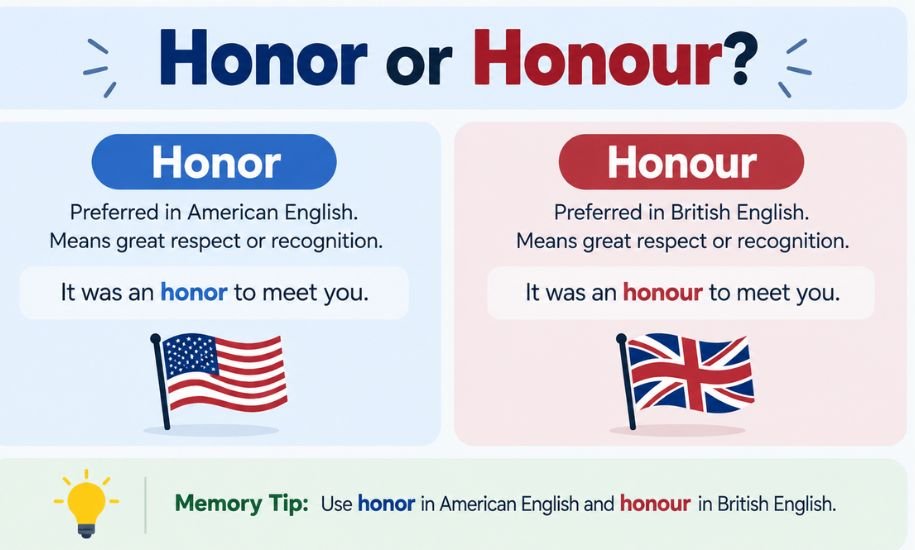
Honor or Honour? American vs. British English
If you have ever wondered whether to write honor or honour, the answer depends on which variety of English you are using. Both spellings are correct, and they have the same meaning. The main difference is regional: American English uses honor, while British English uses honour. Both words can describe respect, integrity, recognition, or a special privilege. Understanding this distinction will help you choose the right spelling for essays, professional documents, formal invitations, and everyday writing without confusing your readers.
Both honor and honour are correct. Honor is the standard American English spelling, whereas honour is preferred in British English and other varieties that follow British spelling conventions. They have the same meaning, so choose the version appropriate for your audience and use it consistently.
Honor vs. Honour: What Is the Difference?
The difference between these two words is simply the letter u. American English generally omits this letter in certain words where British English retains it.
| Feature | Honor | Honour |
|---|---|---|
| Spelling | American English | British English |
| Meaning | Respect, integrity, or recognition | Respect, integrity, or recognition |
| Part of speech | Noun and verb | Noun and verb |
| Example | It was an honor to attend. | It was an honour to attend. |
| Related form | Honored, honoring | Honoured, honouring |
Neither spelling is universally wrong. The choice depends on the English variety you are following.
American publications, schools, and businesses generally use honor. British publications and organisations generally use honour. Canadian and Australian English also commonly use honour, although individual style guides and institutional preferences may vary.
What Does Honor Mean?
Honor is an American English spelling of a word that expresses respect, good character, recognition, or a privilege. It functions as both a noun and a verb.
Honor as a noun
As a noun, the word can describe a feeling of respect, a person’s moral integrity, or something regarded as a special privilege.
Examples:
- It was an honor to receive the award.
- She earned the respect and honor of her colleagues.
- He believes that honesty is a matter of personal honor.
- Meeting the president was a great honor for the young student.
In these sentences, the word refers to recognition, respect, integrity, or a valued experience.
Honor as a verb
As a verb, honor means to show respect, recognise an achievement, or fulfil an obligation.
Examples:
- The school will honor its outstanding graduates.
- We should honor the people who helped our community.
- The company agreed to honor the original contract.
- The ceremony will honor those who served their country.
Use this spelling when writing in American English, including when forming related words such as honored and honoring.
What Does Honour Mean?
Honour has the same meanings as its American counterpart. It is the standard spelling in British English and in other varieties that follow British spelling conventions.
Honour as a noun
As a noun, it can refer to respect, honesty, dignity, recognition, or a special privilege.
Examples:
- It was an honour to meet the author.
- She acted with courage and honour.
- Receiving the scholarship was a great honour.
- The community held a ceremony in honour of its volunteers.
The meaning remains the same when the final spelling includes a u.
Honour as a verb
As a verb, honour can mean to respect someone, celebrate an achievement, or keep a promise or agreement.
Examples:
- The university will honour its most successful students.
- The town organised an event to honour its founder.
- You should honour your commitments.
- The organisation plans to honour the volunteers for their dedication.
These forms are appropriate in British English. Related spellings include honoured, honouring, and honourable.
How Do You Pronounce Honor and Honour?
Although the spellings differ, both words are generally pronounced with two syllables. Their pronunciation can vary according to accent.
In American English, the word often begins with a vowel sound similar to the one in father, followed by a reduced final syllable. In British English, the initial vowel is typically different, and the final sound varies between accents.
The additional u in the British spelling does not create an extra syllable. The difference is mainly a spelling convention rather than a difference in meaning.
When learning the word, focus on the pronunciation used by speakers of your preferred English variety. A British speaker can write honour, while an American speaker can write honor, without changing the intended message.
Should You Write “Your Honor” or “Your Honour” for a Judge?
Both forms are used when addressing a judge, but the appropriate spelling depends on the legal system and its conventions.
- American English: “Your Honor” is the customary written form.
- British English: “Your Honour” is commonly used in relevant judicial contexts.
For example:
American English: “Your Honor, I would like to present additional evidence.”
British English: “Your Honour, may I clarify one point?”
These examples illustrate regional conventions. Actual courtroom forms of address depend on the jurisdiction, court, and type of proceeding. If you are preparing a legal document, follow the official terminology used by the relevant court rather than assuming that one form applies everywhere.
Honor or Honour for a Wedding Invitation?
Both spellings are suitable for wedding invitations. The best choice depends on the style of English used throughout the invitation and the expectations of its audience.
For a British English invitation:
“It would be an honour to have you celebrate this special day with us.”
For an American English invitation:
“It would be an honor to have you celebrate this special day with us.”
Both sentences express the same sentiment. Neither is more formal or respectful simply because of its spelling.
If you are preparing a formal invitation, pay attention to consistency. For example, a British invitation would usually use honour, favour, and centre where those spellings are appropriate. An American invitation would generally use honor, favor, and center.
The same principle applies to wedding programmes, thank-you notes, award announcements, and other formal materials.
Is It “Such an Honour” or “Such an Honor”?
Both expressions are correct. The choice depends on whether you are using British or American English.
Examples:
- British English: “It is such an honour to be invited.”
- American English: “It is such an honor to be invited.”
The article an is correct in both expressions because the following word begins with a vowel sound. The letter h is silent in the standard pronunciation of both forms.
You can use these expressions to show appreciation for an invitation, award, opportunity, or recognition. There is no difference in meaning between the two versions.
Common Mistakes to Avoid
Although both spellings are correct, several usage mistakes are worth avoiding.
1. Treating one spelling as universally incorrect
Writing honour in an otherwise British English article is not a spelling error. Similarly, honor is correct in American English.
Better approach: Identify your audience and follow the appropriate spelling convention.
2. Mixing American and British spellings unnecessarily
Using honor in one paragraph and honour in another can make an article look inconsistent when both refer to the same concept.
Better approach: Choose one variety of English and apply it throughout the document, unless a quotation, official name, or other specific reason requires a different spelling.
3. Applying the wrong spelling to related words
The spelling difference affects several related forms. American English uses honored and honoring, while British English generally uses honoured and honouring.
Better approach: Check the entire word family rather than correcting only the main word.
4. Assuming the extra letter changes the meaning
The letter u does not give honour a separate definition. Both spellings can describe respect, dignity, recognition, or a privilege.
Better approach: Choose the spelling based on regional conventions, not on the intended meaning.
Easy Way to Remember the Difference
Use this simple rule:
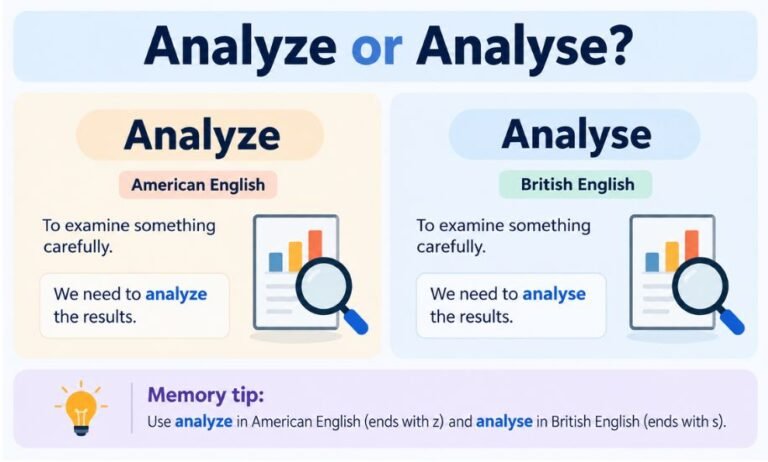
American English drops the “u”; British English keeps it.
This pattern also appears in several other word pairs:
| American English | British English |
|---|---|
| Honor | Honour |
| Color | Colour |
| Favor | Favour |
| Labor | Labour |
| Neighbor | Neighbour |
This is a useful general pattern, although English spelling has exceptions. Remembering the regional convention will help you write consistently across related words.
Frequently Asked Questions
1. Is honor or honour correct?
Both spellings are correct. Honor is the standard American English spelling, while honour is standard in British English and many varieties influenced by British spelling. They share the same meaning, so neither form is inherently more correct than the other.
2. Is honour the British spelling?
Yes. Honour is the standard British English spelling. It is also commonly used in Australian and Canadian English. However, specific organisations may follow their own style guides, so check the relevant requirements when preparing formal or published documents.
3. Do honor and honour have different meanings?
No. Both words can refer to respect, moral integrity, recognition, dignity, or a special privilege. They can also function as verbs meaning to show respect or fulfil a commitment. The distinction is primarily regional spelling.
4. How do you spell honor in the UK?
In British English, the usual spelling is honour. Related forms include honoured, honouring, and honourable. These spellings are generally preferred in British publications and formal writing.
5. Should I use “Your Honor” or “Your Honour” in court?
American legal usage generally uses “Your Honor,” while British legal contexts commonly use “Your Honour.” However, forms of address vary by jurisdiction and court. Always follow the official conventions of the relevant legal system.
6. Is “honorary” spelled differently in British English?
No. Honorary is spelled the same way in standard American and British English. For example, both varieties use the sentence, “She received an honorary degree.” The spelling difference found in honor and honour does not carry over to this word.
Final Verdict: Honor or Honour?
The correct choice depends on your audience. Use honor for American English and honour for British English, keeping related words consistent throughout your writing. Both forms express the same ideas of respect, integrity, and recognition. If you need more straightforward explanations of English spelling and usage, Grammarifyr helps you know the difference and use the right words.
You may also Read : Dessert or Desert: Pronunciation and Meaning Explained
One Comment