Either or Neither: Grammar Rules and Usage
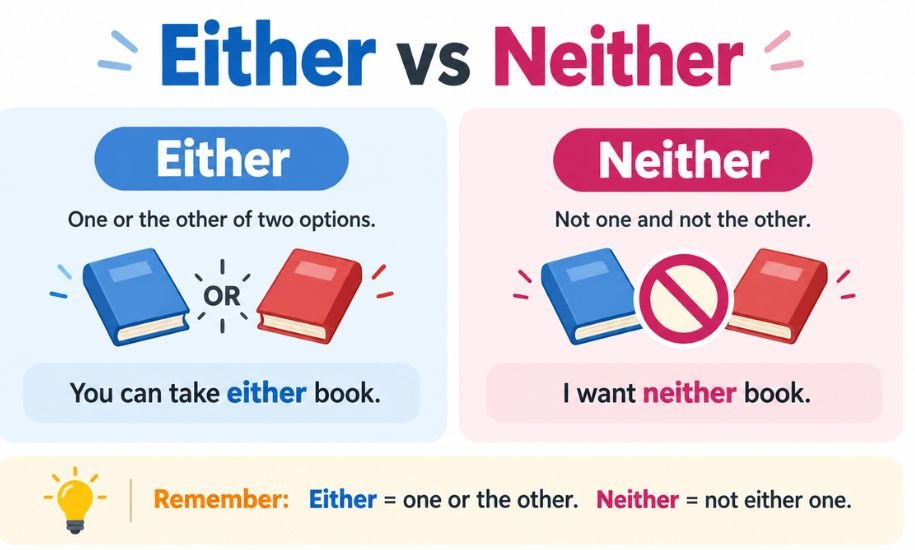
The words either and neither are often confusing because both refer to two people, things, or choices, but they express different meanings. Either is generally used to indicate one of two options, while neither means not one and not the other. Understanding when to use each word can help you form clearer sentences, avoid grammatical mistakes, and communicate more naturally in English. Both words are also used in specific structures, such as either … or … and neither … nor …, which follow slightly different rules.
What Is the Difference Between Either and Neither?
The main difference is that either presents a choice between two possibilities, whereas neither excludes both possibilities. The correct word depends on whether you are accepting an option or rejecting both.
| Feature | Either | Neither |
|---|---|---|
| Meaning | One or the other of two | Not one and not the other |
| Purpose | Expresses a choice or alternative | Expresses a negative statement |
| Common structure | Either … or … | Neither … nor … |
| Typical verb agreement | Usually singular when used alone | Usually singular when used alone |
| Example | Either option is suitable. | Neither option is suitable. |
| Negative use | I don’t like either. | I like neither. |
For example:
- Either: You can take either the blue bag or the black one. (You can choose one.)
- Neither: I want neither the blue bag nor the black one. (You do not want either.)
The distinction is especially important when discussing two options, because changing one word can completely change the meaning of a sentence.
What Does “Either” Mean?
Either is a determiner, pronoun, adverb or conjunction, depending on how it is used. It commonly refers to one of two people or things and is often used to offer a choice.
1. Either as a Determiner
When used as a determiner, either comes before a singular noun and refers to one of two possibilities.
Examples:
- Either answer is acceptable.
- You can sit on either chair.
- Either route will take you to the city centre.
- Either candidate could get the position.
In these sentences, both options are possible, and choosing one is sufficient.
2. Either as a Pronoun
Either can also stand alone instead of repeating a noun.
Examples:
- There are two available rooms. Either is fine.
- Which dessert would you prefer? Either will do.
- You may choose either of them.
The word refers to one of two previously mentioned options.
3. Either as a Conjunction
The structure either … or … connects two alternatives in a sentence.
Examples:
- You can either walk to school or take the bus.
- Either Sarah or Emma will organise the event.
- We will either travel on Friday or leave on Saturday.
This construction makes the available choices clear.
4. Either in Negative Sentences
Either can appear at the end of a negative sentence to mean also not.
Examples:
- I don’t enjoy horror movies either.
- She hasn’t completed the assignment either.
- He isn’t interested in football, and I am not interested either.
Here, either does not express a choice. It adds another negative statement.
What Does “Neither” Mean?
Neither means not one and not the other when referring to two people, objects, or choices. It is used to express a negative idea about both alternatives.
1. Neither as a Determiner
When neither is used before a singular noun, it indicates that both options are excluded.
Examples:
- Neither student passed the examination.
- Neither answer is correct.
- Neither road leads to the airport.
- Neither restaurant is open today.
In each sentence, both possibilities are rejected.
2. Neither as a Pronoun
Neither can also be used without a noun when the two options are already understood.
Examples:
- Which dress do you prefer? Neither.
- Both plans have disadvantages, so neither seems suitable.
- Neither of them attended the meeting.
This usage helps avoid repeating information.
3. Neither as a Conjunction
The structure neither … nor … connects two negative alternatives.
Examples:
- Neither my brother nor my sister likes swimming.
- She is neither tired nor hungry.
- Neither the manager nor the employee was available.
- He speaks neither French nor German.
This construction makes it clear that both alternatives are excluded.
4. Neither in Responses
Neither is commonly used to agree with a negative statement.
Examples:
- “I don’t like cold weather.” “Neither do I.”
- “She can’t drive.” “Neither can her sister.”
- “I’m not ready.” “Neither am I.”
In casual conversation, Me neither is also widely used.
How to Use Either or Neither in Grammar
Understanding the sentence structure makes it easier to choose the right word.
Either … or …
Use either … or … when presenting two alternatives. The alternatives should generally have matching grammatical structures.
Examples:
- You can either study at home or work in the library.
- Either my father or my mother will collect me.
- We can either order pizza or prepare dinner.
When the two subjects have different grammatical numbers, formal grammar generally favours agreement with the subject closest to the verb.
For example:
- Either the teachers or the principal is attending.
- Either the principal or the teachers are attending.
Although these constructions are grammatically possible, a sentence can sometimes be rewritten to sound more natural.
Neither … nor …
Use neither … nor … when neither alternative applies.
Examples:
- Neither the teacher nor the student was present.
- She wants neither a laptop nor a tablet.
- Neither the hotel nor the restaurant offers free parking.
When the subjects differ in number, the verb often agrees with the nearer subject in standard usage. Rephrasing the sentence can avoid awkward agreement.
Either of and Neither of
Both expressions are followed by a plural noun with a determiner or by an object pronoun.
Examples:
- Either of the two answers is acceptable.
- Neither of the players was injured.
- Either of my friends can help.
- Neither of them wants to leave.
In formal English, either of and neither of usually take a singular verb. Plural verbs with neither of are also heard in informal speech, particularly in some varieties of English.
Either and Neither Examples in Sentences
The following examples demonstrate how the words work in everyday English.
| Either | Neither |
|---|---|
| Either book will be useful. | Neither book is available. |
| Either of us can attend. | Neither of us can attend. |
| You can choose either colour. | I like neither colour. |
| Either road leads to the village. | Neither road is safe. |
| Either Sam or Alex will call. | Neither Sam nor Alex called. |
| Either option is acceptable. | Neither option meets our needs. |
| You can either stay or leave. | You can neither stay nor leave. |
| I don’t want either of these. | Neither of these is suitable. |
These examples show that either is suitable for choices and alternatives, while neither is used when both options are excluded.
Common Mistakes to Avoid
Even though these words are simple, certain sentence patterns can lead to errors.
1. Using “or” instead of “nor”
- Incorrect: Neither John or Peter came to class.
- Correct: Neither John nor Peter came to class.
The standard paired structure is neither … nor ….
2. Using a double negative
- Incorrect: I don’t like neither option.
- Correct: I like neither option.
- Also correct: I don’t like either option.
In standard English, avoid combining not with neither in this construction.
3. Using an incorrect verb with either of
- Less suitable in formal writing: Either of the solutions are acceptable.
- Preferred: Either of the solutions is acceptable.
When either of refers to two options, a singular verb is preferred in formal English.
4. Confusing a choice with a rejection
- Choice: Either restaurant is suitable.
- Rejection: Neither restaurant is suitable.
Use either if one of the options will work and neither if both are unsuitable.
5. Using neither when agreeing with a positive statement
- Incorrect: “I enjoy reading.” “Neither do I.”
- Correct: “I enjoy reading.” “So do I.”
Use neither to agree with a negative statement, not a positive one.
Easy Way to Remember the Difference
A simple way to remember these words is to focus on what happens to the two choices.
- Either = one or the other. Think of choosing one of two available options.
- Neither = not either one. Think of rejecting both options.
For example, if someone offers you two drinks, saying “Either is fine” means you will accept one of them. Saying “Neither is fine” means you do not want either drink.
You can also remember the paired conjunctions:
- Either … or … = alternatives
- Neither … nor … = two excluded alternatives
This simple pattern is useful in writing, conversations, examinations and everyday communication.
Either or Neither Exercises With Answers
Test your understanding by choosing the correct word or verb for each sentence.
- You can have ___ tea or coffee.
- ___ of the two answers is correct.
- I don’t enjoy football, and my brother doesn’t ___.
- ___ my mother nor my father is at home.
- ___ of these two dresses will look good on you.
- “I can’t speak Spanish.” “___ can I.”
- Neither of the students ___ ready.
- She is ___ interested in singing nor dancing.
Frequently Asked Questions
Is either or neither correct?
Both are correct English words, but they have different meanings. Either refers to one or the other of two choices, while neither means not one and not the other. The appropriate word depends on whether you are presenting an alternative or excluding both options.
Should I use either or neither in a negative sentence?
Both can be used in negative contexts. Use either at the end of a negative sentence, such as “I don’t like it either.” Use neither to express that both choices are excluded, as in “I like neither option.”
Is neither singular or plural?
Neither is generally treated as singular when used alone or in neither of constructions in formal English. In neither … nor … sentences with subjects of different numbers, the verb usually agrees with the closest subject.
Can either and neither be used together?
Yes. They can appear in the same conversation or paragraph when expressing different ideas. For example, “Either option is fine, but neither of them is available today” is grammatically correct because each word has a different function.
What is the difference between either or and neither nor?
Either … or … introduces two alternatives, such as “You can either call or email.” Neither … nor … excludes both alternatives, as in “She can neither call nor email.” The two structures express contrasting meanings.
Is “Me neither” grammatically correct?
“Me neither” is an accepted and widely used informal response to a negative statement. For example, if someone says, “I don’t like mushrooms,” you can reply, “Me neither.” In more formal contexts, “Neither do I” may be preferable.
Final Verdict: Either or Neither?
Both either and neither are correct, but they serve different purposes. Use either to refer to one of two alternatives and neither when both alternatives are excluded. Remembering the patterns either … or … and neither … nor … will help you avoid common grammatical mistakes. With clear explanations and practical examples, Grammarifyr helps you know the difference and use the right words confidently.
You may also Read : Hercules or Bauer: Differences, Quality and Value
One Comment