To vs Too: Meaning, Rules, and Examples
The words to and too sound exactly alike in most varieties of English, but they have completely different grammatical jobs. That makes them easy to confuse, especially when writing quickly. The good news is that the difference is straightforward once you connect each word with its main purpose. To is commonly used for direction, relationships, and before a verb, while too generally means “also” or “more than necessary.” Understanding these patterns will make it much easier to choose the right word in everyday and formal writing.
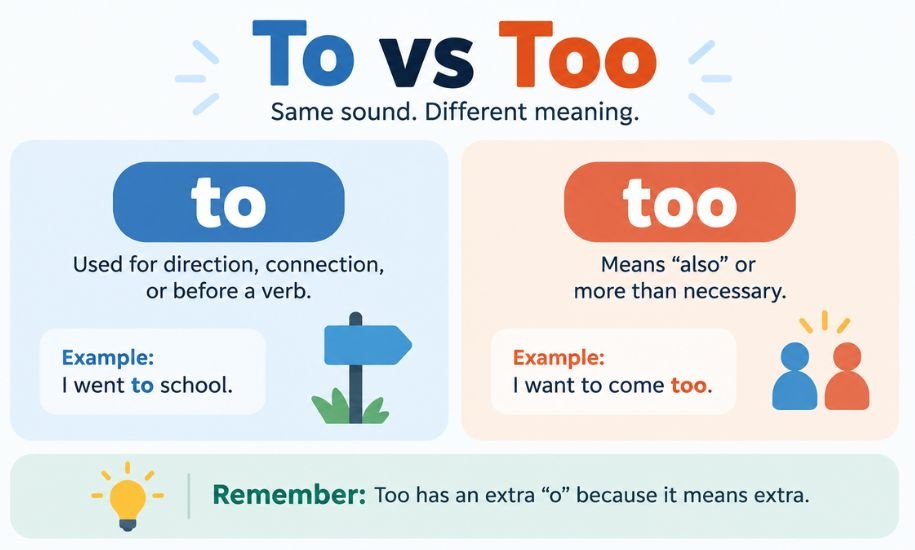
To is generally used for direction, connection, or before a verb: “She went to school” and “I want to learn.” Too means “also” or indicates an excessive amount: “I want to come too” and “It is too expensive.”
To vs Too: The Key Difference
Both to and too are correct English words. The important difference is their meaning and grammatical function.
| Word | Main function | Common meaning | Example |
|---|---|---|---|
| to | Preposition or infinitive marker | Direction, connection, or before a verb | “We went to the park.” |
| too | Adverb | Also, or excessively | “I want to go too.” |
| too | Adverb | More than necessary | “The box is too heavy.” |
A useful first question is: What does the word mean in this sentence?
If it means “also” or “more than necessary,” choose too. If it introduces a verb or shows direction or a relationship, to is usually the correct choice.
What Does “To” Mean?
To is one of the most frequently used words in English. It has several grammatical functions, but two are particularly important when distinguishing it from too.
1. “To” Shows Direction or Destination
Use to when describing movement toward a place, person, or destination.
- We walked to the library.
- Maria drove to the airport.
- Please send this letter to my office.
- The children ran to their parents.
It can also show a relationship or recipient:
- I spoke to my teacher.
- Give the keys to James.
- She introduced me to her colleague.
2. “To” Comes Before a Verb
To is also used as an infinitive marker before the base form of a verb.
- I want to read.
- He needs to leave.
- They decided to stay.
- We hope to win.
- She plans to travel.
This gives you a simple practical clue: when to appears directly before a base-form verb, such as go, eat, study, learn, or write, it is usually the infinitive marker.
What Does “Too” Mean?
Unlike to, too is an adverb. It has two main meanings.
“Too” Means “Also”
The first meaning is also, as well, or in addition.
- I would like some coffee too.
- Sarah is coming too.
- He enjoys classical music too.
- “I’m tired.” — “Me too.”
Try replacing too with also. If the sentence keeps essentially the same meaning, too is probably correct.
For example:
I want to join you too.
This means:
I also want to join you.
“Too” Means “More Than Necessary”
The second meaning describes something excessive or beyond a suitable level.
- The soup is too hot.
- This suitcase is too heavy.
- The shoes are too small.
- You are speaking too quickly.
- The movie was too long.
Notice the difference between very and too:
The soup is very hot.
This simply says that the soup has a high temperature.
The soup is too hot.
This suggests that the temperature is higher than is desirable or manageable.
That distinction is especially important when explaining the to vs too meaning in a sentence.
When to Use Too vs To
If you are unsure when to use too vs to, look at the meaning rather than the pronunciation.
Use “too” when you mean “also”
Correct: I want to come too.
The meaning is “I also want to come.”
Incorrect: I want to come to.
The final word does not express the intended meaning.
Use “too” for an excessive amount
Correct: This coffee is too hot.
Here, too means excessively hot.
Incorrect: This coffee is to hot.
Use “to” before a verb
Correct: I need to study.
Incorrect: I need too study.
Here, to is the infinitive marker.
Use “to” for a destination
Correct: We are going to the museum.
Incorrect: We are going too the museum.
In this sentence, to indicates where we are going.
To vs Too vs Two
The comparison becomes slightly more complicated because there is a third word: two.
To, too, and two are pronounced alike in standard English, but their meanings and spellings are different.
To
Use to for direction, relationships, or before a verb.
She went to the store.
I want to learn Spanish.
Too
Use too for “also” or an excessive amount.
I want to go too.
The jacket is too expensive.
Two
Use two when referring to the number 2.
I have two sisters.
Please bring two chairs.
A simple way to remember the three is:
To = direction or verb
Too = also or excessive
Two = number 2
Examples: Choosing the Correct Word
Seeing the words in different contexts can make the distinction easier.
Example 1
She went to the market.
To indicates the destination.
Example 2
She bought some fruit too.
Too means “also.”
Example 3
She bought two oranges.
Two represents the number 2.
Example 4
I need to finish my homework.
To comes before the verb finish.
Example 5
I have too much homework.
Too indicates an excessive amount.
Example 6
My brother wants to come too.
Too means “also.”
These examples show why pronunciation alone cannot tell you which spelling to choose. The sentence’s meaning and grammatical structure provide the answer.
Have To vs Have Too
The phrase have to is a particularly common source of mistakes.
Have to is used to express necessity or obligation:
- I have to work tomorrow.
- We have to leave soon.
- She has to study tonight.
- They have to follow the rules.
Here, to is followed by a verb.
I have to go.
Writing “I have too go” is incorrect in standard English.
However, too can correctly appear after have when it has its normal meaning:
I have too many books.
Here, too means that the number is excessive.
Similarly:
- I have too much work.
- We have too little time.
- They have too few chairs.
So the distinction is not really about the word have. It depends on what to or too is doing in the sentence.
Common Mistakes With To and Too
Mistake 1: Using “too” before an infinitive
Incorrect: I want too learn.
Correct: I want to learn.
When the word introduces a base-form verb, use to.
Mistake 2: Writing “to” when you mean “also”
Incorrect: I would like to come to.
Correct: I would like to come too.
The intended meaning is “I would also like to come.”
Mistake 3: Confusing “too much” with “to much”
Incorrect: There is to much noise.
Correct: There is too much noise.
The phrase too much means more than is desirable or necessary.
Mistake 4: Confusing “too many” with “to many”
Incorrect: There are to many people here.
Correct: There are too many people here.
Mistake 5: Using “two” for a grammatical function
Incorrect: I want two go home.
Correct: I want to go home.
Two is the number 2; it cannot replace to.
An Easy Way to Remember the Difference
A practical memory trick is to associate the extra o in too with the idea of extra.
Think:
Too = extra
That works for both major meanings:
- too = also, meaning something is added
- too = excessively, meaning there is more than needed
For example:
I want one too. → I want one also.
It is too cold. → It is more cold than desirable.
For to, remember:
To = toward or verb
Examples:
We went to school. → toward a destination
I want to read. → before a verb
And for two:
Two = 2
This simple three-part rule handles most everyday situations.
When Do You Use To vs Too?
When deciding when do you use to vs too, check the word’s role in the sentence.
Ask these questions:
- Does it mean “also”? Use too.
- Does it mean “more than necessary”? Use too.
- Does it show movement toward a destination or person? Use to.
- Does it come before a base-form verb? Use to.
- Does it mean the number 2? Use two.
For example:
I want to go to the concert too.
The first to introduces the verb go. The second shows the destination. Too means “also.”
Frequently Asked Questions
Is “to” or “too” correct?
Both are correct words, but they are used differently. To commonly expresses direction or introduces an infinitive, while too means “also” or “more than necessary.” The correct choice depends on the sentence.
How can I quickly tell whether to use “to” or “too”?
Try replacing the word with “also.” If the meaning still works, use too. If the word introduces a verb or expresses direction, to is usually correct.
Is “too” always related to something excessive?
No. Too has two major uses. It can mean “also”, as in “I want to come too,” or it can indicate excess, as in “The box is too heavy.”
What is the difference between “to,” “too,” and “two”?
To is commonly used for direction and before verbs. Too means “also” or “excessively.” Two is the number 2. All three sound alike in standard pronunciation, which is why they are often confused in writing.
Is “have to” or “have too” correct?
Have to is correct when expressing an obligation, as in “I have to leave.” Too is correct when it means “also” or “excessively,” as in “I have too much work.”
Final Verdict: To or Too?
The simplest rule is this: to is generally used for direction, connection, or before a verb, while too means “also” or “more than necessary.” Keep two separate because it represents the number 2. Once you focus on meaning and grammatical function rather than pronunciation, choosing the right form becomes much easier. For more clear explanations of commonly confused English words, Grammarifyr helps you know the difference and use the right words.
You may also Read : Prefer or Perfer: Correct Spelling and Usage