Empathic or Empathetic: Correct Usage Explained
If you have ever paused before writing “an ___ response” or “an ___ person,” you are not alone. Empathic and empathetic are both legitimate English adjectives, and they share essentially the same meaning. The confusion comes from their nearly identical spelling and their connection to the noun empathy. The good news is that you do not need to worry about choosing a “wrong” word. The better choice usually depends on context, style, and what sounds most natural to your audience.
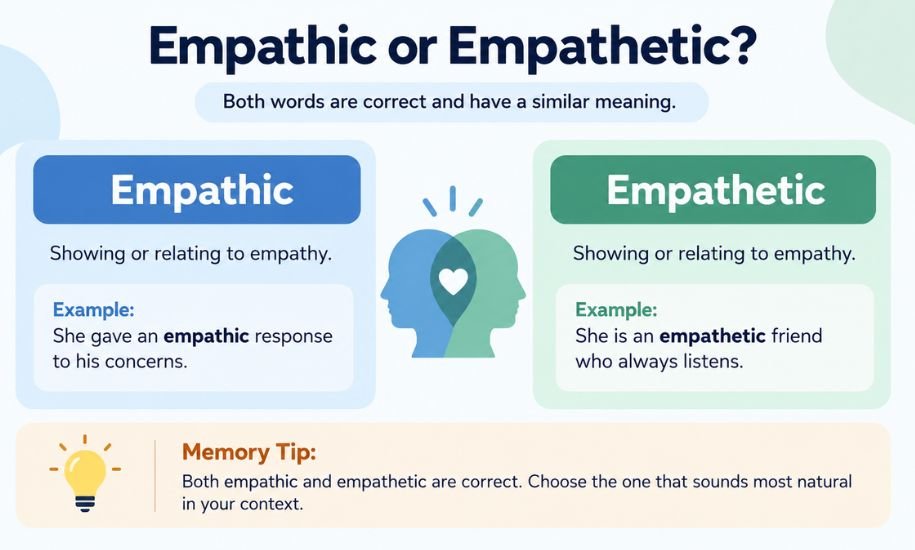
Both empathic and empathetic are correct. They describe someone or something that shows, involves, or relates to empathy. Empathetic is often the more familiar choice in everyday English, while empathic is also standard and is frequently found in psychological, clinical, and academic contexts.
Empathic vs. Empathetic: The Key Difference
There is no major difference in basic meaning between the two adjectives.
| Feature | Empathic | Empathetic |
|---|---|---|
| Correct word? | Yes | Yes |
| Part of speech | Adjective | Adjective |
| Basic meaning | Showing or relating to empathy | Showing or relating to empathy |
| Common use | General, academic, psychological, clinical | General and everyday English |
| Example | An empathic response | An empathetic response |
In many sentences, you can substitute one for the other without changing the meaning.
For example:
- The counselor gave an empathic response.
- The counselor gave an empathetic response.
Both sentences are grammatically correct.
The difference is primarily one of word choice and preference, rather than correctness.
What Does “Empathic” Mean?
Empathic is an adjective meaning characterized by or involving empathy. It describes the ability or tendency to understand another person’s feelings, experiences, or perspective.
The word can be used for people, communication, behavior, listening, responses, and approaches.
Examples of “empathic”
- She is an empathic listener who gives people time to explain themselves.
- The therapist maintained an empathic attitude throughout the conversation.
- His empathic response made the difficult discussion easier.
- The doctor took an empathic approach when speaking with the patient.
You may encounter empathic particularly often in writing related to psychology, counseling, healthcare, education, and interpersonal communication.
That does not mean it is restricted to those subjects. It is a normal English adjective and can be used more broadly.
What Does “Empathetic” Mean?
Empathetic is also an adjective. It describes someone who understands, recognizes, or responds sensitively to another person’s feelings or perspective.
For everyday communication, this is often the form that feels most familiar.
Examples of “empathetic”
- Maria is an empathetic friend.
- An empathetic teacher can recognize when students need extra support.
- He gave an empathetic answer instead of dismissing her concerns.
- Good managers should be empathetic when employees face personal difficulties.
Notice that these sentences could also use empathic in most cases:
Maria is an empathic friend.
The meaning remains essentially the same.
Is It Empathic or Empathetic?
If you are asking “is it empathic or empathetic?”, the answer is either one.
Neither spelling is a simple misspelling of the other. Both have established uses in standard English.
The choice can therefore be based on what fits your sentence and audience best.
For everyday writing
Empathetic is often a natural choice:
She is an empathetic colleague.
For professional or academic contexts
Empathic can work very naturally:
The study examined empathic communication between clinicians and patients.
However, you should not treat this as an absolute rule. Empathetic also appears in professional and academic writing, while empathic can certainly be used in everyday conversation.
The safest rule is simple: choose the form that sounds natural in your context and use it consistently.
Empathetic or Empathic: Which Should You Choose?
When both forms are grammatically correct, deciding between them can feel unnecessary. In most ordinary situations, either will communicate your meaning successfully.
If you want the word that is likely to feel immediately familiar to a broad general audience, empathetic is a practical choice.
For example:
She gave an empathetic response to his concerns.
If you are writing about a specific psychological or clinical concept, empathic may fit especially well:
The therapist demonstrated empathic understanding.
But there is no grammatical requirement that forces you to use one rather than the other.
A useful rule of thumb
- Everyday audience: empathetic is often the easiest choice.
- Psychology, counseling, or academic writing: empathic is often a natural choice.
- Formal writing: both are acceptable.
- Meaning: essentially the same.
Empathically or Empathetically?
The same pattern applies to the adverbs empathically and empathetically.
Both are valid.
An adverb modifies a verb and explains how something is done.
For example:
She listened empathetically to her friend’s concerns.
You could also write:
She listened empathically to her friend’s concerns.
Both sentences describe listening in a way that demonstrates empathy.
More examples
- The manager responded empathetically to the employee.
- The counselor listened empathically without interrupting.
- He spoke empathetically about the family’s situation.
- She approached the disagreement empathically rather than defensively.
As with the adjectives, empathetically may feel more familiar to many general readers, but empathically is not incorrect.
Empath or Empathetic: These Are Not the Same Kind of Word
The comparison empath or empathetic is slightly different because the words have different grammatical functions.
Empath
Empath is a noun. It refers to a person who is highly sensitive to or experiences the emotions of other people.
Example:
She describes herself as an empath.
Empathetic
Empathetic is an adjective. It describes a person, behavior, response, or quality associated with empathy.
Example:
She is an empathetic listener.
So these words should not normally be substituted for each other.
Compare:
Correct:
He is an empath.
Correct:
He is an empathetic person.
The first sentence uses a noun to identify the person. The second uses an adjective to describe the person.
How “Empathy,” “Empathic,” and “Empathetic” Fit Together
Understanding the related word forms makes the distinction much easier.
Empathy — noun
Empathy is the ability to understand or appreciate another person’s feelings or perspective.
Her empathy helped her support her friend.
Empathic — adjective
Empathic describes something characterized by empathy.
He showed an empathic understanding of the situation.
Empathetic — adjective
Empathetic has essentially the same adjective function.
He showed an empathetic understanding of the situation.
Empathically — adverb
Empathically describes an action performed in an empathic way.
She listened empathically.
Empathetically — adverb
Empathetically serves the same basic adverbial function.
She listened empathetically.
This family of words explains why several similar-looking forms can appear in English without one automatically being wrong.
Examples in Sentences
Seeing the alternatives side by side is one of the easiest ways to understand the usage.
Adjectives
The counselor took an empathic approach.
The counselor took an empathetic approach.
Both are correct.
Describing a person
James is an empathic leader.
James is an empathetic leader.
Again, both work.
Describing communication
Her empathic response helped calm the situation.
Her empathetic response helped calm the situation.
The meaning is essentially unchanged.
Adverbs
He responded empathically to the criticism.
He responded empathetically to the criticism.
Both forms are acceptable.
Common Mistakes to Avoid
1. Assuming “empathic” is incorrect
It is not. Empathic is a legitimate adjective.
Incorrect assumption:
“Empathic” is just a misspelling of “empathetic.”
Better understanding:
Both forms are established English words.
2. Assuming “empathetic” is informal
There is no need to treat empathetic as an incorrect or inherently informal alternative. It is a standard adjective.
3. Using “empath” as an adjective
Because empath is related to empathy, writers sometimes use it where an adjective is required.
For example:
She gave an empath response.
That construction is generally not what you want.
Use:
She gave an empathic response.
or:
She gave an empathetic response.
4. Confusing empathy with sympathy
The words empathy and sympathy are related but not identical. Empathy generally involves understanding or sharing another person’s perspective or feelings, whereas sympathy commonly expresses concern or sorrow for someone’s situation.
This distinction matters when choosing words for precise writing.
5. Switching forms unnecessarily
There is usually no reason to alternate between empathic and empathetic in the same piece simply to avoid repetition.
If your article naturally uses empathetic throughout, there is no need to replace some instances with empathic. Consistency generally produces cleaner prose.
Easy Way to Remember the Difference
You do not need a complicated mnemonic because there is no major meaning distinction to memorize.
Instead, remember this:
Empathic and empathetic are both adjectives.
Think of the basic word family:
empathy → empathic / empathetic → empathically / empathetically
And remember:
empath = noun
empathic / empathetic = adjectives
empathically / empathetically = adverbs
If you remember the grammatical role of each form, most usage questions become straightforward.
Which Form Is Better in Formal Writing?
Both can be used in formal writing.
If you are writing an essay, report, professional document, or article, you do not need to avoid either word.
Consider:
The organization encourages empathetic communication among its staff.
This is perfectly appropriate.
You could also write:
The organization encourages empathic communication among its staff.
Also appropriate.
The more important consideration is clarity and consistency. If your intended audience is broad, empathetic may be the more immediately familiar option. If your writing uses terminology common in psychology or counseling, empathic may fit naturally with the surrounding vocabulary.
Frequently Asked Questions
Is “empathic” a real word?
Yes. Empathic is a standard English adjective. It means relating to or characterized by empathy. It is not simply a misspelling of empathetic, and it can be used in both general and specialized contexts.
Is “empathetic” grammatically correct?
Yes. Empathetic is a standard adjective meaning characterized by or showing empathy. For example, “She is an empathetic teacher” is grammatically correct.
Is it empathetic or empathic in a sentence?
Both can be correct. For example, “He gave an empathetic response” and “He gave an empathic response” have essentially the same meaning. Choose whichever better suits your preferred style and context.
Are empathically and empathetically both correct?
Yes. Both are adverbs derived from the corresponding adjectives. “She listened empathetically” and “She listened empathically” are both grammatically acceptable.
Is an empath the same as an empathetic person?
Not exactly. Empath is a noun referring to a person, while empathetic is an adjective describing someone or something that demonstrates empathy. For example, “She is an empath” and “She is empathetic” use the words differently.
Which word should I use most often?
For general-purpose writing, empathetic is a straightforward choice because it is widely familiar. However, empathic is equally legitimate, so there is no grammatical need to replace it simply because another form exists.
The Bottom Line
Empathic and empathetic are both correct. They function as adjectives and have essentially the same meaning, while empathically and empathetically are both acceptable adverb forms. The choice is mainly about context and personal or editorial preference, not right versus wrong. For clear, natural word choices and straightforward explanations of confusing English terms, Grammarifyr helps you know the difference and use the right words.
You may also Read : Other Ways to Say “But”: 25 Better Alternatives for Writing and Speaking
One Comment