Less or Fewer? Meaning and Usage Explained
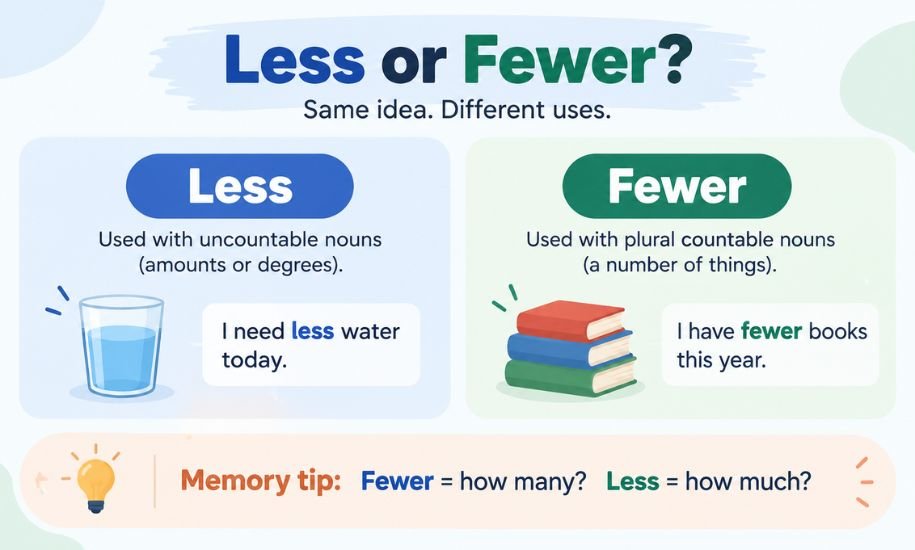
It is easy to hesitate between less and fewer, especially because both describe a smaller quantity. The key is what you are talking about: less generally refers to an amount, while fewer normally refers to a number of separate, countable things. Once you recognize whether a noun can be counted individually, the choice becomes much easier. There are also a few important exceptions involving measurements, time, money, and common expressions.
Less usually goes with uncountable nouns, such as water, time, money, and information. Fewer normally goes with plural countable nouns, such as books, people, mistakes, and cars. However, English commonly uses less with measurements, as in “less than five hours” or “less than $20.”
Less or Fewer: The Basic Difference
The traditional rule is straightforward:
| Word | Main use | Examples |
|---|---|---|
| Less | Smaller amount or degree | less water, less time, less noise |
| Fewer | Smaller number of countable things | fewer books, fewer people, fewer errors |
A quick way to decide is to ask whether you can count the things individually.
If you can, fewer is normally the right choice:
- fewer students
- fewer emails
- fewer chairs
- fewer problems
If you are talking about an amount rather than separate items, use less:
- less patience
- less traffic
- less information
- less electricity
For example:
We have less information than before.
But:
We received fewer reports than before.
Information is treated as an uncountable noun, while reports are individual things that can be counted.
When to Use Less
Less is the comparative form associated with little and generally describes a smaller amount, degree, or quantity of something that is not being treated as individual countable units.
Common examples include:
- less water
- less food
- less money
- less work
- less stress
- less information
- less traffic
- less noise
- less interest
Consider these sentences:
I need less sugar in my coffee.
She has less free time this week.
The new route has less traffic.
We were given less information than we expected.
You can also use less for abstract concepts and degrees:
He showed less interest in the proposal.
The medicine caused less pain than expected.
The noun does not have to be a physical substance. What matters is that it is normally treated as an amount or mass rather than as separate countable objects.
When to Use Fewer
Fewer normally modifies plural countable nouns. These are nouns that can be counted as individual units.
For example:
There are fewer customers today.
I made fewer mistakes this time.
The library has fewer books than it did last year.
We need fewer chairs for the smaller room.
You can usually put a number before the noun:
- three customers
- ten mistakes
- 50 books
- six chairs
That is a strong clue that fewer is appropriate.
More examples
Fewer people attended the event.
Fewer cars were on the road this morning.
Fewer questions appeared on the test.
Fewer companies submitted applications.
Fewer children chose the afternoon activity.
A useful mental comparison is:
- fewer = not as many
- less = not as much
So:
There are fewer students.
means:
There are not as many students.
While:
There is less water.
means:
There is not as much water.
Less Than or Fewer Than?
The same basic distinction applies to less than and fewer than, but measurements create some important exceptions.
Use fewer than when referring to separate countable things:
Fewer than 30 students attended.
Fewer than 100 people applied.
Fewer than ten houses were damaged.
Use less than when referring to an amount or measurement:
The journey took less than three hours.
The package weighs less than five kilograms.
The ticket costs less than $50.
The distance is less than ten miles.
This can seem confusing because hours, kilograms, dollars, and miles are technically countable units. In these expressions, however, they are being used as measurements or quantities.
So these are natural:
It took less than four hours.
The repair cost less than $200.
The village is less than five miles away.
A useful rule is to treat measurements as quantities rather than as collections of individual objects.
Why Do We Say “Less Than Five Hours”?
This is one of the most common points of confusion.
You might reason that because there are five individual hours, fewer than five hours should be correct. In standard modern usage, however, less than five hours is the normal expression when five hours represents a duration.
The same pattern occurs with:
- less than two weeks
- less than six months
- less than 20 miles
- less than $100
- less than ten kilograms
The focus is on the total measurement, not on five separate objects.
Compare that with:
Fewer than five employees worked overtime.
Here, employees are distinct individuals, so fewer is appropriate.
Lesser or Fewer: What’s the Difference?
Lesser and fewer have different jobs and should not normally be substituted for one another.
Fewer means a smaller number:
The new system has fewer errors.
Lesser generally means smaller, lower, or less significant in degree or importance:
It was considered the lesser problem.
He chose the lesser of two evils.
She played a lesser role in the project.
So:
❌ There were lesser students in the classroom.
is not the standard way to say that the classroom contained a smaller number of students.
Use:
✅ There were fewer students in the classroom.
Think of fewer as a number word and lesser as a word describing relative degree, importance, size, or status.
A Lot Less or A Lot Fewer?
Both expressions are correct, but the noun determines which one you need.
Use a lot less with amounts:
We have a lot less time today.
She drinks a lot less coffee now.
The new vehicle uses a lot less fuel.
Use a lot fewer with countable plural nouns:
We received a lot fewer applications this year.
There are a lot fewer cars on the road.
The team made a lot fewer mistakes.
Compare:
a lot less traffic
with:
a lot fewer cars
Traffic is treated as an amount, while cars are individual countable objects.
Less of and Fewer of
When less or fewer comes before certain determiners, possessives, or pronouns, you will often need of.
Examples with less of:
We need less of the mixture.
She wants less of it.
It became less of a problem.
Examples with fewer of:
Fewer of the students completed the assignment.
Fewer of these products are available.
Fewer of them responded.
The choice still follows the same underlying distinction. Less relates to an amount or degree, while fewer refers to a number of countable things.
What About “10 Items or Less”?
You may have seen signs saying:
10 items or less
The traditional grammatical choice is:
10 items or fewer
because items is a plural countable noun.
However, “10 items or less” is very common in everyday English. The expression has become familiar, particularly on signs and in informal contexts.
If you are writing formal prose and want to follow the traditional countable-noun rule, “10 items or fewer” is the safer choice.
Another option is to avoid the issue entirely:
Up to 10 items
This is concise and completely natural.
Is “Less People” Ever Used?
You will encounter less before plural countable nouns, particularly in informal speech and writing:
less people
less problems
less mistakes
These constructions are widespread, but fewer remains the conventional choice in careful formal writing:
fewer people
fewer problems
fewer mistakes
So for an edited article, academic paper, professional report, or other formal text, prefer fewer when the noun is a plural countable noun.
This does not mean that every occurrence of less + plural noun is unintelligible or never used by native speakers. It is better understood as a difference between the traditional formal rule and broader everyday usage.
Does Fewer Mean More or Less?
If you are wondering whether fewer indicates an increase or a decrease, it means a smaller number.
For example:
There were 50 visitors yesterday and 30 today.
You can say:
There were fewer visitors today.
So fewer is associated with a reduction in number.
A useful comparison is:
- more people → a greater number
- fewer people → a smaller number
- more water → a greater amount
- less water → a smaller amount
The distinction is therefore not simply “more versus less.” It is also about number versus amount.
Common Mistakes
1. Using “less” with countable plural nouns
Incorrect in formal standard usage:
The company has less employees.
Better:
The company has fewer employees.
2. Using “fewer” with an uncountable noun
Incorrect:
We need fewer information.
Correct:
We need less information.
3. Using “fewer” with a measurement
Awkward:
The journey took fewer than three hours.
Natural:
The journey took less than three hours.
4. Confusing “lesser” with “fewer”
Incorrect:
The school has lesser students this year.
Correct:
The school has fewer students this year.
5. Assuming “less” is always wrong before a number
Expressions such as less than five hours, less than $100, and less than ten miles are standard because they describe measurements or quantities.
An Easy Way to Remember the Difference
Use this simple pair:
Fewer = how many?
Less = how much?
Ask yourself:
Can I count the things individually?
If yes, fewer is usually the answer:
fewer books
fewer employees
fewer mistakes
If not, use less:
less money
less water
less information
Then remember the measurement exception:
less than five hours
less than $50
less than ten miles
This rule will handle most everyday situations.
Examples: Less vs. Fewer
Here are some quick comparisons:
- less milk / fewer bottles of milk
- less traffic / fewer cars
- less furniture / fewer chairs
- less work / fewer tasks
- less information / fewer facts
- less noise / fewer sounds
- less money / fewer coins
- less food / fewer meals
Notice how changing the noun can change the correct word.
We need less furniture.
But:
We need fewer chairs.
Furniture is treated as an uncountable category, while chairs are individual objects.
Frequently Asked Questions
Is “fewer or less” correct?
Both words are correct, but they normally serve different purposes. Use fewer with plural countable nouns such as people and books. Use less with uncountable nouns and amounts such as water, time, and money.
When should I use fewer instead of less?
Use fewer when you are referring to a number of separate, countable things: fewer students, fewer emails, fewer mistakes. If you are referring to an amount or degree, less is generally appropriate.
Is “less than” or “fewer than” correct?
Both are correct in the right context. Use fewer than with plural countable nouns, such as “fewer than 20 employees.” Use less than for amounts and measurements, such as “less than three hours” or “less than $50.”
Does fewer mean more or less?
Fewer means a smaller number. If a shop had 100 customers on Monday and 70 on Tuesday, it had fewer customers on Tuesday.
Is “a lot less” or “a lot fewer” correct?
Both can be correct. Use a lot less with amounts, such as “a lot less time,” and a lot fewer with countable plural nouns, such as “a lot fewer customers.”
Is “10 items or less” grammatically correct?
“10 items or fewer” follows the traditional formal rule because items is countable. However, “10 items or less” is widespread in everyday English. For formal writing, “10 items or fewer” is the safer choice.
The Bottom Line
Use fewer for a smaller number of countable things and less for a smaller amount or degree. Remember the common measurement pattern: less than five hours, less than $100, and less than ten miles are all standard. Once you ask “how many?” or “how much?”, choosing the right form becomes much easier. For more clear explanations of confusing English choices, Grammarifyr helps you know the difference and use the right words.
You may also Read : Forrest or Forest: Meaning and Spelling Guide
One Comment