Their or Thier: Correct Spelling and Meaning
It is easy to mix up their and thier because the two forms contain exactly the same letters in a different order. However, there is an important distinction: one is the standard English spelling, while the other is a spelling error. If you are unsure how to write the possessive form connected with “they,” the correct choice is their. Understanding its meaning and seeing it used in context can make the spelling much easier to remember.
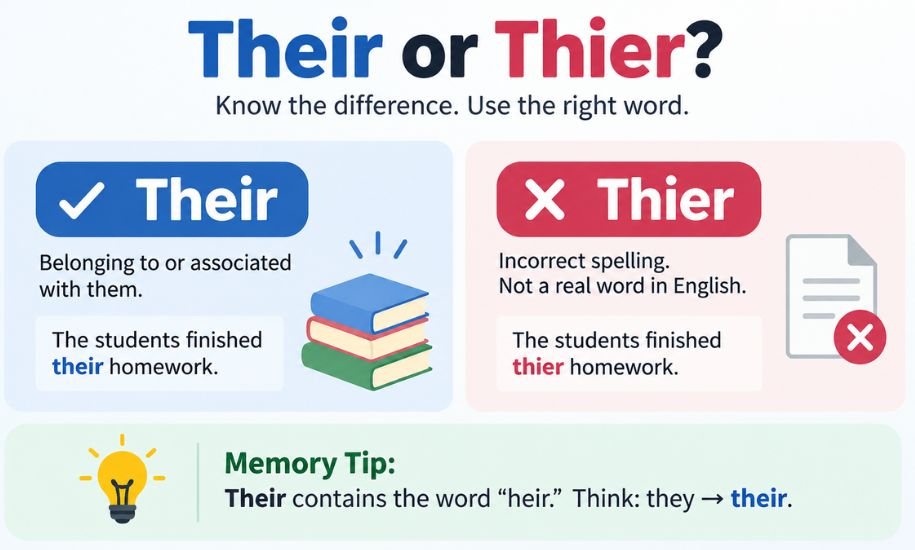
Their is the correct spelling. Thier is a misspelling and is not the standard form used in English. “Their” is a possessive determiner used to show that something belongs to or is associated with people or things previously mentioned.
Their or Thier: Which Is Correct?
The correct spelling is their:
T-H-E-I-R
The form thier is incorrect in standard English. It usually occurs when the letters e and i are accidentally reversed.
| Form | Correct? | Meaning | Example |
|---|---|---|---|
| their | ✅ Yes | Belonging to or associated with them | They left their coats here. |
| thier | ❌ No | Common misspelling of “their” | They left thier coats here. |
So, if you are wondering is it their or thier, use their when you mean possession or association.
Examples
- The children packed their lunches.
- The players returned to their hotel.
- Someone forgot their umbrella.
- The company changed their website design.
In each sentence, their connects something with a person, group, or entity.
What Does “Their” Mean?
Their is a possessive determiner. It normally indicates that something belongs to, is connected with, or is associated with them.
For example:
The students opened their books.
Here, their tells us that the books belong to the students.
Another example:
The dogs are playing with their toys.
The toys are associated with the dogs.
It can also be used with a singular person when the person’s gender is unknown, unspecified, or when the writer chooses gender-neutral language:
Someone left their keys on the desk.
In this sentence, their refers to one person, although the exact person is not identified.
More examples
- The employees submitted their reports.
- The bird returned to its nest, while the children returned to their home.
- Each participant received their own copy.
- The customers were asked to bring their receipts.
The important point is that their expresses a possessive relationship.
Is “Thier” a Real Word?
No. Thier is not the standard English spelling of a separate word with its own meaning. In ordinary English writing, it is treated as a misspelling of their.
For example:
Correct:
The students completed their assignment.
Incorrect:
The students completed thier assignment.
The mistake does not create a different grammatical form. It simply places the i and e in the wrong order.
This distinction is important when writing formal documents, school assignments, articles, emails, or other edited content.
How to Spell Their Correctly
If you are trying to remember how to spell their or thier, focus on the middle letters:
T-H-E-I-R
The sequence is:
TH + EI + R
Not:
TH + IE + R
A useful way to remember the spelling is to connect their with they:
- They went home.
- Their bags were left behind.
Both words begin with the, which can help reinforce the correct spelling.
Another memory aid is to notice the word heir inside their:
t + heir = their
An heir is someone connected with inheritance or property, so the association with ownership can also make the spelling easier to recall.
Why Do People Write “Thier”?
The mistake usually comes from reversing the order of two vowels.
The correct sequence is:
e → i
But the incorrect spelling uses:
i → e
Because the letters are close together and the two versions look very similar, it is easy to type the wrong sequence without noticing.
There can also be confusion because English contains many words with different ie/ei patterns. A writer who remembers a general spelling pattern may incorrectly apply it to this word.
The safest approach is not to rely on a broad rule. Instead, remember the specific spelling:
their = T-H-E-I-R
Their, There, and They’re
Another common source of confusion is the similarity among their, there, and they’re. Although they sound alike or very similar in many varieties of English, they have different meanings and grammatical functions.
Their
Their expresses possession or association.
The children found their shoes.
The shoes belong to or are associated with the children.
There
There commonly refers to a place or location.
Your shoes are over there.
It can also appear in constructions such as:
There is a problem with the printer.
They’re
They’re is a contraction of they are.
They’re waiting outside.
You can test this by replacing they’re with they are:
They are waiting outside.
The sentence still works, so they’re is correct.
A simple test
When choosing among these three forms, ask:
- Whose? → their
- Where? → there
- They are? → they’re
For example:
Their car is parked there, and they’re waiting inside.
Each word performs a different job.
Correct and Incorrect Examples
Seeing the spelling side by side makes the distinction easier.
| Incorrect | Correct |
|---|---|
| The team celebrated thier victory. | The team celebrated their victory. |
| The children forgot thier bags. | The children forgot their bags. |
| They returned to thier seats. | They returned to their seats. |
| The workers finished thier project. | The workers finished their project. |
| Someone left thier phone here. | Someone left their phone here. |
The pattern is consistent: whenever you mean the possessive form related to they, write their.
Common Mistakes With “Their”
1. Writing “thier”
This is the most direct spelling error.
Incorrect:
They brought thier equipment.
Correct:
They brought their equipment.
2. Using “there” for possession
There is not the possessive form of they.
Incorrect:
The students left there books at home.
Correct:
The students left their books at home.
3. Using “they’re” for possession
They’re means they are, so it cannot normally replace their.
Incorrect:
The players put they’re uniforms away.
Correct:
The players put their uniforms away.
4. Assuming “thier” is an alternative spelling
Unlike some American and British spelling differences, their and thier are not two regional versions of the same word. Thier is simply a misspelling in standard English.
Their or Thier Spelling: An Easy Rule
If you mean belonging to them, choose:
THEIR
For example:
The students brought their notebooks.
You can mentally connect their with they:
they → their
You can also remember:
their = t + heir
These simple associations are often more useful than trying to apply a complicated spelling rule.
How “Their” Works in a Sentence
Because their is a possessive determiner, it generally comes before a noun or noun phrase.
Examples:
- their house
- their car
- their teacher
- their new project
- their decision
For example:
The company announced their new product.
Here, their modifies the noun phrase “new product.”
It is different from the standalone possessive pronoun theirs:
This is their car.
This car is theirs.
The first sentence uses their before the noun car, while theirs stands independently.
Their vs Thier in Formal Writing
When proofreading an article, assignment, report, or professional message, always change thier to their when the intended meaning is possession or association.
Because the incorrect form is simply a spelling mistake, it should not be retained as an alternative spelling.
A useful proofreading technique is to search specifically for thier after completing a document. This can catch accidental letter transpositions that might otherwise be overlooked.
Frequently Asked Questions
Is it their or thier?
Their is correct. It is the possessive determiner associated with “they,” as in “They brought their books.” Thier is a misspelling and should not be used in standard English.
How do you spell their correctly?
The correct spelling is T-H-E-I-R. Remember the vowel sequence EI, not IE. A useful association is they → their, since both words begin with “the.”
What is the meaning of their?
Their indicates possession, connection, or association with someone or something referred to as “they.” For example, “The players collected their equipment” means the equipment belongs to or is associated with the players.
Is thier an alternative British spelling?
No. Thier is not a standard British alternative to their. British and American English both use their for the possessive determiner.
What is the difference between their and they’re?
Their shows possession or association, while they’re is a contraction of they are. For example, “They brought their bags” uses the possessive form, while “They’re waiting” means “They are waiting.”
How can I remember the spelling?
Remember their as T-H-E-I-R, with EI in the middle. Connecting it with they or remembering the word heir inside their can also help.
The Bottom Line
When choosing between these two forms, their is the correct spelling. Thier is simply a misspelling caused by reversing the e and i. Use their when showing possession or association, and remember to distinguish it from there and they’re. For more clear explanations of confusing English words and spelling choices, Grammarifyr helps you know the difference and use the right words.
You may also Read : Shined or Shone: Meaning and Usage Explained

One Comment