Recieve or Receive: Meaning and Correct Usage
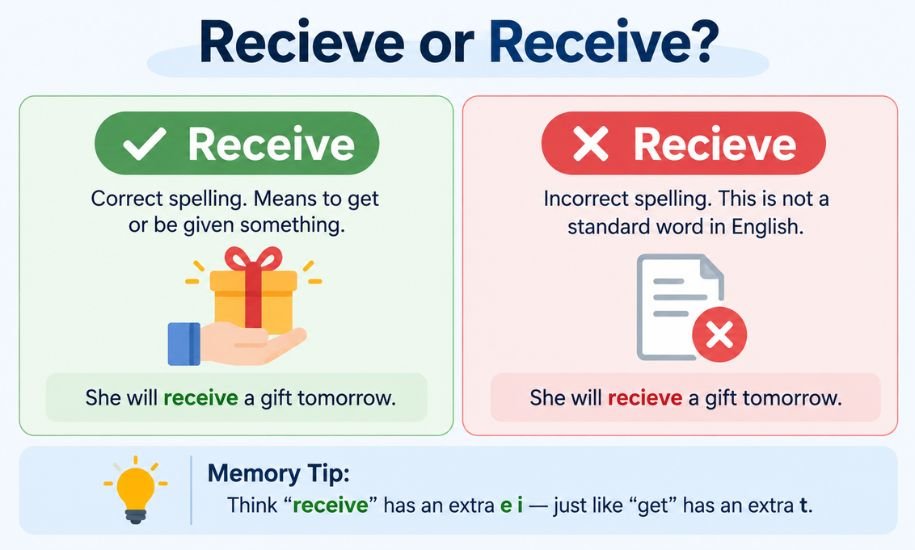
If you have ever hesitated over the spelling of receive, you are not alone. The word is easy to mix up because English has many familiar words containing ie, while receive uses ei. This often leads people to write “recieve” by accident. However, there is a straightforward answer: receive is the correct spelling in standard English. The form recieve is a misspelling, not an alternative British or American spelling.
Receive is the correct spelling. Recieve is a misspelling and should not be used in standard English. The spelling is r-e-c-e-i-v-e, with ei after the letter c.
Receive or Recieve: What’s the Difference?
The two forms look almost identical, but only one is standard English.
| Form | Correct? | Meaning | Example |
|---|---|---|---|
| receive | Yes | To get, accept, or be given something | I hope to receive your reply soon. |
| recieve | No | Not a standard English word | Avoid this spelling in formal writing. |
Receive is a verb. It can describe getting something, accepting something, welcoming someone, or experiencing something.
For example:
- Did you receive my email?
- We expect to receive the documents tomorrow.
- She received a birthday present.
- The team received positive feedback.
The incorrect spelling usually occurs because writers remember the common pattern ie and place the letters in the wrong order.
What Does “Receive” Mean?
Receive is a verb meaning to get, accept, or take something that is given, sent, offered, or communicated.
Its meaning can change slightly depending on the context.
To get something
This is one of the most common uses:
I received a letter from the university.
Here, the person got a letter.
To accept something
The word can also refer to accepting something offered or presented:
She received the award on behalf of her team.
To get information or communication
You can receive an email, message, phone call, invitation, or piece of news:
Did you receive my message?
To experience something
The word can also be used for experiences or treatment:
The proposal received considerable attention.
In each case, the spelling remains receive.
Why Is “Recieve” Incorrect?
Recieve is simply a spelling error. It does not have a separate meaning and is not an accepted alternative spelling of receive in standard English.
The mistake is understandable because English contains many words with the letter sequence ie, such as:
- believe
- achieve
- piece
- relief
- field
A writer who remembers the familiar “i before e” pattern may therefore instinctively spell the word as recieve.
The problem is that receive belongs to a group of words in which ei follows c:
- receive
- deceive
- conceive
- perceive
- receipt
- ceiling
So the correct spelling is:
re + ceive → receive
not:
re + cieve → recieve
The “I Before E” Rule and Receive
One reason this word causes confusion is the well-known spelling mnemonic:
“I before E, except after C.”
This guideline helps explain why receive is spelled with ei rather than ie.
Compare:
- believe
- achieve
- relief
- piece
with:
- receive
- deceive
- conceive
- perceive
- receipt
The important pattern is that words such as receive place ei after c.
However, the phrase is a spelling guideline, not an absolute rule. English has several exceptions, including words such as weird, seize, and foreign. Therefore, it is better to use the rule as a helpful memory aid rather than treating it as a universal formula.
How to Spell Receive Correctly
Break the word into smaller parts:
R-E-C-E-I-V-E
A useful way to focus on the potentially confusing part is:
rec + ei + ve
The important sequence is:
CEI
not:
CIE
So:
✅ receive
❌ recieve
You can also connect it with related words that follow the same pattern:
receive → deceive → conceive → perceive
Seeing these words together makes the ei after c pattern easier to remember.
Receive in Example Sentences
Here are some natural examples of the correct spelling:
- I hope to receive your application soon.
- Did you receive the package this morning?
- She was delighted to receive the invitation.
- We received several useful suggestions.
- He did not receive the information until Monday.
- The school will receive additional funding.
- Have you received my latest email?
- The restaurant received excellent reviews.
Notice that the spelling remains the same even when the verb changes tense:
- receive — present
- received — past
- receiving — present participle
Receive, Received, and Receiving
The spelling pattern becomes particularly useful when looking at related forms.
Receive
I receive several messages every day.
Received
We received your application yesterday.
Receiving
She is receiving visitors this afternoon.
When adding -ing, the final e is removed:
receive → receiving
When adding -ed, the final e is retained:
receive → received
These forms are useful to learn together because they reinforce the spelling of the base verb.
| Form | Example |
|---|---|
| receive | I receive your emails. |
| receives | She receives regular updates. |
| received | He received the package. |
| receiving | They are receiving applications. |
Is “Recieve” a British Spelling?
No. Recieve is not the British spelling of the word.
British English uses:
receive
American English also uses:
receive
So there is no US-versus-UK spelling difference here.
For example:
British English:
I hope you receive the documents soon.
American English:
I hope you receive the documents soon.
Both varieties use exactly the same spelling.
Why Do People Write “Recieve”?
The main problem is the order of the vowels.
The letters i and e appear in many English words, and their order is not always predictable from pronunciation. Because believe, piece, and achieve use ie, it is easy to transfer that pattern incorrectly to receive.
The word also contains a sequence that looks visually unusual:
cei
Once you learn a few related words—receive, deceive, conceive, perceive—the pattern becomes easier to recognise.
Common Mistakes to Avoid
1. Writing “recieve” in formal work
❌ Please recieve the attached document.
✅ Please receive the attached document.
The incorrect form should be corrected in emails, applications, reports, essays, and other formal writing.
2. Assuming “recieve” is British English
❌ British English: recieve
✅ British English: receive
There is no regional spelling distinction here.
3. Applying “I before E” without considering the rest of the word
The mnemonic can be useful, but English spelling contains exceptions and special patterns. In receive, the ei follows c.
4. Confusing spelling with pronunciation
The pronunciation does not tell you to write ie. The word is pronounced approximately ri-SEEV, but its standard spelling is receive.
An Easy Way to Remember the Spelling
Try this short association:
After C, use EI in receive.
Then remember the related group:
receive — deceive — conceive — perceive
All four contain cei.
Another simple visual trick is to remember:
C + EI = receive
So when you reach the middle of the word, think:
re-C-EI-ve
That makes it much less tempting to reverse the vowels.
Synonyms for Receive
Depending on the context, possible synonyms include:
- get
- obtain
- accept
- acquire
- collect
- take
- welcome
- be given
- be sent
However, these words are not always interchangeable. For example, receive can describe getting an email, while welcome is more appropriate when describing how someone responds to a guest.
Examples:
I received an email from my manager.
The hotel welcomed its guests warmly.
Choosing the synonym depends on the intended meaning.
Frequently Asked Questions
Is “recieve” ever correct?
No. Recieve is a misspelling of receive in standard modern English. It should be corrected in formal and informal writing.
Is “receive” the correct spelling in British English?
Yes. Receive is the standard spelling in British English. It is also the standard spelling in American English, so there is no regional difference for this word.
Why is receive spelled with “ei”?
The ei sequence occurs after c in words such as receive, deceive, conceive, and perceive. This is related to the familiar spelling guideline “i before e, except after c,” although that guideline has exceptions.
What does receive mean?
Receive is a verb that generally means to get, accept, or be given something. You can receive a letter, package, message, gift, payment, invitation, or information.
How do I remember the spelling of receive?
Remember “ei after c” and connect the word with deceive, conceive, and perceive. The sequence cei is the key part to remember.
Final Verdict: Recieve or Receive?
Receive is the correct spelling, while recieve is an incorrect spelling. The easiest way to remember the difference is to focus on ei after c: receive, deceive, conceive, perceive. Although the “i before e, except after c” guideline is helpful, it has exceptions, so learning common word patterns is often the safest approach. For more clear explanations of easily confused English words, Grammarifyr helps you know the difference and use the right words.
You may also Read : Further or Farther: Meaning and Usage Explained

One Comment