Beginning or Begining: Meaning, Rules and Examples
When writing about the start of an event, the first part of a story, or the early stage of a process, you may wonder whether to use beginning or begining. The two forms look almost identical, but only one is correct in standard English. The confusion usually comes from forgetting to double the final consonant when adding -ing to the verb begin. Understanding this simple spelling rule can help you avoid mistakes in essays, emails, articles, and everyday writing.
Beginning or Begining: Which Is Correct?
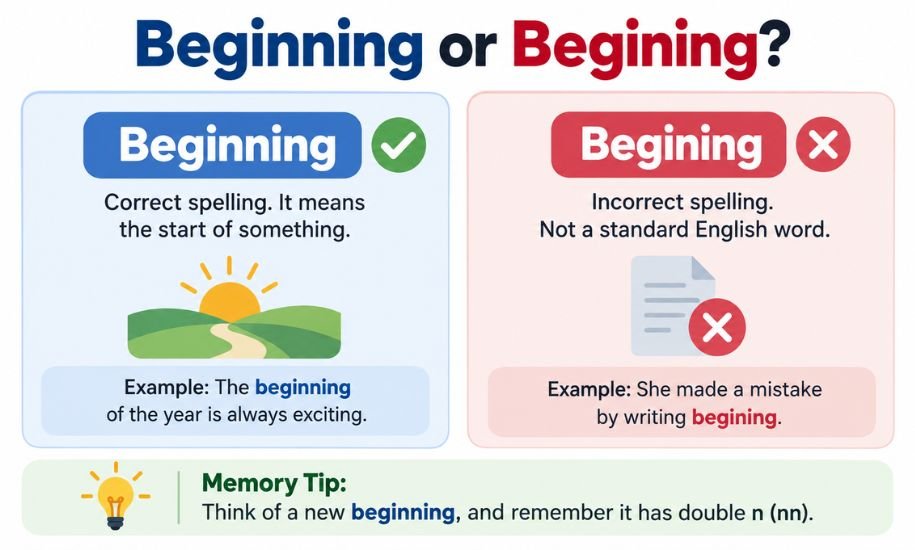
Beginning is the only standard spelling in both American and British English. The alternative, begining, is incorrect because it leaves out one of the two consecutive n’s required by the spelling rule.
| Word | Correct? | Explanation |
|---|---|---|
| Beginning | Yes | Standard spelling with two n’s |
| Begining | No | Misspelling with one n |
| Begin | Yes | Base form of the verb |
| Began | Yes | Simple past tense |
| Begun | Yes | Past participle |
The word beginning can describe the first stage of something or an action that is starting.
Examples:
- The beginning of the movie was surprisingly emotional.
- We are beginning a new chapter in our lives.
- She explained the beginning of the project in detail.
- The course is designed for beginning learners.
In each sentence, beginning is spelled with two n’s. This spelling does not change between British and American English.
What Does Beginning Mean?
Beginning refers to the start, origin, or initial part of something. It can describe the first moment of an event, the opening section of a book, or the early stage of a process. It is also the present participle of the verb begin.
The word has several grammatical uses:
- As a noun: It refers to the first part or starting point of something.
- As a present participle: It describes an action that is starting or in progress.
- As an adjective: It describes someone or something at an introductory or early stage.
Examples of beginning as a noun:
- The beginning of the school year is always exciting.
- We missed the beginning of the concert.
Examples as a present participle:
- The children are beginning to understand the lesson.
- He is beginning to feel more confident.
Example as an adjective:
– She enrolled in a beginning-level photography class.
The meaning depends on how the word functions in the sentence, but its spelling always remains the same.
Why Is Beginning Spelled With Two N’s?
The correct spelling follows the English consonant-doubling rule. When a verb ends in a consonant-vowel-consonant pattern and meets the relevant stress conditions, its final consonant is often doubled before adding a suffix such as -ing.
The verb begin has two syllables, with the stress on the second syllable: be-GIN. Since it ends in a consonant-vowel-consonant pattern, the final n is doubled before adding -ing.
Spelling formation
Begin
Base verb
-ing
Suffix
Beginning
The final n is doubled before adding -ing.
Other verbs follow a similar pattern:
| Base verb | Correct spelling |
|---|---|
| Run | Running |
| Sit | Sitting |
| Stop | Stopping |
| Plan | Planning |
| Begin | Beginning |
| Admit | Admitting |
However, not every verb ending in a consonant-vowel-consonant sequence doubles its final consonant. Stress and spelling conventions also matter. For example, open becomes opening, not openning, because the final syllable is not stressed.
Is Begining a Real Word?
Begining is not a standard English word. It is a spelling mistake that usually occurs when someone adds -ing to begin without doubling the final n.
Although readers will often understand what the writer intends, the misspelling should be corrected in formal and informal writing.
Incorrect: We are begining our journey tomorrow.
Correct: We are beginning our journey tomorrow.
Incorrect: The begining of the story was difficult to understand.
Correct: The beginning of the story was difficult to understand.
The incorrect form does not have a separate meaning, grammatical function, or accepted regional spelling. It should not be used as an alternative to beginning.
Beginning Examples in Sentences
Seeing the correct spelling in different contexts makes it easier to understand how the word works in everyday English.
As a noun:
- The beginning of their friendship dates back to childhood.
- At the beginning of the meeting, the manager introduced the new team.
- Every successful journey has a beginning.
As a present participle:
- The weather is beginning to improve.
- I am beginning to understand the instructions.
- The students are beginning their final examination.
As an adjective:
- The instructor prepared a beginning course for new students.
- This beginning chapter introduces the main characters.
These examples show that beginning can refer to a starting point, an action in progress, or an introductory level.
Begin, Began, Begun, and Beginning: What’s the Difference?
The verb begin is irregular, which means its past-tense forms do not follow the usual pattern of adding -ed. Knowing its different forms can help you use beginning correctly.
| Verb form | Usage | Example |
|---|---|---|
| Begin | Base form | We begin the lesson at nine. |
| Begins | Present tense, third-person singular | The show begins soon. |
| Began | Simple past | She began her new job last week. |
| Begun | Past participle | The event has begun. |
| Beginning | Present participle or gerund | They are beginning their training. |
The distinction between began and begun is particularly important. Use began for a completed past action and begun with an appropriate helping verb, such as has, have, or had.
Correct: The lecture began at noon.
Correct: The lecture has begun.
Incorrect: The lecture has began.
Remember that beginning is formed by adding -ing to begin, with the final consonant doubled.
Easy Ways to Remember the Correct Spelling
If you regularly forget whether beginning has one or two n’s, a few simple techniques can help.
- Remember the base word: Start with begin, then double the final n before adding -ing.
- Think of running: Just as run becomes running, begin becomes beginning.
- Break it into parts: Think of the spelling as begin + n + ing.
- Read it aloud: Repeating the word while writing it can help reinforce the correct spelling.
A useful reminder is that beginning contains a double n, just like running and planning. Practising these words together can make the spelling pattern easier to recall.
Common Mistakes to Avoid
Even though the rule is straightforward, a few errors can occur when using this word.
1. Leaving out the second n
Writing begining is the most direct spelling mistake. Always double the final consonant when forming beginning.
2. Confusing beginning with began
Beginning can describe an action that is happening now, while began refers to an action that took place in the past.
- Correct: She is beginning her assignment.
- Correct: She began her assignment yesterday.
3. Using began instead of begun
When using the present perfect tense, begun is required rather than began.
- Correct: The ceremony has begun.
- Incorrect: The ceremony has began.
4. Assuming the spelling changes by region
Unlike some words that have different accepted spellings in American and British English, beginning is spelled the same way in both.
Paying attention to these distinctions can help make your writing clearer and more accurate.
Beginning or Begining Quiz
Test your understanding of the correct spelling and the related verb forms.
Check your spelling knowledge
0 / 5 answered
1. Which is the correct spelling?BeginingBeginningBegginning
2. What is the correct -ing form of begin?BeginingBeginningBeginned
3. Choose the correct sentence.The class has began.The class has begun.The class has begin.
4. Which sentence uses beginning as a noun?We are beginning now.The beginning was memorable.They began early.
5. Is begining accepted in standard English?Yes, in British EnglishYes, in American EnglishNo, it is a misspellingSubmit answers
Frequently Asked Questions
Is beginning or begining correct?
Beginning is correct. It is the standard spelling in both American and British English. Begining is a misspelling that leaves out one of the two consecutive n’s.
Why does beginning have two n’s?
The final consonant of begin is doubled before adding -ing. This follows the consonant-doubling rule for verbs with a stressed final syllable that end in a consonant-vowel-consonant pattern.
Is beginning an American or British spelling?
Beginning is the standard spelling in both American and British English. There is no regional spelling difference between these varieties for this word.
What is the meaning of beginning?
Beginning means the start, first part, or initial stage of something. It can also be the present participle of begin, describing an action that is starting or in progress.
How do you pronounce beginning?
Beginning is pronounced with three syllables, with the stress on the second syllable. The first syllable is unstressed, while the second carries the main emphasis.
What is the difference between began, begun, and beginning?
Began is the simple past tense of begin, while begun is its past participle, used with helping verbs. Beginning is the -ing form, used in continuous tenses and as a noun or adjective.
Final Verdict: Beginning or Begining?
Beginning is the correct spelling, and begining is a misspelling. The word is formed by doubling the final n in begin before adding -ing. Remembering this rule will help you use the word accurately in sentences, essays, and everyday communication. At Grammarifyr, understanding small spelling differences like this can help you write more clearly and use the right words with confidence.
You may also Read : Effect or Affect: What's the Difference? Examples
One Comment