50+ Ways to Say Hi: Different, Funny, Friendly & Creative Greetings
Saying “hi” is simple, but it isn’t always the best choice for every conversation. Sometimes you want to sound warmer, more relaxed, funnier, or a little more creative. The right greeting can make a message feel friendly instead of formal, or playful instead of ordinary.
This guide explores ways to say hi in different situations, including casual conversations, texts, professional settings, and funny interactions. You’ll also find useful alternatives to “hi” and examples showing when each expression sounds natural.
Other Ways to Say Hi
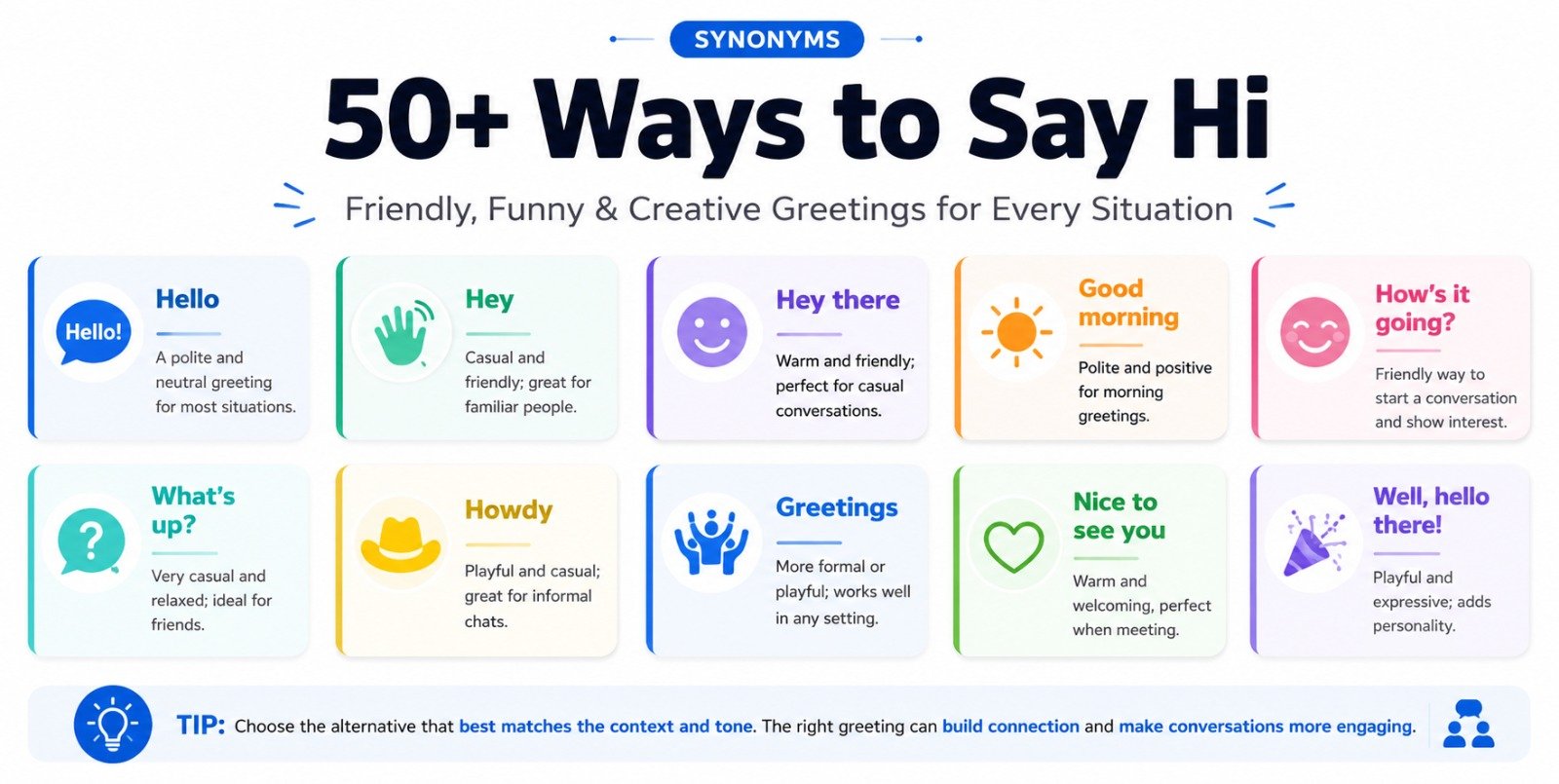
There are plenty of natural alternatives to “hi,” but they don’t all communicate exactly the same feeling. “Hey” is casual and familiar, while “hello” is more neutral. “Greetings” can sound formal or deliberately playful, depending on the situation.
Here are some of the most useful alternatives:
| Greeting | Tone | Best Used For |
|---|---|---|
| Hello | Neutral | Most everyday situations |
| Hey | Casual | Friends and familiar people |
| Hey there | Friendly | Friends, coworkers, casual chats |
| Hi there | Warm | Friendly conversations |
| Howdy | Casual/playful | Informal conversations |
| Greetings | Formal/playful | Written or humorous situations |
| What’s up? | Very casual | Friends and acquaintances |
| How’s it going? | Friendly | Starting a conversation |
| Good morning | Polite | Morning conversations |
| Nice to see you | Warm | Meeting someone you know |
The best choice depends on who you’re talking to, where you are, and the impression you want to make.
Different Ways to Say Hi
Other Ways to Say Hi: Simple and Natural
If you simply want to replace “hi” without changing the meaning too much, these are some of the safest choices:
- Hello!
- Hey!
- Hey there!
- Hi there!
- Howdy!
- Greetings!
- Good morning!
- Good afternoon!
- Good evening!
- Nice to see you!
- How are you?
- How’s it going?
- What’s up?
- What’s new?
- How have you been?
“Hello” is probably the closest all-purpose alternative. “Hey” is more relaxed, while “What’s up?” works more like an invitation to start a casual conversation.
Other Ways to Say Hi to a Friend
With friends, you have much more freedom to sound relaxed or playful.
Try:
- Hey, buddy!
- Hey, friend!
- Hey, you!
- What’s up?
- How’s everything?
- What’s new?
- How have you been?
- Hey, stranger!
- Look who’s here!
- Nice to see you!
- How’s life?
- What’s happening?
- Yo!
- Hey, superstar!
- Well, hello there!
For example:
“Hey, stranger! It’s been ages. How have you been?”
“Hey, stranger” doesn’t literally mean the person is a stranger. It’s usually a playful way to greet someone you haven’t seen or spoken to for a while.
Casual Ways to Say Hi
Other Ways to Say Hi Casually
For everyday conversations, especially with friends and people you already know, short greetings usually sound the most natural.
- Hey!
- Hey there!
- Hi there!
- Howdy!
- Yo!
- What’s up?
- Sup?
- How’s it going?
- What’s going on?
- How are things?
- What’s new?
- Hey, you!
- How have you been?
“Yo!” and “Sup?” are especially informal. They can sound perfectly natural between close friends but may be inappropriate in a formal workplace or when meeting someone for the first time.
Other Ways to Say Hi at Work
Workplace greetings need a little more awareness of the relationship and setting.
For a coworker you know well, you could say:
- Hey!
- Hi there!
- Good morning!
- How’s it going?
- How are things?
- Nice to see you!
For a manager, client, or new professional contact, safer choices include:
- Hello.
- Good morning.
- Good afternoon.
- It’s nice to meet you.
- Nice to see you again.
- I hope you’re doing well.
For example:
“Good morning, Sarah. I hope you’re doing well.”
That sounds more appropriate in a professional email or meeting than “Yo, Sarah!”
Funny Ways to Say Hi
Sometimes an ordinary “hi” feels too boring, especially when you’re greeting a close friend. Funny greetings can make the opening of a conversation more memorable.
Other Ways to Say Hi: Funny Greetings
Try these playful options:
- Well, well, well… look who’s here!
- Ahoy there!
- What’s shaking?
- Howdy, partner!
- Greetings, human!
- Look alive!
- Yo, superstar!
- What’s cookin’?
- Hey, stranger!
- Well, hello there!
- Look who decided to show up!
- Salutations!
- What’s up, buttercup?
- Hello, legend!
- Behold, a familiar face!
- Fancy seeing you here!
- Yo yo yo!
- How goes it?
- Hello, fellow human!
- What’s good?
These aren’t interchangeable with ordinary greetings in every situation. “Greetings, human!” might be hilarious between close friends but would obviously sound strange in a business meeting.
For example:
“Well, well, well… look who finally decided to appear!”
This works when you’re joking with someone you know well. The humor comes from exaggerating the greeting rather than simply replacing “hi” with another synonym.
Cute Ways to Say Hi
A cute greeting can make a conversation feel warmer and more affectionate.
Other Ways to Say Hi in a Cute Way
- Hey, you!
- Hi, sunshine!
- Hello, lovely!
- Hey, cutie!
- Hi, sweetie!
- Well, hello there!
- Hey, beautiful!
- Hi, superstar!
- Hello, sunshine!
- Hey, favorite person!
Use these according to your relationship. Some, such as “Hey, cutie!” or “Hi, sweetie!”, can sound affectionate or romantic and may not be suitable for coworkers or casual acquaintances.
Creative Ways to Say Hi
If you want something less predictable, creative greetings can give your conversation a distinctive personality.
Other Ways to Say Hi Creatively
- Well, hello!
- Look who’s here!
- Fancy seeing you!
- Ahoy!
- Greetings and salutations!
- Hello, stranger!
- The legend has arrived!
- And there you are!
- Surprise! It’s me.
- Guess who?
- Behold!
- A wild friend appears!
- Welcome, fellow human!
- Hello from my corner of the universe!
Creative greetings work best when they match the personality of the conversation. A little originality can be fun, but forcing an unusual phrase into an ordinary situation can make the interaction feel unnatural.
Ways to Say Hi Over Text
Texting gives you more room to experiment because punctuation, emojis, and short phrases can change the tone.
Other Ways to Say Hi in a Text
Instead of simply sending “Hi,” try:
- Hey!
- Heyyy!
- Hiii!
- Hey there 😊
- What’s up?
- How’s it going?
- What are you up to?
- Hey, stranger!
- Guess who?
- How have you been?
- What’s new?
- You around?
- Hey you!
- Long time no talk!
- Look who’s online!
For example:
“Heyyy! What are you up to?”
The extra letters make the greeting feel more relaxed and enthusiastic, although this style is best kept for casual messaging.
Ways to Say Hi in the Morning
“Hi” isn’t always the most natural opening when you first see someone in the morning.
Other Ways to Say Hi in the Morning
- Good morning!
- Morning!
- Morning, everyone!
- Hey, good morning!
- Morning! How are you?
- Good morning! How’s your day going so far?
- Morning! Ready for the day?
“Morning!” is casual and common in everyday speech. “Good morning” is more neutral and works well in professional settings.
Ways to Say Hi After a Long Time
When you haven’t seen or spoken to someone for a while, a basic “hi” may not acknowledge the time apart.
Other Ways to Say Hi After a Long Time
- Hey, stranger!
- Long time no see!
- It’s been a while!
- Wow, it’s good to see you!
- How have you been?
- Where have you been?
- What have you been up to?
- It’s great to see you again!
- Look who’s back!
- I haven’t seen you in forever!
For example:
“Hey, stranger! It’s been a while. How have you been?”
Here, “It’s been a while” adds information that “hi” alone doesn’t communicate.
Ways to Say Hi Without Actually Saying “Hi”
Sometimes you can begin a conversation without using a traditional greeting at all.
Other Ways to Say Hi Without Saying Hi
You can start with a question:
- How are you doing?
- What’s up?
- How’s your day going?
- What have you been up to?
- How’s everything?
- What’s new?
- How have things been?
Or you can comment on the situation:
- Good to see you!
- Nice seeing you here!
- Great to have you here.
- Look who’s here!
- I was just thinking about you.
These aren’t exact synonyms for “hi,” but they can perform the same conversational function: opening an interaction and inviting a response.
Formal Alternatives to Hi
There are situations where “hi” may feel too casual. In professional, official, or unfamiliar settings, a more neutral greeting is often better.
Other Ways to Say Hi Formally
- Hello.
- Good morning.
- Good afternoon.
- Good evening.
- Greetings.
- It’s a pleasure to meet you.
- It’s nice to meet you.
- Nice to see you again.
- I hope you’re doing well.
For example, an email might begin:
“Good morning, Mr. Williams. I hope you’re doing well.”
Rather than:
“Hey, Mr. Williams!”
The second version isn’t necessarily grammatically wrong, but it can feel too informal depending on the relationship.
“Hi” vs. “Hello” vs. “Hey”
These three greetings are closely related, but their tones aren’t identical.
Hi is friendly and neutral. It’s suitable for most everyday conversations.
Hello is slightly more formal or neutral. It is a good choice when you don’t know someone well or want to sound polite.
Hey is more casual and conversational. It’s especially common among friends, coworkers, and people who already have a familiar relationship.
Compare:
- “Hi, James.” — Friendly and neutral.
- “Hello, James.” — Neutral and slightly more formal.
- “Hey, James!” — Relaxed and familiar.
The context determines which one sounds best.
Which Greeting Should You Choose?
Think about four things before choosing an alternative to “hi”:
Your relationship: A close friend gives you more freedom than a client or stranger.
The setting: A party, text message, office meeting, and formal email each have different expectations.
Your tone: Decide whether you want to sound friendly, polite, funny, enthusiastic, or affectionate.
The purpose: If you want to start a conversation, a greeting followed by a question can be more effective than a greeting alone.
For example, “Hey!” is enough for a quick acknowledgment, while “Hey! How have you been?” naturally encourages conversation.
Common Mistakes When Choosing a Greeting
Using a Very Casual Greeting in a Formal Situation
“Yo!” may be perfectly fine with a friend but isn’t a good default for a client, interviewer, or unfamiliar professional contact.
Assuming Funny Greetings Work Everywhere
Humor depends heavily on familiarity. A joke that makes your best friend laugh may confuse someone you’ve just met.
Treating Every Alternative as an Exact Synonym
“What’s up?” is not simply another word for “hi.” It is a casual greeting that can also function as a question about what someone is doing or how things are going.
Likewise, “Good morning” is tied to the time of day, while “Hey there” isn’t.
Overthinking a Simple Greeting
You don’t need an elaborate expression every time. In many situations, a straightforward “Hi!”, “Hello!”, or “Hey!” is exactly right.
Examples of Different Greetings in Real Conversations
With a close friend
“Hey! What are you up to tonight?”
With a coworker
“Good morning! How’s your day going?”
After not seeing someone for months
“Hey, stranger! It’s been a while!”
With a new acquaintance
“Hello, it’s nice to meet you.”
In a casual text
“Heyyy! How have you been?”
With someone you’re joking around with
“Well, well, well… look who’s here!”
In a professional email
“Good afternoon. I hope you’re doing well.”
The greeting changes because the relationship and setting change, not because one expression is universally better than another.
Frequently Asked Questions
What are some other ways to say hi?
Common alternatives include hello, hey, hey there, hi there, howdy, greetings, what’s up, how’s it going, and good morning. The best option depends on how formal or casual the situation is.
What is a funny way to say hi?
You could say “Well, well, well… look who’s here!”, “Ahoy there!”, “What’s shaking?”, “Greetings, human!”, or “Howdy, partner!”. Funny greetings are best reserved for people who understand your sense of humor.
What is the difference between “hi,” “hello,” and “hey”?
“Hi” is friendly and neutral, “hello” is slightly more formal or neutral, and “hey” is generally more casual and familiar. All three are common, but the appropriate choice depends on the setting.
How can I say hi to someone over text?
For a casual text, try “Hey!”, “Hey there!”, “What’s up?”, “How’s it going?”, or “Hey, stranger!”. If you’re contacting someone professionally, a simple “Hello” or “Good morning” is usually safer.
What is a polite way to say hi?
“Hello,” “Good morning,” “Good afternoon,” and “Good evening” are polite choices. They work particularly well when you’re speaking to someone you don’t know well or when the setting is professional.
What is a cute way to say hi?
Depending on your relationship, you could use “Hey, you!”, “Hi, sunshine!”, “Hello, lovely!”, or “Hey, cutie!”. More affectionate greetings should be used only when the relationship makes them appropriate.
What can I say instead of hi to a friend?
Try “Hey!”, “What’s up?”, “How’s it going?”, “Hey, buddy!”, “Hey, stranger!”, or “What’s new?”. Friends generally allow more casual and playful greetings.
Is “how are you?” another way to say hi?
It can function as a greeting, but it isn’t an exact synonym for “hi.” “How are you?” specifically asks about someone’s well-being, while “hi” simply acknowledges or greets them.
Final Thoughts
There are plenty of ways to say hi, but the best greeting isn’t necessarily the most creative one. Use “hey” with friends, “hello” when you want a neutral option, a time-based greeting in professional settings, and a playful expression when you’re sure the other person will appreciate the humor. Paying attention to the relationship, setting, and tone will make your greeting sound natural rather than forced.
That attention to small differences is exactly what makes everyday communication clearer. Grammarifyr helps you understand those subtle wording choices so you can choose a greeting that fits both the person and the moment.
You may also Read : Funny Ways to Say Happy Birthday: 75+ Cool, Clever & Hilarious Ideas
One Comment