Seel or Seal: Meaning and Correct Usage
If you are unsure whether to write seel or seal, the correct spelling depends on what you are trying to say. For the everyday English meaning “to close or secure something,” seal is the correct word. This is the form you need when talking about closing an envelope, package, container, or opening. Seel is not the standard spelling for this meaning, so it should not replace seal in normal English writing.
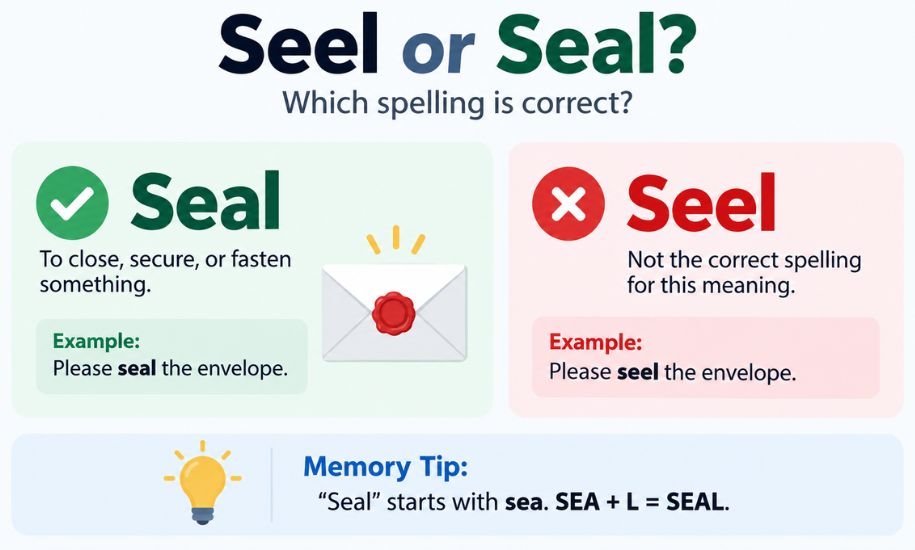
Seal is the correct spelling when you mean “to close, secure, or fasten something.” For example, you should write “seal an envelope,” not “seel an envelope.” “Seel” is not the standard spelling for this everyday usage.
Seel or Seal: Which Is Correct?
When the intended meaning is to close or secure something, seal is correct.
The word can function as both a verb and a noun:
- Verb: Please seal the envelope.
- Verb: She sealed the box with tape.
- Noun: The bottle has a tight seal.
- Noun: The document carries an official seal.
By contrast, seel should not be used as a spelling variant of seal in these sentences.
| Word | Standard English for this meaning? | Meaning | Example |
|---|---|---|---|
| seal | Yes | To close, secure, or protect something | Seal the envelope. |
| seel | No | Not the standard spelling for this meaning | Seel the envelope. ✗ |
So if you are writing an email, letter, school assignment, article, or other standard English text, choose seal.
What Does “Seal” Mean?
Seal has several meanings, but one of its most common uses as a verb is to close something securely.
For example, you can seal an envelope by closing its flap. You can also seal a box, container, package, window, or opening.
Examples:
- Please seal the envelope before mailing it.
- He sealed the package with strong tape.
- Make sure the container is sealed tightly.
- The workers sealed the opening to prevent water from entering.
The word also has broader meanings. You can seal an agreement or seal a deal, meaning to formally finalize it.
As a noun, a seal can refer to something that closes or protects an opening. It can also mean an official mark or stamp, such as the seal of an organization.
There is another completely different noun, seal, referring to a marine animal.
What About “Seel”?
For the spelling question in ordinary modern English, seel is not the word you want when you mean “close or secure.”
That means the following is incorrect in standard usage:
Please seel the envelope.
The correct version is:
Please seal the envelope.
It is important not to invent a separate everyday meaning for seel simply because it looks like a possible spelling. If your intended meaning is to close, secure, or fasten something, use seal.
Seel or Seal an Envelope?
The correct expression is seal an envelope.
When you seal an envelope, you close the flap so that the letter or other contents are secured inside.
Correct examples
- I need to seal an envelope before I leave.
- She sealed the envelope and placed it on the desk.
- Please seal the envelope carefully.
- He forgot to seal the envelope before putting it in the mailbox.
Incorrect examples
- I need to seel an envelope. ✗
- She seeled the envelope. ✗
- Please seel the letter. ✗
The past tense is sealed, not seeled.
The Grammar Forms of “Seal”
Understanding the different forms can help prevent spelling mistakes.
| Form | Example |
|---|---|
| seal | I will seal the package. |
| seals | She seals every envelope carefully. |
| sealed | He sealed the box yesterday. |
| sealing | They are sealing the containers now. |
Notice that every form keeps the spelling seal:
- seal
- seals
- sealed
- sealing
There is no standard form seel, seeled, or seeling for this meaning.
The Difference in Meaning and Usage
The basic difference is not between two standard alternatives such as affect and effect. Instead, this is primarily a case of the correct word versus an incorrect spelling for the intended everyday meaning.
Seal is used when something is closed, secured, protected, or formally finalized.
For example:
The envelope was sealed.
Here, sealed means the envelope was closed securely.
Another example is:
The company sealed the agreement.
Here, sealed means the agreement was formally finalized.
The same spelling therefore works across several related meanings.
Why Is This Spelling Confusing?
The confusion is easy to understand because seal is pronounced like the letter combination might suggest other spellings. English contains many words whose spelling cannot be predicted perfectly from pronunciation.
Someone hearing seal may incorrectly write seel, especially if they have learned the word primarily through speech rather than reading.
However, pronunciation does not make seel an acceptable spelling variant for the ordinary verb.
A useful distinction is:
Sound: “seel”
Correct spelling: seal
So when you hear someone say “seal the envelope,” remember that the written form begins with sea-, not see-.
Correct Usage Examples
Here are some examples showing how seal works in everyday English.
Closing something
Please seal the envelope before you send it.
The mechanic sealed the leak temporarily.
Make sure you seal the container properly.
Protecting an opening
The material helps seal the gap around the window.
The lid creates a tight seal.
Finalizing something
Both sides agreed to seal the deal.
The new contract sealed the agreement between the companies.
Using “seal” as a noun
The package arrived with its seal intact.
The bottle’s seal was broken.
These examples show why the word is useful beyond the specific phrase “seal an envelope.”
“Seal” as a Noun vs. “Seal” as a Verb
One reason this word appears in many different sentences is that it can be both a noun and a verb.
Seal as a verb
As a verb, seal means to close, secure, or otherwise make something airtight, watertight, or protected.
They sealed the box.
Seal as a noun
As a noun, seal can refer to the thing that closes or protects an opening.
The bottle has a seal underneath the cap.
It can also mean an official mark:
The certificate bears the organization’s official seal.
And it can refer to a marine mammal:
We saw a seal swimming near the shore.
These meanings are spelled the same, although their contexts are different.
Common Mistakes to Avoid
1. Writing “seel the envelope”
Incorrect:
Please seel the envelope.
Correct:
Please seal the envelope.
2. Using “seeled” as the past tense
Incorrect:
She seeled the package.
Correct:
She sealed the package.
The past tense of seal is sealed.
3. Assuming “seel” is the British spelling
Seel is not simply the British version of seal. British English uses seal too.
For example:
British English: Please seal the envelope.
American English: Please seal the envelope.
There is no US-versus-UK spelling difference here.
4. Confusing spelling with pronunciation
Because seal is pronounced /siːl/, it can be tempting to spell it phonetically as seel. English spelling does not always work that way, so the written form needs to be learned separately.
An Easy Way to Remember the Correct Spelling
Think of the word sea.
The correct spelling starts with sea-:
SEA + L = SEAL
You can remember it with the simple association:
Seal starts with “sea.”
This also helps distinguish it from seel when writing quickly.
If you are talking about closing an envelope, imagine the flap being secured with a seal. The spelling you need is seal.
Is “Seal” the Same in American and British English?
Yes. Seal is the standard spelling in both American and British English when referring to closing or securing something.
You do not need to change it depending on your audience.
For example, these are correct in both varieties:
- Seal the envelope.
- The package was sealed.
- The bottle has a protective seal.
- They sealed the agreement.
So this is not a case like color/colour or center/centre, where regional spelling conventions differ.
Frequently Asked Questions
Is “seel or seal” correct?
Seal is correct when you mean to close, secure, or fasten something. For example, “Please seal the envelope.” Seel should not be used as the spelling of this ordinary English word.
Is it “seel or seal” an envelope?
The correct expression is “seal an envelope.” The verb seal means to close the envelope securely. For example: “She sealed the envelope before putting it in the mailbox.”
What is the meaning of “seal”?
As a verb, seal can mean to close or secure something. As a noun, it can mean a protective closure, an official mark, or a marine mammal, depending on the context.
Is “seel” a British spelling of “seal”?
No. Seal is used in both British and American English. Seel is not an alternative British spelling for the ordinary word meaning to close or secure something.
What is the past tense of “seal”?
The past tense and past participle are sealed. For example: “He sealed the envelope yesterday” and “The package was sealed securely.”
How can I remember the spelling?
Remember SEA + L = SEAL. The word starts with sea, which can help you avoid writing seel when you mean to close or secure something.
Final Verdict: Seel or Seal?
When you mean to close, secure, or fasten something, the correct spelling is seal. Write “seal an envelope,” “sealed the package,” and “a protective seal.” Seel should not be used as a spelling alternative in standard English. For more clear explanations of confusing English words and correct usage, Grammarifyr helps you Know the Difference. Use the Right Words.
You may also Read : Began or Begun: Meaning and Grammar Explained