Favorite or Favourite: US vs UK Spelling
If you have ever wondered whether to write favorite or favourite, you are dealing with a difference between American and British English rather than a simple spelling mistake. Both forms are correct, and both have the same meaning. The main difference is where they are used: favorite is the standard American English spelling, while favourite is the standard British English spelling. Choosing the right form depends mainly on your intended audience and the variety of English you are following.
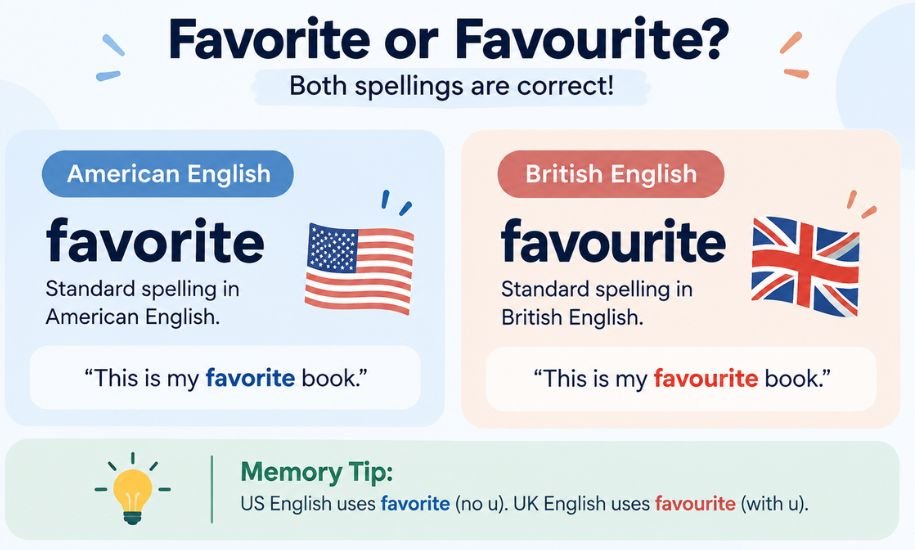
Favorite and favourite are both correct spellings. Favorite is standard in American English, while favourite is standard in British English. They have the same meaning and pronunciation, so the choice depends on the variety of English you are using.
Favorite vs Favourite at a Glance
| Feature | Favorite | Favourite |
|---|---|---|
| Standard variety | American English | British English |
| Correct spelling? | Yes | Yes |
| Meaning | Most liked or preferred | Most liked or preferred |
| Pronunciation | Same | Same |
| Main difference | No u | Includes u |
| Example | My favorite book | My favourite book |
The important point is that neither spelling is universally more correct. Use the form that matches the English variety of your writing.
What Does “Favorite” Mean?
Favorite is the standard American English spelling. It can be used as an adjective or a noun.
As an adjective, it describes someone or something that a person likes or prefers more than others.
For example:
- This is my favorite restaurant.
- Blue is my favorite color.
- She is my favorite author.
- That is his favorite song.
As a noun, favorite refers to a person or thing that is especially preferred.
- This book is my favorite.
- Which dessert is your favorite?
- She is one of my favorites.
The word can also be used in certain contexts to describe a competitor expected to have a strong chance of winning, particularly in sports or competitions.
What Does “Favourite” Mean?
Favourite has exactly the same basic meaning as favorite, but it is the standard British English spelling.
Examples include:
- This is my favourite restaurant.
- Blue is my favourite colour.
- She is my favourite author.
- That is his favourite song.
As a noun:
- This book is my favourite.
- Which dessert is your favourite?
- She is one of my favourites.
The extra u does not change the meaning or pronunciation. It simply reflects the spelling convention used in British English.
Is It Favorite or Favourite in American English?
In American English, the usual spelling is favorite.
For example:
What is your favorite movie?
Pizza is my favorite food.
That is my favorite part of the book.
American English generally uses -or in several words where British English uses -our, although the pattern does not apply identically to every word.
Compare:
- favorite → favourite
- favor → favour
- color → colour
- honor → honour
- neighbor → neighbour
- behavior → behaviour
Therefore, if you are writing consistently in American English, favorite is the appropriate choice.
Is It Favorite or Favourite in British English?
In British English, the standard spelling is favourite.
For example:
What is your favourite film?
Pizza is my favourite food.
That is my favourite part of the book.
The same spelling is also commonly used in other varieties of English that follow British spelling conventions.
This means that if your article, essay, website, or other writing follows British English, favourite is normally the better choice.
Why Are Both Spellings Correct?
The difference comes from established spelling conventions in different varieties of English.
American English commonly uses favorite, while British English retains favourite. Similar differences appear in words such as color/colour and favor/favour.
This does not mean that British speakers use an incorrect version or that American speakers have removed a necessary letter. They are simply different regional spelling standards.
For formal writing, the most important rule is consistency. If you choose American English, use favorite alongside other American spellings. If you are writing in British English, use favourite.
Favorite or Favourite: Which Is Correct?
If you are asking which is correct, the answer is: both.
The correct choice depends on the English variety.
Use “favorite” when:
- Writing in American English
- Following an American style guide
- Writing primarily for a US audience
- Using other American spellings such as color and center
Use “favourite” when:
- Writing in British English
- Following British spelling conventions
- Writing primarily for a UK audience
- Using other British spellings such as colour and centre
For example:
American English:
Chocolate is my favorite dessert.
British English:
Chocolate is my favourite dessert.
Both sentences are grammatically correct.
Favorite or Favourite Meaning in a Sentence
The meaning remains unchanged regardless of the spelling.
Consider:
Sarah is my favorite singer.
and:
Sarah is my favourite singer.
Both sentences mean that Sarah is the singer Sarah’s writer or speaker likes most.
Another pair:
This is my favorite restaurant.
This is my favourite restaurant.
Again, there is no difference in meaning. The only difference is the spelling convention.
The word can express a strong preference for a person, object, activity, place, food, or other thing.
Common Examples
Here are some examples showing how the two forms correspond.
| American English | British English |
|---|---|
| My favorite book is a mystery novel. | My favourite book is a mystery novel. |
| What is your favorite color? | What is your favourite colour? |
| This is my favorite restaurant. | This is my favourite restaurant. |
| Football is his favorite sport. | Football is his favourite sport. |
| She is my favorite actress. | She is my favourite actress. |
Notice that the sentence structure and meaning remain essentially the same. The spelling changes to match the regional convention.
Is “Favorite” or “Favourite” More Correct?
Neither form is inherently more correct.
The appropriate spelling depends on the variety of English being used. Calling favourite wrong simply because you normally use American English would be inaccurate. Likewise, calling favorite wrong in all contexts would be inaccurate.
A useful approach is to decide which style you are following before writing and then maintain it consistently.
For instance, an American-English text might use:
favorite, color, center, behavior
A British-English text might use:
favourite, colour, centre, behaviour
Consistency makes your writing look deliberate and polished.
Common Mistakes to Avoid
1. Treating “favourite” as a misspelling
Favourite is not a misspelling. It is the standard British spelling.
2. Treating “favorite” as incorrect everywhere
Favorite is the standard American spelling and is completely correct in American English.
3. Mixing regional spellings unnecessarily
A sentence such as:
My favourite color is blue.
combines the British favourite with the American color.
It is understandable, but writers should generally maintain one spelling system within a piece of formal writing.
4. Assuming the extra “u” changes the meaning
It does not. Favorite and favourite mean the same thing.
5. Choosing a spelling without considering the audience
If you are writing for a primarily American audience, favorite will normally be the natural choice. For British English readers, favourite is generally expected.
How to Remember the Difference
A simple way to remember the distinction is:
US English → favorite
UK English → favourite
The British form contains the extra u, just like:
color → colour
favor → favour
If you already know which spelling system you are using, the choice becomes straightforward.
Favorite or Favourite in Formal Writing
Both forms are acceptable in formal writing when used according to the appropriate regional standard.
For example, an American academic paper can correctly say:
The author identifies this as her favorite example.
A British publication can correctly write:
The author identifies this as her favourite example.
The important issue is not choosing one spelling universally. Instead, follow the style requirements of your school, employer, publication, or intended audience.
If a particular style guide specifies American or British English, follow that guide consistently.
Frequently Asked Questions
Is it favorite or favourite?
Both are correct. Favorite is the standard American English spelling, while favourite is the standard British English spelling. The two forms have the same meaning and pronunciation.
Is favorite or favourite correct spelling?
Both spellings are correct in their respective varieties of English. Use favorite for American English and favourite for British English.
Is it spelled favorite or favourite?
It can be spelled either way. American English normally spells the word favorite, while British English normally spells it favourite.
Does favorite mean the same as favourite?
Yes. Both words mean a person or thing that is especially liked or preferred. The difference is regional spelling rather than meaning.
Is “favourite” only used in British English?
Favourite is the standard British spelling and is also used in other English varieties that follow British spelling conventions. It should not be treated as a spelling error simply because American English uses favorite.
Which spelling should I use in formal writing?
Use the spelling that matches your chosen variety of English and the expectations of your audience. Most importantly, remain consistent throughout the document.
The Bottom Line
Favorite and favourite are both correct. Favorite is the American English spelling, while favourite is the British English spelling. They have the same meaning, so your choice should depend on the regional English style you are following. For more clear explanations of confusing English spellings and word choices, Grammarifyr helps you know the difference and use the right words.
You may also Read : Offense or Offence: US and UK Spelling Explained

One Comment