Offense or Offence: US and UK Spelling Explained
If you have ever paused over offense or offence, you are dealing with a difference between English spelling conventions rather than two completely different words. Both forms are correct, but the preferred spelling depends on the variety of English you are using. Offense is standard in American English, while offence is standard in British English. The same distinction appears in phrases such as “no offense/no offence” and in sports terminology. Once you know which English variety you are following, choosing the right form is straightforward.
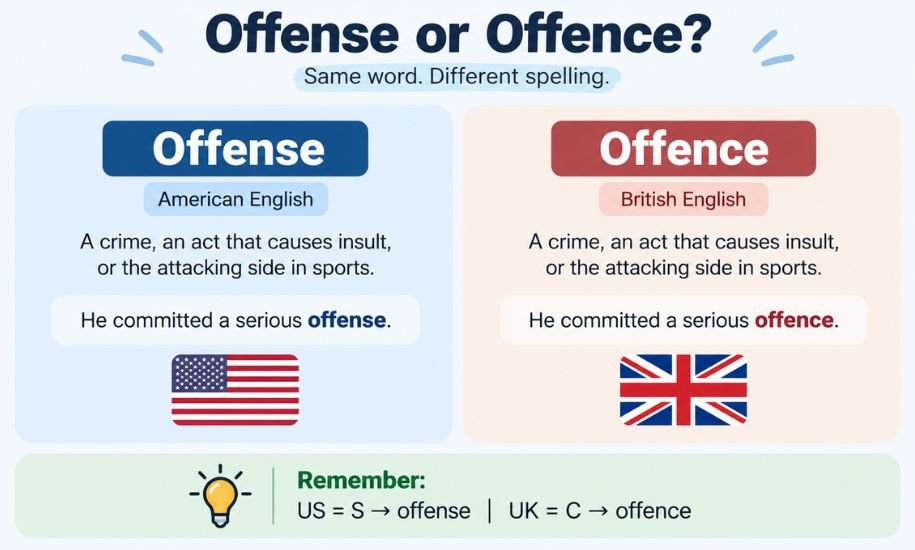
Both “offense” and “offence” are correct. “Offense” is the standard American English spelling, while “offence” is the standard British English spelling. They have the same basic meanings, including a crime, an act that causes insult, and the attacking side of a sports team.
Offense vs Offence: The Key Difference
The difference is primarily regional spelling, not meaning.
| Feature | American English | British English |
|---|---|---|
| Spelling | offense | offence |
| Plural | offenses | offences |
| Crime | criminal offense | criminal offence |
| Feeling insulted | take offense | take offence |
| Common expression | no offense | no offence |
| Sports | offense | offence |
Oxford and Cambridge both identify offense as the US form and offence as the British form.
So, if you are writing for an American audience, choose offense. If you are following British English, choose offence.
Neither spelling should automatically be treated as a misspelling.
What Does “Offense” Mean?
Offense is a noun in American English. It has several related meanings.
1. A crime or violation
An offense can be an illegal act or a violation of a law.
Examples:
- He was charged with a serious offense.
- The court treated it as a minor offense.
- Driving without a valid license can be an offense.
Oxford defines offense in this sense as an illegal act.
2. Something that causes hurt or insult
The word can also refer to the feeling of being upset, angry, or insulted because of something someone has said or done.
Examples:
- I hope my comment did not cause offense.
- She took offense at his remark.
- He meant no offense by the question.
This meaning is also found in British English, but the spelling changes to offence.
3. An attacking side in sports
In American sports terminology, offense can mean the players or team responsible for trying to score.
For example:
The team’s offense scored 28 points.
This sports meaning is particularly established in American football and basketball.
What Does “Offence” Mean?
Offence has the same basic meanings as offense. The main difference is that it is the standard spelling in British English.
For example:
He committed a serious offence.
I hope you do not take offence at my comment.
The team’s offence created several scoring opportunities.
Cambridge lists offence as the British form corresponding to US offense, including meanings related to crime, causing upset, and scoring in sport.
Therefore, the choice is not:
correct word vs incorrect word
It is:
American spelling vs British spelling
Is It “Offense or Offence” in American and British English?
The simplest rule is:
American English → offense
British English → offence
This follows a broader pattern in which some American spellings use -se where British English uses -ce, as in:
- defense / defence
- offense / offence
- pretense / pretence
Scribbr also identifies offense and offence as regional spellings of the same noun.
American English examples
He committed a serious offense.
I didn’t mean to cause offense.
The team’s offense was effective.
British English examples
He committed a serious offence.
I didn’t mean to cause offence.
The team’s offence was effective.
The grammar and meaning remain essentially the same.
No Offense or No Offence?
Both no offense and no offence are correct.
The difference again comes down to regional spelling:
- No offense → American English
- No offence → British English
The expression is used to indicate that the speaker does not intend to insult, upset, or show disrespect to someone. Cambridge lists no offence (intended) as an established expression with this function.
American English
No offense, but I think we should try another approach.
British English
No offence, but I think we should try another approach.
You can also use the expression with intended:
No offense intended.
No offence intended.
The spelling changes, but the meaning does not.
One practical point is worth remembering: saying “no offense” does not automatically make a statement polite. The phrase signals that the speaker does not intend to insult someone, but the words that follow can still sound blunt depending on context.
Offense or Offence in Sports
The word has a specific sports meaning in addition to its general meanings.
In sports, offense/offence can refer to the players or team attempting to score, or to the team’s attacking strategy.
For example:
The team’s offense struggled to score.
In British spelling:
The team’s offence struggled to score.
Cambridge defines the sports sense as the part of a game that involves trying to score points, or the players who attempt to do so.
However, sports terminology can vary by country and sport. In British football (soccer), for example, attack or attacking play is often a more natural term than offence when describing the attacking side.
So spelling and sports vocabulary are related but not always identical.
Offense or Offence in Basketball
In basketball, offense is the standard American spelling.
It generally refers to the team that has possession and is attempting to score, as well as the strategies and plays used to create scoring opportunities.
Examples:
- The team’s offense improved after halftime.
- Their offense relies heavily on three-point shooting.
- He played offense for his college basketball team.
- The coach introduced a new offensive system.
Oxford specifically lists the sports sense of offense and includes basketball-related usage.
In British English, the corresponding noun is offence:
The team’s offence needs to improve.
So if you are writing an American basketball article, offense is the natural choice.
Common Examples in Sentences
Seeing the two spellings side by side makes the distinction easier.
| American English | British English |
|---|---|
| It was a serious offense. | It was a serious offence. |
| She took offense at his comment. | She took offence at his comment. |
| I meant no offense. | I meant no offence. |
| The team has a strong offense. | The team has a strong offence. |
| He was convicted of the offense. | He was convicted of the offence. |
Notice that the sentence structure does not need to change. Only the spelling of the noun changes.
Common Mistakes to Avoid
1. Calling “offence” an American spelling
In standard American English, offense is the usual form.
American:
The player committed an offense.
British:
The player committed an offence.
2. Assuming “offense” is always wrong
It is not. Offense is the established American English spelling and is appropriate in US writing.
3. Mixing regional spellings unnecessarily
If your article consistently uses British spelling, such as colour, centre, and defence, then offence will normally fit that style.
If you are writing in American English, use offense alongside forms such as color, center, and defense.
Consistency is more important than choosing one form as universally “correct.”
4. Confusing the noun with “offensive”
The adjective is offensive in both American and British English.
Correct:
His comment was offensive.
Not:
His comment was offencive.
The noun changes between offense and offence, but the adjective does not follow the same spelling variation.
5. Assuming “no offense” has a different meaning from “no offence”
It does not. These are regional spelling variants of the same expression.
How to Choose the Right Spelling
Use offense if you are:
- Writing in American English
- Following a US style guide
- Writing for an American publication
- Discussing American sports using American terminology
Use offence if you are:
- Writing in British English
- Following a UK style guide
- Writing for a British publication
- Following a spelling system that uses the British form
If you are writing for an international audience, choose one English variety and use it consistently.
For example, don’t switch randomly between:
The team has a strong offense.
and
The team has a strong defence.
If the rest of the article follows British spelling, offence would generally provide better consistency. If it follows American spelling, offense and defense would normally be used.
Easy Way to Remember the Difference
A simple rule is enough:
US = S → offense
UK = C → offence
You can connect it with another familiar pair:
defense → offence
defence → offence
In other words, if your writing uses the British -ce pattern in defence, use offence. If it uses the American -se pattern in defense, use offense.
Frequently Asked Questions
Is “offense” or “offence” correct?
Both are correct. Offense is the standard American English spelling, while offence is the standard British English spelling. They generally have the same meanings.
Is “offence” British or American?
Offence is the standard British English spelling. American English normally uses offense. Both forms refer to the same noun and can describe a crime, an insult, or an attacking side in sports.
Is “no offense” or “no offence” correct?
Both are correct. Use no offense in American English and no offence in British English. The expression indicates that the speaker does not intend to insult or upset someone.
Does offense mean a crime?
Yes. One meaning of offense is an illegal act or violation of a law. The British spelling is offence. For example, “He was charged with a serious offense” becomes “He was charged with a serious offence” in British English.
Is offense used in basketball?
Yes. In American basketball terminology, offense refers to the team or players attempting to score and can also refer to their attacking system or strategy. British English uses offence as the corresponding spelling.
Are “offense” and “offence” pronounced differently?
Generally, no. The two spellings represent the same word and are normally pronounced alike in their main meanings. The major distinction is spelling rather than pronunciation. Oxford gives the same basic pronunciation for the noun’s crime and insult-related senses.
The Bottom Line
Offense and offence are both legitimate spellings of the same word. Choose offense for American English and offence for British English, including phrases such as “no offense/no offence” and sports terminology. The best choice is therefore determined by the English variety and style you are following, not by a difference in meaning. For more clear explanations of confusing English forms, Grammarifyr helps you choose the right words with confidence.
You may also Read : Nor vs Or: Meaning, Usage, and Examples
One Comment