Analysis or Analyses: Meaning and Usage
It is easy to hesitate over analysis and analyses because the two words look almost identical. The difference, however, is grammatical rather than a matter of spelling preference. Analysis is the singular noun, while analyses is its plural form. The confusion becomes slightly greater because analyses can also be a verb in British English. Understanding whether you are referring to one examination, several examinations, or the act of examining something will usually tell you which form belongs in your sentence.
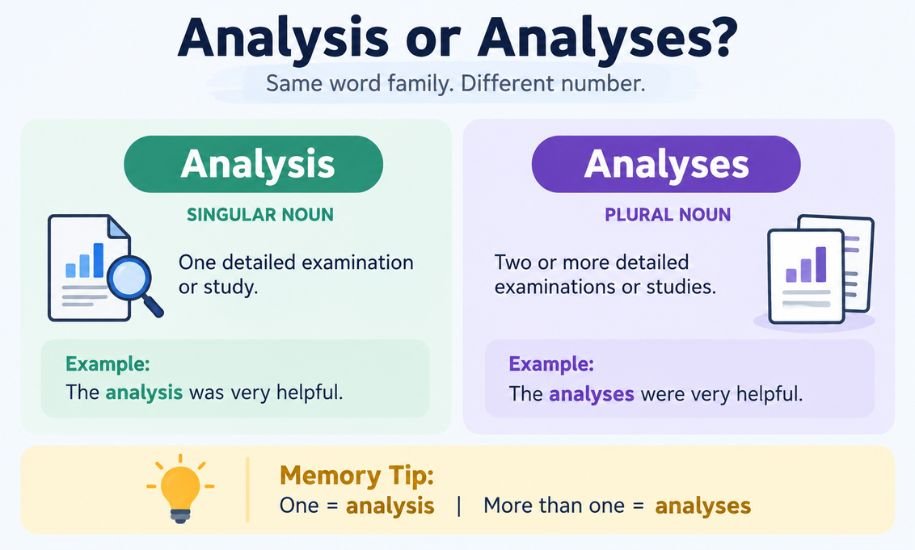
Analysis is the singular noun, while analyses is the plural noun. For example, “The analysis was detailed” refers to one examination, while “The analyses were detailed” refers to more than one. In British English, analyses can also be a verb meaning “examines closely.”
Analysis vs. Analyses at a Glance
| Feature | Analysis | Analyses |
|---|---|---|
| Word type | Noun | Plural noun |
| Number | Singular | Plural |
| Meaning | One detailed examination | More than one detailed examination |
| Example | The analysis was useful. | The analyses were useful. |
| Related verb | analyze/analyse | analyses can be a British verb form |
The simplest rule is:
One = analysis
More than one = analyses
What Does “Analysis” Mean?
Analysis is a singular noun referring to a detailed examination or study of something. It can involve examining data, information, evidence, literature, a problem, or a situation to understand it more clearly.
For example:
- The analysis of the survey results took several hours.
- Her analysis of the novel was insightful.
- The report contains a detailed analysis of the market.
- This analysis explains why the project failed.
Because analysis is singular, it normally takes singular determiners and verbs.
Correct:
The analysis is complete.
Incorrect:
The analysis are complete.
The word can be used in many fields, including science, business, economics, literature, statistics, and everyday discussion.
What Does “Analyses” Mean?
Analyses is the plural form of analysis. It refers to two or more examinations, studies, or evaluations.
For example:
- The researchers conducted several analyses.
- The analyses produced different results.
- Three separate analyses were included in the report.
- The team compared the analyses before reaching a conclusion.
Notice the verb in the first two examples:
The analyses were completed.
Because analyses is plural when used as a noun, it takes a plural verb.
Why Is the Plural Not “Analysises”?
English has many nouns whose plurals do not simply take -s. Analysis follows a pattern found in several words ending in -is.
Compare:
- analysis → analyses
- diagnosis → diagnoses
- hypothesis → hypotheses
- thesis → theses
- crisis → crises
Therefore, analysises is not the standard plural form.
Is It Analysis or Analyses?
The choice depends on how many examinations you mean.
Use analysis when there is one:
The analysis of the evidence was convincing.
Use analyses when there is more than one:
The analyses of the evidence reached different conclusions.
Compare these examples:
- The scientist completed an analysis of the sample.
- The scientists completed several analyses of the samples.
A useful way to check your sentence is to replace the word with examination.
If you would say:
one examination
use analysis.
If you would say:
several examinations
use analyses.
How the Verb Forms Add to the Confusion
The distinction becomes more interesting when analysis is confused with analyse or analyze.
Analysis is a noun:
The analysis was thorough.
Analyse is a verb used in British English:
They analyse the evidence carefully.
Analyze is the usual American English spelling of the same verb:
They analyze the evidence carefully.
So the basic relationship is:
| Noun | Verb |
|---|---|
| analysis | analyse (British English) |
| analysis | analyze (American English) |
| analyses | plural of analysis |
The noun and verb should not be treated as interchangeable.
Correct:
The analysis of the data was completed.
Correct:
The researchers analyse the data.
Correct in American English:
The researchers analyze the data.
Incorrect:
The analyse of the data was completed.
Can “Analyses” Be a Verb?
Yes, but this is where regional English matters.
In British English, analyses can be the third-person singular present-tense form of analyse:
She analyses the results carefully.
Here, analyses is a verb.
However, analyses is also the plural noun:
The researchers conducted several analyses.
Here, it is a noun.
The surrounding sentence makes the difference clear.
Analyses as a noun
The analyses were published in the journal.
Here, analyses means multiple examinations or studies.
Analyses as a British verb
The researcher analyses the results.
Here, analyses means that the researcher examines the results.
In American English, the second sentence would normally use analyzes:
The researcher analyzes the results.
Analysis, Analyse, or Analyze?
These three forms have different grammatical roles.
Analysis
A noun meaning a detailed examination:
The analysis identified several problems.
Analyse
A verb used primarily in British English:
We need to analyse the evidence.
Analyze
The corresponding standard American English verb:
We need to analyze the evidence.
This distinction is particularly important in formal writing. If you are writing for an American audience, analyze is normally the appropriate verb spelling. For British English, analyse is standard.
The noun analysis, however, is used in both varieties.
Examples in Sentences
Here are some examples showing how the forms work naturally.
Singular noun
The analysis of the financial data revealed a significant trend.
Her analysis was based on information from several sources.
The doctor provided an analysis of the test results.
Plural noun
The researchers performed several analyses.
The analyses produced similar findings.
We compared four different analyses of the problem.
British English verb
The scientist analyses each sample separately.
She analyses the evidence before writing her report.
American English verb
The scientist analyzes each sample separately.
She analyzes the evidence before writing her report.
These examples show why context matters more than appearance. The same spelling can have different grammatical functions.
Common Mistakes to Avoid
1. Using “analysises” as the plural
Incorrect:
The report contains three analysises.
Correct:
The report contains three analyses.
2. Using a plural verb with the singular noun
Incorrect:
The analysis are complete.
Correct:
The analysis is complete.
3. Using a singular verb with the plural noun
Incorrect:
The analyses is complete.
Correct:
The analyses are complete.
4. Treating “analyse” as a noun
Incorrect:
The analyse of the results was detailed.
Correct:
The analysis of the results was detailed.
5. Mixing British and American verb spellings unnecessarily
Both analyse and analyze are established forms, but they belong to different spelling conventions.
For consistent American English:
She analyzes the data.
For consistent British English:
She analyses the data.
The important point is to maintain the spelling convention appropriate to your intended variety of English.
An Easy Way to Remember the Difference
The most useful rule is simply:
Analysis = one
Analyses = more than one
You can also remember the related pattern:
analysis → analyses
diagnosis → diagnoses
hypothesis → hypotheses
If the noun refers to a single examination, use the -sis ending:
one analysis
If you are referring to multiple examinations, use -ses:
several analyses
For the verb, remember:
British: analyse → analyses
American: analyze → analyzes
That makes the difference easier to recognize in context.
Frequently Asked Questions
Is “analysis” singular or plural?
Analysis is singular. It refers to one detailed examination or study. For example, “The analysis was completed yesterday.” The plural form is analyses, as in “The analyses were completed yesterday.”
What is the plural of analysis?
The plural of analysis is analyses, not analysises. For example, “The researchers conducted several analyses of the data.”
Is “analyses” a real word?
Yes. Analyses is the standard plural of analysis. In British English, it can also be the third-person singular present form of analyse, as in “She analyses the evidence.”
What is the difference between analysis and analyse?
Analysis is a noun, while analyse is a verb used in British English. For example, “The analysis was useful” uses the noun, whereas “They analyse the results” uses the verb.
Should I use “analyze” or “analyse”?
Both are accepted, but the preferred spelling depends on the variety of English. Analyze is standard in American English, while analyse is standard in British English and several other varieties.
Is “analysises” correct?
No. The standard plural of analysis is analyses. The form analysises should not be used in standard English.
The Bottom Line
Use analysis when you mean one examination, study, or evaluation, and use analyses when you mean two or more. Do not use analysises as the plural. Also remember that analyse and analyze are verbs, with the former associated with British English and the latter with American English.
Once you separate the singular/plural noun forms from the verb forms, the distinction becomes much easier. For more clear explanations of confusing English forms and everyday usage questions, Grammarifyr helps you know the difference and use the right words.
You may also Read : Disgard or Discard: Correct Spelling Explained