Tomatos or Tomatoes: The Correct Spelling Explained
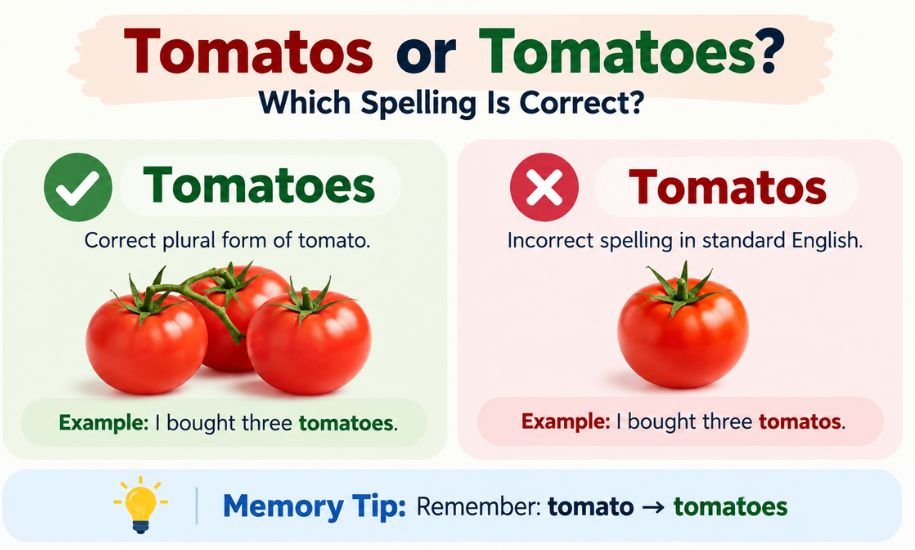
When writing about this familiar red food, you may hesitate between tomatos and tomatoes. The confusion usually comes from the way English forms plurals, especially with nouns ending in -o. There is a simple answer: tomatoes is the standard plural spelling of tomato. Tomatos is a misspelling in standard English. There is also a separate question people often ask about this food: is a tomato a fruit or a vegetable? The answer depends on whether you are talking about botanical classification or culinary use.
Tomatoes is the correct plural of tomato. “Tomatos” is a misspelling and should not be used in standard English. Botanically, tomatoes are fruits, although they are commonly treated as vegetables in cooking.
Tomatos or Tomatoes: Which Is Correct?
The correct spelling is tomatoes.
- Singular: tomato
- Plural: tomatoes
- Incorrect plural: tomatos
For example:
- I bought one tomato.
- I bought five tomatoes.
- The recipe calls for three tomatoes.
The plural form does not simply add -s. Instead, tomato takes -es, producing tomatoes.
| Form | Correct? | Use |
|---|---|---|
| tomato | Yes | Singular |
| tomatoes | Yes | Plural |
| tomatos | No | Standard-English misspelling |
| tomato’s | Sometimes | Singular possessive |
| tomatoes’ | Sometimes | Plural possessive |
It is important not to confuse tomatoes with tomato’s. The apostrophe in tomato’s usually indicates possession, not plurality.
Why Is “Tomatoes” the Correct Plural?
English plural formation is not completely predictable. Many nouns form plurals simply by adding -s, such as:
- book → books
- car → cars
- apple → apples
- chair → chairs
However, some nouns ending in -o traditionally take -es. Tomato belongs to this group, giving us tomatoes.
Other familiar examples include:
- potato → potatoes
- hero → heroes
- echo → echoes
This does not mean every English noun ending in -o must take -es. English has exceptions, including photo → photos and piano → pianos. That is why it is better to learn tomatoes as the established plural rather than rely on an absolute rule about every word ending in -o.
Is “Tomatos” a Real Word?
In standard English, tomatos is not the accepted plural spelling of tomato.
You may occasionally encounter tomatos online or in informal writing, but its appearance does not make it the standard form. It is generally a spelling error.
So if you are writing an article, school assignment, recipe, report, email, menu, or other formal text, use tomatoes.
Correct
We planted six tomato plants and harvested dozens of tomatoes.
Incorrect
We planted six tomato plants and harvested dozens of tomatos.
The second sentence should use tomatoes.
What Does “Tomato” Mean?
Tomato is a noun referring to the edible fruit of a tomato plant. It can refer to a single tomato or, more broadly, to the food itself.
Examples:
- This tomato is perfectly ripe.
- She sliced a tomato for the sandwich.
- The soup needs another tomato.
- A fresh tomato can add flavor to a salad.
When you have more than one, use tomatoes:
- The basket is full of tomatoes.
- We need four tomatoes for the sauce.
- These tomatoes are ready to eat.
The spelling stays the same regardless of whether you are writing in American or British English. Tomatoes is the standard plural form in both.
Tomato, Tomato’s, and Tomatoes’ — What’s the Difference?
Apostrophes can create another source of confusion.
Tomato
Tomato is the singular noun.
I cut one tomato.
Tomatoes
Tomatoes is the plural noun.
I cut three tomatoes.
Tomato’s
Tomato’s is normally the possessive form of the singular noun.
The tomato’s skin was very thin.
Here, the apostrophe shows that the skin belongs to or is associated with one tomato.
Tomatoes’
Tomatoes’ is the possessive form of the plural noun.
The tomatoes’ bright color made the salad look fresh.
Here, the apostrophe comes after the s because the noun is already plural.
A useful rule is:
tomato = one
tomatoes = more than one
tomato’s = belonging to one
tomatoes’ = belonging to multiple tomatoes
Why Do People Write “Tomatos”?
The error is easy to understand. Writers may assume that every noun forms its plural by adding -s, resulting in tomato + s = tomatos.
The problem is that English contains many established plural patterns that do not follow a single universal rule.
Because potato becomes potatoes and tomato follows the same pattern, remembering these two together can help:
potato → potatoes
tomato → tomatoes
You do not need to memorize a complicated grammar rule. Simply remember that the standard plural contains -es.
Is a Tomato a Fruit or a Vegetable?
This question has a slightly different answer depending on the context.
Botanically, a tomato is a fruit. It develops from the flower of the tomato plant and contains seeds, which are characteristics used in botanical classification.
Culinarily, tomatoes are commonly treated as vegetables. They are frequently used in savory dishes such as salads, sauces, soups, sandwiches, and pasta dishes.
So if someone asks, “Is a tomato a fruit or a vegetable?”, the clearest answer is:
A tomato is botanically a fruit, but it is commonly used as a vegetable in cooking.
There is no real contradiction. The two classifications use different criteria.
Is Tomato a Fruit or Vegetable in Everyday Cooking?
In the kitchen, people generally group tomatoes with vegetables because of the way they are prepared and served.
Think about a typical salad containing lettuce, cucumber, onions, and tomatoes. In a culinary context, calling the tomato a vegetable makes practical sense because it is being used alongside other savory ingredients.
Botanical classification works differently. A botanical fruit develops from the reproductive part of a flowering plant and generally contains seeds. By that definition, tomatoes qualify as fruits.
The same distinction explains why the culinary and scientific descriptions can appear to disagree even though both are reasonable in their respective contexts.
Are Tomatoes a Fruit or Vegetable?
The plural form does not change the classification.
Tomatoes are fruits botanically.
For example:
Tomatoes develop from the flowers of tomato plants and contain seeds.
In cooking, however, they are generally handled as vegetables.
So the answer to “Are tomatoes a fruit or vegetable?” is essentially the same as the answer for one tomato:
Tomatoes are botanically fruits but are commonly treated as vegetables in culinary contexts.
A Famous Legal Tomato Debate
Tomatoes have even been involved in a famous legal dispute.
In Nix v. Hedden, decided by the U.S. Supreme Court in 1893, the classification of tomatoes became relevant to tariff law. The case concerned whether tomatoes should be treated as fruits or vegetables for purposes of the tariff legislation of the time.
The Court considered the ordinary meaning and common use of the terms in the legal context. This historical case is often mentioned when discussing the tomato’s unusual position between botanical classification and everyday culinary language.
It is worth keeping the distinction clear, though: the legal issue was about tariff treatment and common usage, not a scientific ruling that changed the botanical classification of tomatoes.
Examples With “Tomatoes”
Here are some natural examples showing the correct plural form:
- The tomatoes are ripe and ready to pick.
- She added chopped tomatoes to the sauce.
- These tomatoes have a rich, sweet flavor.
- We bought several tomatoes at the market.
- The recipe requires two large tomatoes.
- He grows tomatoes in his backyard garden.
Correct vs. Incorrect
Correct: We need three tomatoes for the recipe.
Incorrect: We need three tomatos for the recipe.
Correct: The tomatoes are still green.
Incorrect: The tomatos are still green.
The difference is only a few letters, but tomatoes is the form you should use in standard writing.
An Easy Way to Remember the Spelling
A simple memory trick is to pair tomato with potato:
tomato → tomatoes
potato → potatoes
Both words use -es in their standard plural forms.
You can also remember the complete sequence:
one tomato → two tomatoes
If you are unsure while writing, focus on the ending: tomat + oes, not tomat + os.
Common Mistakes to Avoid
1. Using “tomatos” as the plural
The standard plural is tomatoes.
2. Using “tomato’s” when you mean several tomatoes
The apostrophe does not normally make a noun plural.
Incorrect:
I bought five tomato’s.
Correct:
I bought five tomatoes.
3. Assuming every word ending in “o” takes “-es”
English has exceptions. Words such as photo and piano normally form plurals with -s.
It is better to learn the established plural of each word rather than apply one rule to every noun ending in -o.
4. Treating “fruit” and “vegetable” as mutually exclusive in every context
The terms can refer to different classification systems. Botanically, tomatoes are fruits; in culinary usage, they are generally treated as vegetables.
Frequently Asked Questions
Is “tomatos” or “tomatoes” correct?
Tomatoes is correct. It is the standard plural form of tomato. Tomatos is a misspelling and should be avoided in standard English writing.
What is the plural of tomato?
The plural of tomato is tomatoes. For example: “The farmer harvested hundreds of tomatoes.”
Is a tomato a fruit or a vegetable?
Botanically, a tomato is a fruit because it develops from a flower and contains seeds. In culinary contexts, it is commonly treated as a vegetable because of how it is prepared and eaten.
Are tomatoes and potatoes pluralized the same way?
Yes. Both normally take -es in the plural: tomato → tomatoes and potato → potatoes.
Is “tomato’s” the plural of tomato?
No. Tomatoes is the plural. Tomato’s is normally the possessive form of the singular noun, as in “the tomato’s color.”
How can I remember the correct spelling?
Pair it with potato: tomato → tomatoes and potato → potatoes. Both standard plurals use -es.
The Bottom Line
When choosing between tomatos or tomatoes, use tomatoes. Tomato is singular, while tomatoes is plural; tomatos is not the standard plural spelling. And if you are wondering about the separate classification question, a tomato is botanically a fruit, even though it is commonly treated as a vegetable in cooking. Grammarifyr helps make these small but important word distinctions easier to understand and use correctly.
You may also Read : Lets or Let’s: Meaning and Grammar Explained

One Comment