Dreamt or Dreamed: UK and US English Guide
If you are unsure whether to write dreamt or dreamed, the good news is that you do not have to choose between a correct and an incorrect word. Both forms are correct. They are the past tense and past participle forms of the verb dream, and they generally have the same meaning. The main difference is regional preference: dreamt is especially common in British English, while dreamed is particularly common in American English. Both can describe a dream during sleep or a hope and ambition.
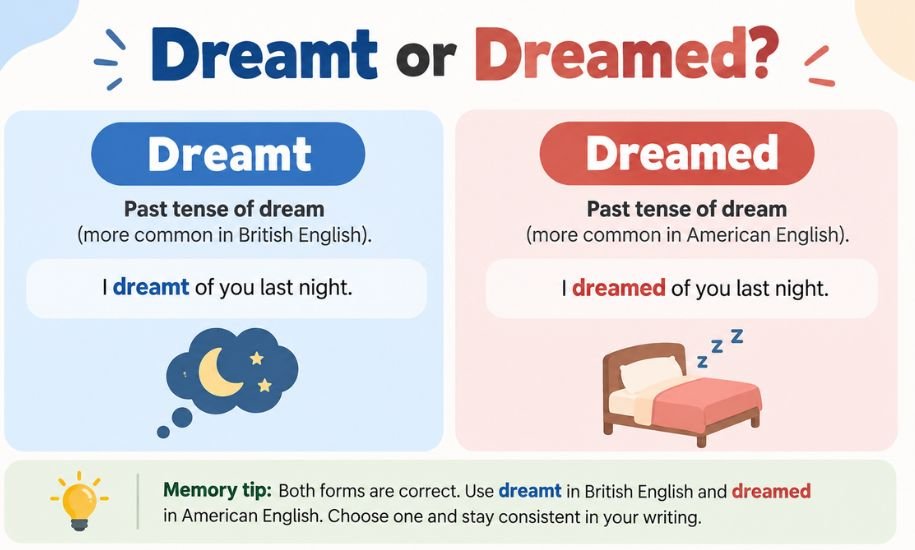
Both dreamt and dreamed are correct forms of dream. Dreamed is more common in American English, while dreamt is especially common in British English. The two forms generally have the same meaning.
Dreamt vs. Dreamed at a Glance
The easiest way to understand the difference is to think of these as two accepted forms of the same verb.
| Feature | Dreamt | Dreamed |
|---|---|---|
| Base verb | dream | dream |
| Past tense | dreamt | dreamed |
| Past participle | dreamt | dreamed |
| Correct? | Yes | Yes |
| Meaning | Same | Same |
| British English | Common | Also used |
| American English | Used, but less common | Very common |
| Example | I dreamt about you. | I dreamed about you. |
Neither form is inherently more grammatically correct than the other. In most situations, you can use either one without changing the meaning of your sentence.
What Does “Dreamt” Mean?
Dreamt is the past tense and past participle of dream. It can refer to something you experienced while sleeping or to something you hoped for or imagined.
For example:
- I dreamt about my old school last night.
- She dreamt that she was flying.
- He dreamt of becoming a professional musician.
- We had dreamt about taking that trip for years.
The word is completely standard English. It is not a misspelling of dreamed.
The form dreamt follows a pattern found in several English verbs that can have both an -ed form and a shorter -t form. Similar alternatives include learned/learnt and spelled/spelt, although the usage patterns of each verb vary.
What Does “Dreamed” Mean?
Dreamed is the regular past tense and past participle of dream. It has exactly the same basic meanings as dreamt.
For example:
- I dreamed about the ocean last night.
- She dreamed that she could fly.
- They dreamed of owning a house.
- He had dreamed about that opportunity for years.
Because dreamed follows the familiar -ed pattern, it is especially common in American English.
It is also perfectly acceptable in British English, so using dreamed does not automatically make a sentence American.
Why Are Both Forms Correct?
English has several verbs that developed more than one accepted past-tense form. Dream is one of them.
The two forms are:
dream → dreamt
and
dream → dreamed
The difference is therefore not a matter of changing the tense or meaning. Both forms indicate that the dreaming happened in the past.
Compare:
I dreamt about my grandmother.
I dreamed about my grandmother.
The sentences mean the same thing. The choice is mainly a matter of regional preference and personal style.
British English: Dreamt or Dreamed?
In British English, dreamt is a familiar and widely used form.
For example:
I dreamt about you last night.
She dreamt of becoming a writer.
However, dreamed is also used in British English. It should not be treated as an error.
If you are writing primarily for a British audience, dreamt may sound particularly natural:
I dreamt about a strange place last night.
But this version is also grammatically fine:
I dreamed about a strange place last night.
The important point is that British English permits both forms.
American English: Which Form Is More Common?
In American English, dreamed is generally the more familiar choice.
For example:
I dreamed about my childhood home.
She dreamed of becoming an astronaut.
American speakers may still use dreamt, particularly in literary writing, quotations, or individual speech patterns, but dreamed is the usual everyday form for many US English speakers.
So if you are writing specifically for an American audience, dreamed is a natural choice.
“I Dreamed of You” or “I Dreamt of You”?
Both are correct:
I dreamed of you last night.
I dreamt of you last night.
Neither sentence changes the meaning simply because a different past-tense form is used.
The same applies to dream about:
I dreamed about you last night.
I dreamt about you last night.
These sentences can both describe having a dream involving another person.
The choice between dreamed and dreamt is therefore usually about style or regional English, not meaning.
Dreamt of vs. Dreamed of
Both dreamt of and dreamed of are common constructions.
When dream of refers to an ambition or strong desire, it often has a figurative meaning:
She dreamt of becoming a doctor.
She dreamed of becoming a doctor.
Both sentences describe her ambition.
You can also use dream of when referring to something experienced during sleep:
I dreamt of walking through a forest.
I dreamed of walking through a forest.
In contrast, dream about is particularly natural when describing the subject or content of a sleeping dream:
I dreamed about my old friends.
I dreamt about my old friends.
Dreamt or Dreamed in Different Tenses
Understanding the grammar becomes easier when you look at the verb forms together.
| Tense/Form | Example with “dream” |
|---|---|
| Present | I dream about traveling. |
| Simple past | I dreamt about traveling. |
| Simple past | I dreamed about traveling. |
| Present perfect | I have dreamt about it. |
| Present perfect | I have dreamed about it. |
| Past perfect | I had dreamt about it. |
| Past perfect | I had dreamed about it. |
Both dreamt and dreamed can function as the simple past and past participle.
For example:
Simple past:
She dreamt about the house.
She dreamed about the house.
Present perfect:
She has dreamt about the house before.
She has dreamed about the house before.
Past perfect:
She had dreamt about becoming a writer.
She had dreamed about becoming a writer.
Dreamt Pronunciation
The pronunciation of dreamt is different from its spelling in a way that can initially look unfamiliar.
It is commonly pronounced approximately like:
dreamt → “dremt”
The final t is pronounced, so it does not sound exactly like dream.
By comparison:
dreamed → “dreemd”
The pronunciation difference is useful to know because someone familiar with dreamed may not immediately recognize dreamt when hearing it.
Examples of Both Forms
Here are some natural examples showing that either form can work.
Talking about sleeping
I dreamt about being on a deserted island.
I dreamed about being on a deserted island.
Talking about an ambition
He dreamt of opening his own restaurant.
He dreamed of opening his own restaurant.
Talking about a past experience
She dreamt that she was late for school.
She dreamed that she was late for school.
Using the present perfect
I have dreamt about that place before.
I have dreamed about that place before.
Using the past perfect
They had dreamt of seeing the mountains.
They had dreamed of seeing the mountains.
In each pair, changing the verb form does not fundamentally change the meaning.
Common Mistakes to Avoid
1. Assuming “dreamt” is incorrect
Some writers mistakenly believe that dreamt is an error because dreamed looks more familiar.
Correct:
I dreamt about my family.
Dreamt is a legitimate English form.
2. Assuming “dreamed” is only American
Although dreamed is particularly common in American English, it is not restricted to the United States.
British English speakers and writers also use it.
3. Treating the two forms as different tenses
Dreamt and dreamed are not different tenses.
Both can be used as the simple past:
I dreamt about it.
I dreamed about it.
Both can also be used as a past participle:
I have dreamt about it.
I have dreamed about it.
4. Mixing regional styles unnecessarily
Neither form is wrong, but consistency can make your writing feel more natural.
If you are following British English throughout an article, dreamt may fit the overall style. If you are following American English, dreamed may be the more natural choice.
How to Choose the Right Form
A simple rule can help:
Writing mainly in American English?
Use dreamed as your default.
Writing mainly in British English?
Use dreamt or dreamed, depending on your preferred style.
Writing for an international audience?
Either form is understandable and grammatically correct.
The most important thing is not to treat one accepted form as a spelling mistake. Instead, consider the variety of English you are using and remain consistent with it.
An Easy Way to Remember
Think of dream as having two doors to the past:
dream → dreamed
dream → dreamt
Both doors lead to the same meaning.
If you prefer a simple regional reminder, remember:
Dreamed = especially common in American English
Dreamt = especially common in British English
This is a preference, not an absolute rule. Both forms can appear in either variety.
Frequently Asked Questions
Is “dreamt” a correct word?
Yes. Dreamt is a standard English word and is the past tense and past participle of dream. It is especially common in British English, although it can also be used in American English.
Is “dreamed” grammatically correct?
Yes. Dreamed is the regular past tense and past participle of dream. It is particularly common in American English and is also used in British English.
Which is more common in the UK, dreamt or dreamed?
Dreamt is especially familiar in British English, but dreamed is also correct and used by British speakers and writers. The choice can depend on personal and stylistic preference.
Which should I use in American English?
Dreamed is generally the safest default for American English. For example, “I dreamed about you last night” sounds natural in standard US English.
Can I say “I dreamed of you”?
Yes. “I dreamed of you” is grammatically correct. You can also say “I dreamt of you.” Both sentences can describe a dream involving someone.
Is “dreamt” the past tense of “dream”?
Yes. Dreamt can be the simple past of dream, as in “I dreamt about the ocean.” It can also function as the past participle, as in “I have dreamt about it before.”
The Bottom Line
Dreamt and dreamed are both correct. They are alternative past-tense and past-participle forms of dream, with essentially the same meaning. Dreamed is especially common in American English, while dreamt is particularly common in British English. When choosing between them, follow the variety of English and writing style you are using rather than treating either form as incorrect. For clear explanations of confusing English forms and word choices, Grammarifyr helps you know the difference and use the right words.
You may also Read : Anyway or Anyways: Correct Usage Explained