Further or Farther: Meaning and Usage Explained
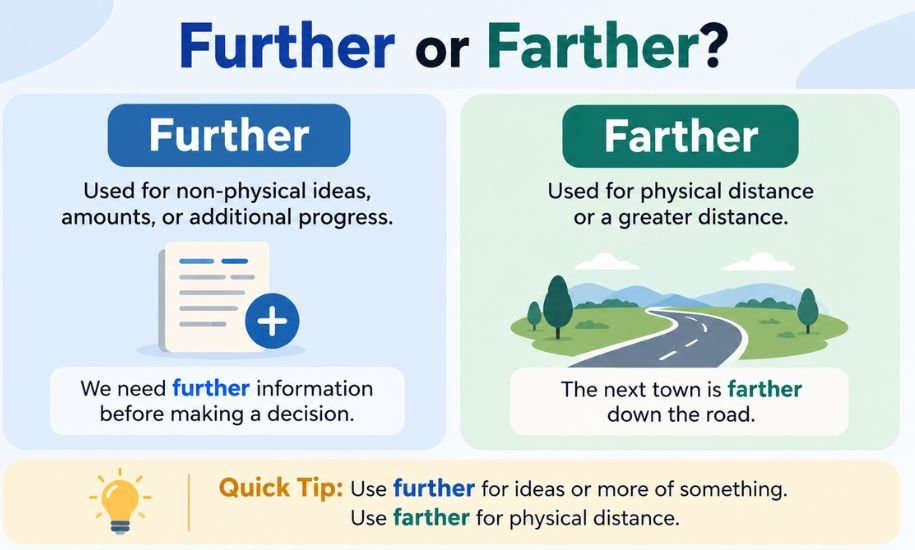
Further and farther are both correct English words, but they are not always interchangeable. The confusion comes from the fact that both can describe greater distance, while further also has broader meanings such as “additional,” “to a greater extent,” or “to advance.” In British English, further is particularly common when talking about physical distance, while American English often uses farther for literal distance. Understanding this small distinction makes it easier to choose the natural word in each sentence.
Both further and farther are correct. For physical distance, either can often be used, although farther is especially common in American English and further is very common in British English. For meanings such as “additional,” “to a greater extent,” or “to advance,” use further.
Further vs. Farther at a Glance
| Feature | Further | Farther |
|---|---|---|
| Correct word? | Yes | Yes |
| Physical distance | Yes | Yes |
| Additional/more | Yes | No |
| Abstract degree or extent | Yes | Generally no |
| “Further information” | Yes | No |
| “Farther away” | Yes | Yes |
| Common in British English for distance | Very common | Less common |
| Common in American English for distance | Common | Very common |
The simplest practical distinction is this: farther is strongly associated with physical distance, while further has both distance and non-distance meanings.
However, the rule is not absolute. Modern English, especially British English, frequently uses further for literal distance too.
What Does “Further” Mean?
Further can function as an adjective, adverb, verb, and, in some contexts, a determiner. Its meanings depend on the sentence.
One of its most common uses is to mean additional or more.
For example:
- Please contact us if you need further information.
- Do you have any further questions?
- The committee requested further evidence.
- We need further discussion before making a decision.
In these examples, further does not describe physical distance. It means something like additional, more, or extra.
It can also mean to a greater extent:
- We need to investigate the matter further.
- The company plans to expand further.
- The discussion went further than expected.
Another important use is as a verb meaning to advance or promote something:
- The training will further her career.
- The organization wants to further its objectives.
This broader range of meanings is the main reason further appears in many situations where farther cannot naturally be substituted.
What Does “Farther” Mean?
Farther is traditionally associated with greater physical distance.
For example:
- The second village is farther from the city.
- How much farther do we need to walk?
- The hikers traveled farther than expected.
- The mountain looked farther away than it actually was.
It is the comparative form traditionally associated with far when referring to measurable or literal distance.
The superlative form is farthest:
- This is the farthest point we reached.
- She lives in the farthest house along the road.
That said, farther is not restricted to one rigid grammar rule in modern usage. In many varieties of English, particularly American English, it is the preferred choice when the writer wants to emphasize literal physical distance.
When Should You Use “Further”?
Use further when the meaning involves something additional, greater in degree, or more advanced.
Additional information
- For further information, please email the office.
- Further details will be provided tomorrow.
Here, farther information would not be standard.
Additional questions
- If you have any further questions, let me know.
Again, farther questions would not normally be used.
Greater extent
- We need to examine the issue further.
- The researchers investigated the problem further.
The meaning is not about physical space. It is about taking an investigation to a greater degree or stage.
Progress or advancement
- The course helped further his professional development.
Here, further means to advance or promote something.
When Should You Use “Farther”?
Use farther when you want to clearly express greater physical distance, particularly in American English.
Consider:
The hotel is farther from the airport than I expected.
The word describes literal geographical distance.
Other examples include:
- The boat traveled farther out to sea.
- We walked farther along the trail.
- The nearest town is farther north.
- She moved farther away from the edge.
In American English, these sentences sound very natural with farther.
Further or Farther for Distance?
This is where the distinction becomes less straightforward.
Both words can describe physical distance:
How much farther is the station?
How much further is the station?
Both are acceptable.
Major English dictionaries recognize that further and farther can overlap when referring to distance. The traditional distinction is useful, but it should not be treated as an absolute grammar rule.
There is also a regional preference.
In American English, farther is often preferred for literal physical distance:
How much farther do we have to drive?
In British English, further is extremely common for physical distance:
How much further do we have to drive?
Therefore, British readers should not assume that farther is the only correct choice for physical distance. Likewise, American readers will frequently encounter further in distance expressions.
Further or Farther Down the Road?
Both forms can be correct when down the road refers to actual physical location.
For example:
- There is a petrol station further down the road.
- There is a petrol station farther down the road.
The choice can reflect regional preference or personal style.
However, further down the road can also be figurative. It may refer to a later point in time or a later stage of a process:
We can discuss the long-term effects further down the road.
In this figurative sense, further is the natural choice.
So if down the road means “later,” use further.
Further or Farther North?
Both are possible when describing geographical distance or position.
- The town lies farther north than the capital.
- The town lies further north than the capital.
Farther north emphasizes literal distance and is especially familiar in American English.
Further north is very natural in British English and is also widely used elsewhere.
The important point is that neither should automatically be treated as an error.
Should You Say “Run Further” or “Run Farther”?
Both expressions are acceptable.
For example:
I can run farther than I could last year.
and
I can run further than I could last year.
Both can describe the physical distance someone is capable of running.
Farther may appeal to writers who want a clear connection with physical distance, particularly in American English. Further is equally natural in many contexts and is particularly common in British English.
The same principle applies to sentences such as:
- She walked farther than expected.
- She walked further than expected.
- The runners traveled farther along the course.
- The runners traveled further along the course.
“Nothing Could Be Further From the Truth”
One of the most familiar expressions containing further is:
Nothing could be further from the truth.
Here, further refers to an abstract degree of difference rather than a literal physical distance.
The sentence means that something is completely or extremely different from the truth.
For example:
He claims that I ignored his advice, but nothing could be further from the truth.
The expression is well established, so further is the natural choice.
Common Mistakes
1. Using “farther” for additional information
Incorrect:
For farther information, contact the office.
Correct:
For further information, contact the office.
When information means additional information, use further.
2. Assuming “farther” is always required for physical distance
This is an oversimplification.
We walked further along the beach.
is perfectly acceptable, especially in British English.
3. Using “farther” in abstract expressions
Incorrect or highly unnatural:
We need to investigate the matter farther.
Better:
We need to investigate the matter further.
The second sentence means that the investigation needs to progress to a greater extent.
4. Confusing “further” with “farther” in fixed expressions
Expressions such as further information, further questions, and nothing could be further from the truth require further in standard usage.
5. Treating British and American usage as identical
Regional preferences matter. American English tends to make greater use of farther for literal distance, while British English commonly uses further in those same contexts.
An Easy Way to Remember the Difference
A useful memory trick is:
Farther → think “far” and physical distance.
If you are clearly talking about measurable distance, farther is a safe choice, especially in American English.
Further → think “more.”
If you mean additional, more, to a greater extent, or further development, choose further.
For example:
- farther away → physical distance
- further information → additional information
- farther down the road → physical distance
- further down the road → physical or figurative, depending on context
- further discussion → additional discussion
- nothing could be further from the truth → abstract difference
This is a useful guideline rather than an absolute rule, because further is also widely accepted for physical distance.
Further, Farther, Furthest, and Farthest
The superlative forms can cause another layer of confusion.
Traditionally:
- farther → comparative physical distance
- farthest → greatest physical distance
- further → additional or greater extent
- furthest → greatest extent or degree
Examples:
Which house is farther away?
That was the farthest we traveled.
Let’s investigate the matter further.
This is the furthest the negotiations have progressed.
But, just as with further and farther, actual usage overlaps, particularly with furthest and farthest. British English commonly uses furthest more broadly, while American English often favors farthest when literal distance is intended.
Further or Farther: Examples in Sentences
Here are some quick examples to make the distinction easier to see:
Physical distance:
The next town is farther away.
Physical distance, British preference:
The next town is further away.
Additional information:
Please send further information about the course.
Additional questions:
I don’t have any further questions.
Greater degree:
The researchers examined the evidence further.
Literal movement:
The hikers walked farther into the forest.
Figurative progress:
The project has progressed further than expected.
Established expression:
Nothing could be further from the truth.
FAQs
Is “further or farther” a choice between two correct words?
Yes. Both further and farther are legitimate English words. They overlap when describing physical distance, while further also has important meanings involving addition, degree, progress, and abstract extent.
Is “farther” only used for physical distance?
Not necessarily as an absolute rule, but it is strongly associated with physical distance. In American English, farther is especially common for literal distance. For additional or abstract meanings, further is normally the appropriate choice.
Is “further” more common in British English?
Yes, particularly when talking about physical distance. British English commonly uses further where American English may prefer farther. However, farther is not automatically incorrect in British English.
Which is correct: “further down the road” or “farther down the road”?
Both can be correct when referring to a physical location. Further down the road can also have a figurative meaning referring to a later stage or time, in which case further is the natural choice.
Should I write “further information” or “farther information”?
Use further information. Here, further means “additional.” Farther information is not standard usage.
Is “nothing could be further from the truth” correct?
Yes. Nothing could be further from the truth is the standard expression. It uses further in an abstract sense to indicate that something is very different from the truth.
The Bottom Line
Further and farther are both correct, and the difference is not as strict as the traditional “farther for physical distance, further for everything else” rule suggests. For literal distance, either may work, with farther particularly common in American English and further especially common in British English. For meanings such as additional, more, greater extent, or advancement, use further. When in doubt, Grammarifyr can help you choose the word that best fits the meaning and context.
You may also Read : Dreamt or Dreamed: UK and US English Guide